
Market Entry Consulting to Grow Profitably.
Entering a new market can create meaningful growth, diversify your revenue, and strengthen your regional position.
It can also absorb capital, leadership attention, and commercial resources long before the opportunity begins to generate returns.
The real question is not simply whether a market looks attractive. You need to know whether your company can realistically win there, which entry model gives you the strongest path, what local adaptations will be required, and which risks could make the opportunity less attractive than it first appears.
Midas Consulting helps you replace assumptions with evidence. We assess market attractiveness, customer needs, competitors, regulation, channels, partners, economics, and execution feasibility so you can decide where to invest, where to wait, and where not to enter.
With more than 200 market-entry projects completed across Latin America and selected international markets, we help leadership teams move from expansion ambition to a focused, evidence-based entry roadmap.
200+ market-entry consulting projects
Across Latin America and selected international markets
25+ years of experience
Helping leadership teams make high-stakes expansion decisions
Country-by-country expertise
Argentina, Brazil, Chile, Colombia, Mexico, Peru, and regional Latin America
From go/no-go to execution
Market prioritization, entry mode, partners, channels, pricing, and implementation

Is the Market Attractive, or Does It Only Look Attractive?
Most expansion opportunities look promising when they are viewed from a distance.
A market may be large but difficult to access. It may be growing but dominated by entrenched competitors. Demand may exist, but channel margins, taxes, regulation, logistics, working-capital requirements, or product adaptations may make the economics unattractive.
You may need market-entry consulting when:
- You are comparing several countries, regions, segments, or product opportunities.
- Your leadership team needs a clear go/no-go recommendation.
- The market looks attractive, but you do not know whether your company can realistically win.
- Available market data is incomplete, inconsistent, or too general for an investment decision.
- You need to understand customer needs and buying behavior before adapting your offer.
- You are uncertain about regulatory, import, certification, tax, or operational requirements.
- You do not know whether to enter directly, through a distributor, through a partner, by acquisition, through licensing, or with a digital-first model.
- You need to understand how incumbent competitors may respond.
- You are concerned about selecting the wrong distributor or local partner.
- You need to compare the economics and risks of different entry modes.
- Your regional strategy needs to be adapted country by country.
- Your organization is enthusiastic about the opportunity, but the underlying assumptions have not been tested.
- You need to know whether delaying or avoiding entry may be the better strategic choice.
What Will You Be Able to Decide with Our Market Entry Consulting?
At the end of the engagement, your leadership team should be able to answer:
- Which markets, regions, segments, or categories should we prioritize?
- Which opportunities should we monitor, delay, partner into, or avoid?
- How attractive is the market after accounting for real local costs and risks?
- Do we have a credible right to win?
- Which customer needs and purchase criteria should shape our offer?
- How strong are the incumbents, and how might they respond?
- Which entry mode offers the best balance of speed, control, investment, and risk?
- Should we use distributors, partnerships, direct investment, licensing, acquisition, or another model?
- What product, service, pricing, or operating adaptations will be required?
- How much investment and management attention will execution require?
- What are the most important assumptions that still need to be tested?
- What should happen during the first 12 months?
The objective is to give you a clear decision, the evidence behind it, and a realistic path to execution.
Market Entry Consulting Connects Opportunity with the Ability to Win
Market entry consulting is the structured process of deciding:
- Whether a market deserves investment
- Which markets or segments should come first
- Whether your company can realistically compete
- Which entry model offers the strongest path
- What local adaptations will be needed
- How the strategy should be implemented
A rigorous market-entry assessment combines:
- Market size and growth
- Profitability potential
- Customer needs
- Buying behavior
- Competitive intensity
- Regulatory constraints
- Channel access
- Partner availability
- Investment requirements
- Cost to serve
- Operational feasibility
- Organizational readiness
This matters because market size alone does not determine whether an opportunity is attractive.
A smaller market where your company has strong differentiation, channel access, and manageable regulation may be more valuable than a much larger market where incumbents are entrenched and economics are unfavorable.
For a deeper explanation, read our executive guide: Market Entry in Latin America: Turning Complexity into Growth.

First Decide Whether to Enter. Then Decide How to Enter and Win.
Market entry analysis and market entry strategy answer different questions.
Market Entry Analysis Consulting
Market entry analysis helps you decide:
- Which countries, regions, segments, or opportunities deserve investment
- Which markets are attractive
- Which markets are realistically winnable
- Which assumptions need to be tested
- Which opportunities should be prioritized, monitored, delayed, or avoided
The central question is:
Should we invest in this opportunity at all?
Market Entry Strategy Consulting
Once the opportunity has been selected, market entry strategy defines:
- Which customer segments to target
- How to position your offer
- Which entry mode to use
- Which channels and partners to activate
- How to price
- What to adapt locally
- How to build early traction
- How to organize implementation
The central question is:
How should we enter and build a sustainable position?
Many companies move too quickly to distributor selection, pricing, or launch planning before establishing whether the market deserves investment.
We help you resolve the questions in the right order.
For a deeper explanation of the first decision, read: Market Entry Analysis: How Companies Decide Which Markets to Enter, and Which to Avoid.
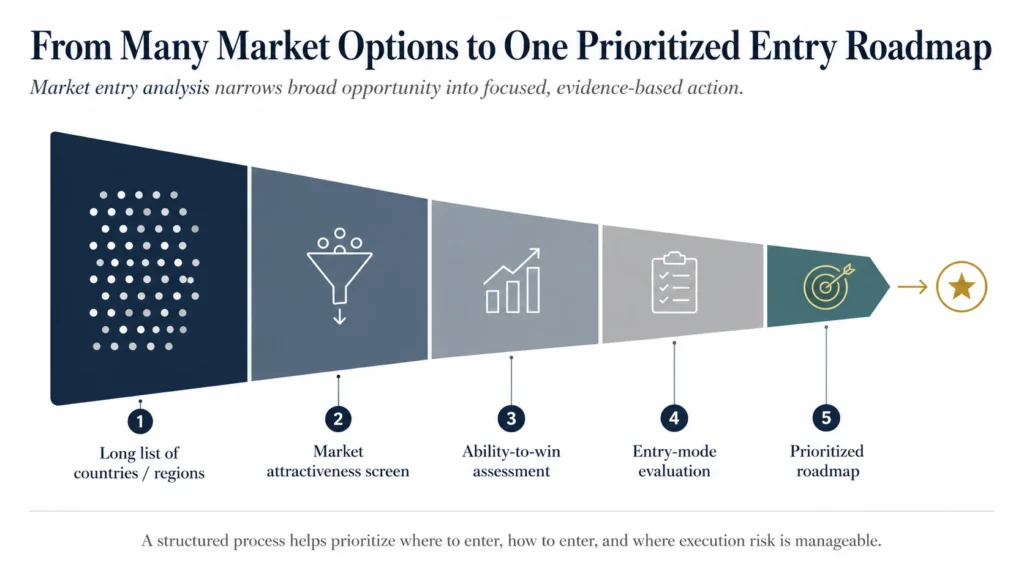
Figure 1. The Midas Market Entry Roadmap. A structured process narrows multiple expansion possibilities into a prioritized, evidence-based entry roadmap.
Where Can Midas Consulting Help You Make a Better Market Entry Decision?
Every expansion challenge is different. We design the project around the decision you need to make rather than forcing your company into a standard template.
Market Screening and Prioritization
Compare countries, regions, customer segments, product categories, or business opportunities to identify which ones offer the strongest risk-adjusted potential.
Go/No-Go Assessment
Determine whether the opportunity justifies the investment, leadership attention, commercial effort, and execution risk.
A strong conclusion may be to enter, partner, delay, monitor, acquire, or not enter.
Market and Demand Analysis
Estimate demand, identify attractive segments, understand growth drivers, and assess whether the market can support your revenue and profitability objectives.
Customer and Buying-Behavior Research
Understand customer needs, purchase criteria, decision-makers, adoption barriers, current alternatives, and willingness to change.
Competitive and Strategic Analysis
Evaluate incumbent strengths, positioning, pricing, channels, capabilities, vulnerabilities, strategic priorities, and possible reactions to a new entrant.
Regulatory and Structural Assessment
Clarify the potential impact of certification requirements, sanitary registrations, import procedures, taxes, labor rules, customs, local content requirements, payment terms, and other operating constraints.
Channel and Route-to-Market Assessment
Determine how customers buy, which channels control access, how margins are distributed, and which route can reach customers profitably.
Distributor and Partner Strategy
Define partner requirements, assess whether suitable candidates exist, understand their expectations, and determine how governance, incentives, exclusivity, and performance management should work.
Entry-Mode Selection
Compare direct investment, distributors, partnerships, licensing, acquisition, digital-first entry, representative offices, and other models.
Product, Service, and Pricing Adaptation
Identify what needs to change locally in your offer, configuration, service model, pricing, packaging, messaging, or commercial conditions.
Implementation Roadmap
Translate the recommendation into priorities, responsibilities, milestones, investments, risks, KPIs, and early traction initiatives.
Risk and Competitor-Response Testing
Pressure-test how competitors, customers, partners, regulators, and internal stakeholders may react before you commit substantial capital.

Market Entry Consulting Must Connect Strategy, Economics, and Execution
A market may appear attractive from a macroeconomic perspective and still be difficult to enter profitably.
That is why we examine the opportunity as a system.
Depending on your needs, the engagement may cover:
- Strategic objectives for expansion
- Country, region, category, or segment prioritization
- Market size and growth
- Profitability and cost-to-serve
- Customer needs and adoption barriers
- Decision-makers and purchasing processes
- Competitor structure and likely reactions
- Informal or substitute competition
- Regulatory and certification requirements
- Import and customs considerations
- Tax and working-capital implications
- Product and service adaptation
- Pricing corridors
- Channels and route to market
- Distributor and partner requirements
- Entry-mode alternatives
- Local capabilities and staffing
- Investment requirements
- Risk scenarios
- Implementation priorities
- KPIs and learning cycles
We do not assume that entering is always the right answer.
A credible market-entry project should be able to recommend entry, selective entry, partnership, monitoring, delay, acquisition, or no entry.
How We Build a Market Entry Strategy You Can Defend and Execute With Our Market Entry Consulting
Every engagement is customized, but our market-entry projects generally follow six connected stages.
1. Define the Strategic Objective
We begin by clarifying why you are considering expansion.
Your objective may include:
- Revenue growth
- Customer diversification
- Regional expansion
- Competitive defense
- Supply-chain resilience
- Access to capabilities
- Strategic positioning
- Economies of scale
- A new customer or product opportunity
This matters because the objective shapes the markets, criteria, entry modes, investment levels, and risks that should be evaluated.
2. Screen and Prioritize the Opportunities
We begin broadly and then narrow the field.
Depending on the question, we compare:
- Countries
- Regions
- Cities
- Customer segments
- Product categories
- Applications
- Channels
- Business models
The screening criteria may include:
- Market size
- Growth
- Profitability
- Import dependency
- Customer concentration
- Competitive intensity
- Regulatory barriers
- Channel accessibility
- Distributor availability
- Execution complexity
- Strategic fit
- Ability to win
The goal is to identify where the opportunity is both attractive and realistically capturable.
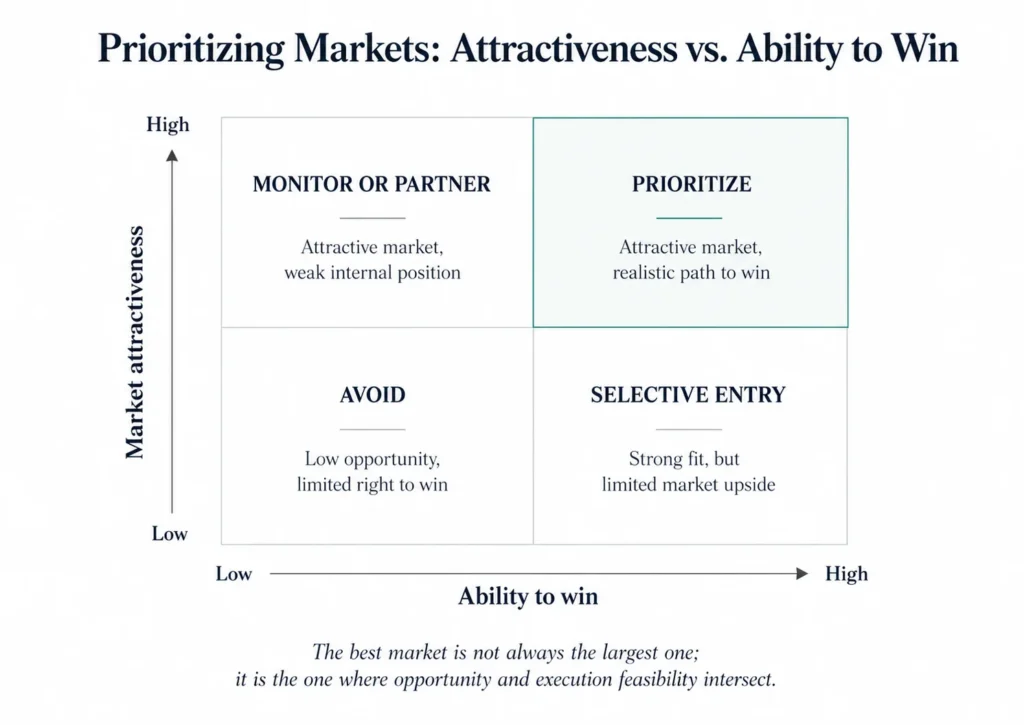
Figure 2. Prioritize Markets Based on Attractiveness and Your Ability to Win. The largest or fastest-growing market is not always the best choice. Priority should go to opportunities where market attractiveness intersects with a credible path to winning.
3. Conduct the Deep-Dive Analysis
Once the most promising opportunities have been identified, we go beyond top-line data.
Depending on the project, we may combine:
- Secondary research
- Customer interviews
- Distributor and channel interviews
- Regulatory and industry sources
- Former executive perspectives
- Competitor analysis
- Expert interviews
- Supplier insights
- Field research
- Financial and operating data
This stage helps reveal the local realities that are often invisible in desk research.
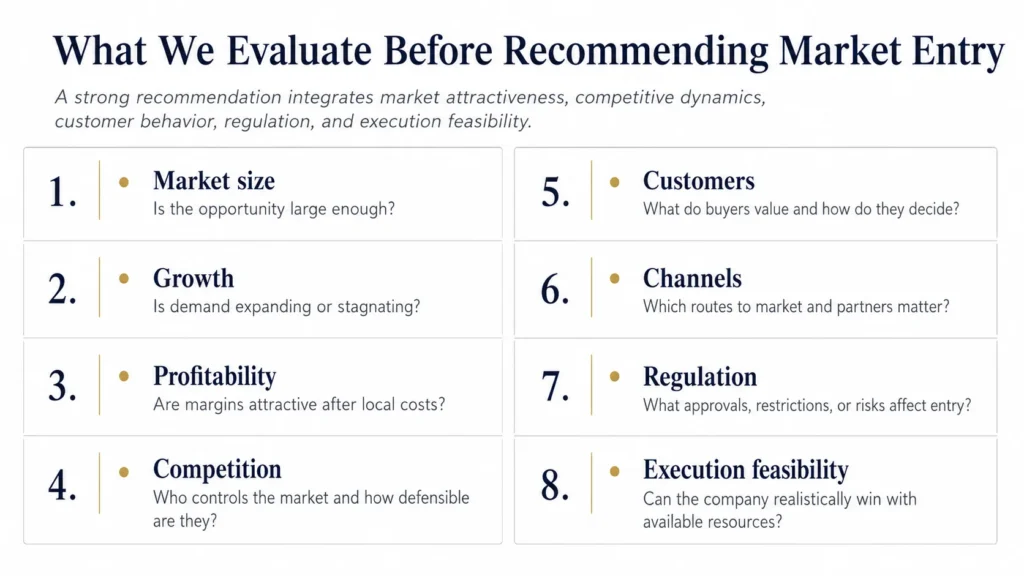
Figure 3. Eight Questions Every Market Entry Decision Should Answer. A credible market-entry recommendation must evaluate the commercial opportunity and the practical ability to execute, not only market size.
4. Build Scenarios and Choose the Entry Path
We compare the potential entry modes and their trade-offs.
Options may include:
- Distributor-led entry
- Partnership or joint venture
- Licensing
- Digital-first entry
- Representative office
- Direct investment
- Acquisition
- Greenfield operation
- A phased or hybrid model
We assess each option based on:
- Speed
- Investment
- Control
- Risk
- Channel access
- Partner dependency
- Regulatory complexity
- Margin potential
- Local capabilities
- Scalability
For high-stakes decisions, we may also use scenarios or a business wargame to test competitor reactions, regulatory delays, pricing pressure, demand variation, and implementation risk.
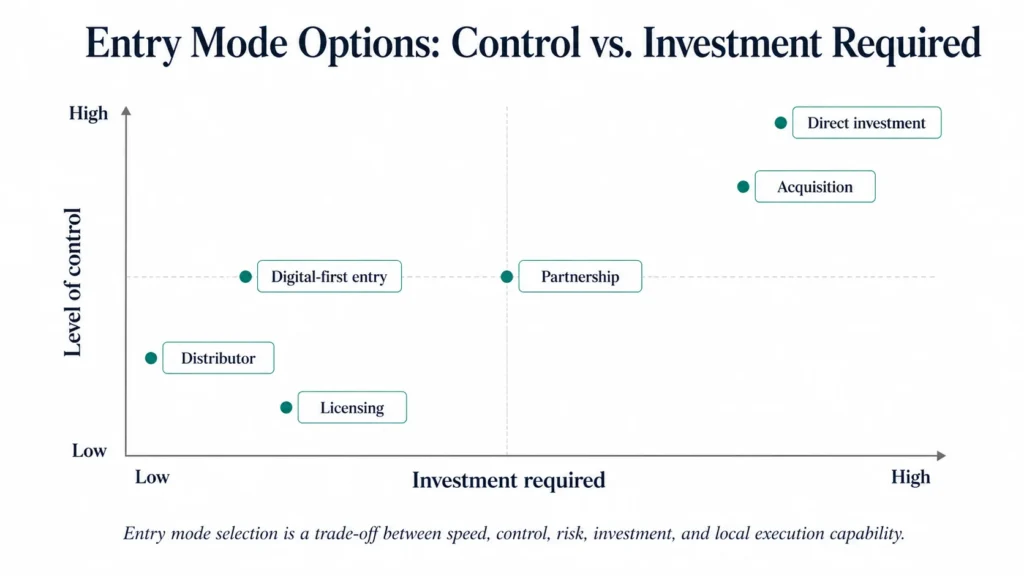
Figure 4. Choose an Entry Mode That Balances Speed, Control, Investment, and Risk. No entry mode is universally superior. The right model depends on how much control you need, how much you are prepared to invest, how quickly you need to move, and which local capabilities are available.
5. Build the Tailored Market Entry Plan
Once the market and entry mode are selected, we define:
- Target segments
- Priority customers
- Value proposition
- Product or service adaptations
- Pricing corridor
- Route to market
- Channel and partner roles
- Commercial messages
- Investment priorities
- Local capabilities
- First-year initiatives
- Governance
- KPIs
This is where market entry connects directly with go-to-market strategy.
6. Execute, Measure, and Adapt
Market entry is not a single decision made at the beginning of the project.
We define early indicators, test assumptions in the market, identify quick wins, and adjust the approach as evidence develops.
Possible indicators include:
- Customer interest
- Qualified opportunities
- Distributor activation
- Regulatory milestones
- Channel coverage
- Time to first sale
- Conversion
- Pricing realization
- Margin
- Working-capital needs
- Repeat purchase
- Early market share
The objective is to create a disciplined cycle of execution, learning, and adaptation.
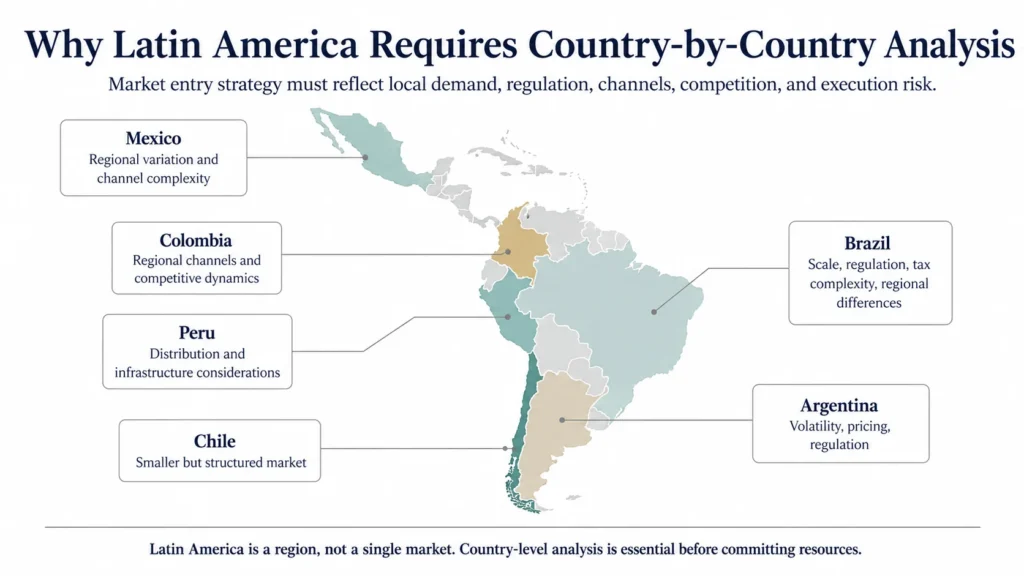
Figure 5. Latin America Is a Region, Not a Single Market. Demand, regulation, channel structure, competitive behavior, pricing, infrastructure, and execution risk can vary significantly by country, and sometimes by region within the same country.
How We Protect the Quality of Your Market Entry Decision With Our Consulting
Market-entry research often deals with incomplete information, uncertain estimates, and markets where reliable data is not always publicly available.
A strong recommendation must make that uncertainty visible.
Multiple Sources of Evidence
Depending on the engagement, we may combine:
- Public and proprietary databases
- Customer interviews
- Distributor and channel interviews
- Expert interviews
- Former executive perspectives
- Regulatory sources
- Industry associations
- Competitor analysis
- Supplier and partner insights
- Financial and operating data
- Field research
- Midas’ local and sector experience
We triangulate important findings whenever feasible rather than relying on a single source.
Clear Treatment of Assumptions
We distinguish between:
- Confirmed facts
- Evidence-supported estimates
- Management assumptions
- Working hypotheses
- Unknowns that require testing during implementation
This helps your leadership team understand where the evidence is strong and where flexibility is still required.
Apples-to-Apples Comparisons
When markets are compared, we account for differences such as:
- Taxes
- Import costs
- Channel margins
- Product mix
- Customer concentration
- Regulatory requirements
- Labor structure
- Geography
- Informal competition
- Cost to serve
- Working capital
- Entry-mode differences
Local Validation
We validate important assumptions with local customers, channels, experts, regulators, or market participants whenever the scope permits.
Ethical Competitive Research
We use lawful and ethical research methods and comply with SCIP’s code of ethics. The gold standard in the intelligence profession.
We do not request trade secrets, encourage sources to breach legal or contractual obligations, or present uncertain competitive information as confirmed fact.
Confidentiality
Your expansion plans, strategic assumptions, financial information, customer priorities, entry alternatives, and internal capabilities are treated confidentially.
Where appropriate, the engagement can operate under a mutual nondisclosure agreement.
Executive Review
We review emerging conclusions with your leadership team before finalizing the recommendation.
This helps identify blind spots, resolve inconsistencies, and ensure that the proposed strategy reflects your organization’s real capabilities and risk tolerance.
What a Market Entry Consulting Project Can, and Cannot, Do
A structured market-entry process improves the quality of the decision, but it does not eliminate uncertainty.
What Market Entry Consulting Can Do
It can help you:
- Compare opportunities using consistent criteria
- Replace internal assumptions with external evidence
- Identify hidden costs and execution barriers
- Understand customer and channel realities
- Select a more appropriate entry model
- Allocate capital and management attention more effectively
- Identify which assumptions should be tested first
- Reduce the risk of avoidable strategic mistakes
What Market Entry Consulting Cannot Do
It cannot:
- Guarantee market success
- Predict competitor behavior with certainty
- Eliminate regulatory or economic volatility
- Replace legal, tax, regulatory, or technical due diligence
- Make incomplete markets fully transparent
- Remove the need to learn and adapt during implementation
Practical Trade-Offs
A thorough assessment may require:
- Several weeks or months of research
- Upfront investment before revenue is visible
- Access to internal executives and data
- Alignment across Strategy, Finance, Sales, Marketing, Legal, Regulatory, Supply Chain, and local teams
The process is most valuable when the cost of making the wrong market-entry decision is materially greater than the cost of conducting the analysis.
What Will You Receive in a Market Entry Consulting Project?
Your deliverables will depend on the question and agreed scope, but a typical market-entry engagement may include:
- Strategic objective and decision criteria
- Country, region, segment, or category screening
- Market-attractiveness assessment
- Ability-to-win assessment
- Market-size and growth estimates
- Profitability and cost-to-serve analysis
- Customer-needs and buying-behavior insights
- Competitor profiles and strategic implications
- Channel and route-to-market assessment
- Regulatory and structural risk assessment
- Distributor or partner requirements
- Entry-mode comparison
- Product, service, or pricing adaptations
- Investment and organizational implications
- Go/no-go or prioritization recommendation
- Risks, assumptions, and dependencies
- Scenarios and sensitivity analysis
- First-year priorities
- KPIs and early-warning indicators
- Implementation roadmap
- Executive presentation and decision workshop
You will also receive progress discussions and preliminary findings throughout the project.
We prefer to challenge and refine the analysis with your organization rather than disappear for several weeks and return with a finished report that your teams have not helped test.
Trusted Market Entry Consulting by Companies Making Complex Expansion Decisions
Midas Consulting has supported multinational and regional organizations in market entry, market analysis, go-to-market, distributor search, partner evaluation, competitor analysis, benchmarking, and related expansion decisions.
Our experience includes sectors such as:
The logos below represent organizations Midas has supported in market-entry and related strategic engagements.

















Why Executives Choose Midas for Market Entry Decisions
We Are Prepared to Recommend No Entry
Our objective is not to justify expansion.
It is to help you make the best decision.
If the market’s competitive intensity, margins, regulation, channel access, investment requirements, or execution risks create an unattractive risk-return profile, we will say so.
We Evaluate Attractiveness and Ability to Win
A market can be attractive without being winnable for your company.
We assess both the opportunity and your realistic capacity to compete, differentiate, reach customers, and execute.
We Combine Desk Research with Local Validation
Public information can provide context, but it rarely answers all the questions a C-level team needs to resolve.
We complement it with interviews, local insights, channel perspectives, competitor analysis, and direct validation whenever appropriate.
We Understand Latin America Country by Country
Latin America should not be approached as one homogeneous market.
Regulation, taxes, customer behavior, channel structures, informal competition, pricing practices, infrastructure, and business culture can vary significantly.
We help you maintain regional direction while adapting the recommendation to local realities.
We Connect Market Entry Consulting with Strategic Intelligence
Expansion decisions take place inside a competitive system.
Incumbents may defend customers, change pricing, strengthen channels, lobby regulators, or make the opportunity more difficult after your entry becomes visible.
Our strategic-intelligence capabilities help you interpret those risks and pressure-test the strategy.
We Make Uncertainty Visible
When evidence is incomplete, we say so.
You receive a clear distinction between validated findings, estimates, assumptions, hypotheses, and issues that require in-market testing.
We Work Alongside Your Team
Your executives and local teams have essential knowledge about capabilities, constraints, risk tolerance, and implementation realities.
We involve them throughout the project to strengthen the recommendation and build ownership.
We Focus on Execution
The engagement does not end with a go/no-go decision.
When entry is recommended, we translate the strategy into customer priorities, entry mode, channel choices, partner requirements, adaptations, investments, milestones, and KPIs.
Market Entry Consulting in Action
Client identities and selected details have been withheld or generalized to protect confidentiality.
Case 1: Expanding in Mexico and Assessing Entry into Brazil
The situation
A global insurance company wanted to strengthen its position in Mexico and determine whether Brazil offered an attractive expansion opportunity.
The company needed to answer two different questions:
- Where should it focus its growth efforts in Mexico?
- Was Brazil sufficiently attractive and winnable to justify entry?
What we did
We analyzed the property-insurance markets in Brazil and Mexico and conducted in-depth interviews with:
- Customers
- Brokers
- Competitors
- Industry associations
- Other relevant stakeholders
We assessed demand, customer needs, competitive structure, channel dynamics, and the company’s ability to compete.
The executive impact
The work identified stronger growth opportunities within the company’s existing core market in Mexico rather than recommending overly broad expansion.
It also confirmed the potential of Brazil and helped the company design an entry strategy based on its strengths.
Case 2: Prioritizing Product Categories for Entry into Mexico
The situation
A company evaluating expansion into Mexico had several potential product categories but limited commercial resources.
The challenge was not simply whether Mexico was attractive. Leadership needed to know:
- Which categories should receive investment first
- Which customer needs mattered most
- What product adaptations would be required
- Where the sales team should focus
What we did
We used a funneling process:
- First, secondary research screened multiple categories based on demand, profitability, and accessibility.
- Second, in-depth interviews validated customer needs, purchasing criteria, channel dynamics, competitive threats, and adaptation requirements.
- Third, the findings were translated into a prioritized roadmap.
The executive impact
The company avoided spreading resources across too many categories.
It concentrated its early sales effort on the most attractive opportunities and built greater internal confidence around a fact-based Mexico expansion plan.
Case 3: Recommending No Entry into an Unattractive Brazilian Market
The situation
A company was evaluating Brazil’s bullet-resistant glass market and wanted to know whether the opportunity justified the investment required.
The initial market narrative appeared promising, but the true risk-return profile was unclear.
What we did
We assessed:
- Market demand
- Competitive intensity
- Margin pressure
- Entry barriers
- Channel access
- Investment requirements
- The company’s ability to differentiate
The executive impact
The analysis showed that the competitive intensity, margins, and entry barriers created an unattractive risk-return profile.
Midas recommended that the company not enter.
Based on the investment assumptions being considered, the recommendation helped the company avoid committing significant resources to an opportunity with a limited probability of attractive returns.
Case 4: Entering with a Stronger Local Partner and Commercial Model
The situation
A multinational company saw attractive demand in a Latin American market but lacked direct local infrastructure and did not fully understand distributor expectations.
Several potential partners had market access, but their capabilities, motivation, focus, and strategic fit varied considerably.
What we did
The project combined:
- Market analysis
- Customer research
- Channel assessment
- Distributor-requirement definition
- Partner mapping
- Candidate qualification
- Entry-mode comparison
- Commercial-model design
The executive impact
The company entered with a clearer partner profile, better-informed expectations, and a commercial model designed around local channel economics rather than headquarters assumptions.
Confidentiality and results note
These summaries are based on Midas Consulting engagements. Client identities and selected contextual details have been withheld or generalized to protect confidentiality. Results reflect management decisions or client-reported outcomes associated with the projects and should not be interpreted as guarantees of future performance.
Market Entry Consulting Is Stronger When It Is Connected to Strategic Intelligence
A market-entry decision is not made in a static environment.
Competitors may defend key customers, reduce prices, strengthen distributor incentives, accelerate product launches, or influence the market before your entry is complete.
Regulators may delay approvals. Partners may prioritize another supplier. Economic conditions may change the real cost of serving the market. Customer adoption may develop differently than expected.
That is why market-entry decisions often need to connect with market analysis, competitor analysis, benchmarking, distributor search, go-to-market strategy, scenario planning, business wargaming, M&A, and strategic execution.
Midas’ Strategic Intelligence Applied hub brings together practical frameworks, applied research, and lessons from complex corporate engagements to help you make better decisions under uncertainty.
Market Entry Consulting Expertise Across Latin America
Latin America offers significant opportunities, but it should not be approached as a single homogeneous market.
Demand, regulation, taxes, channels, competition, infrastructure, pricing, import conditions, and execution requirements vary substantially.
Explore our country-specific insights:
- Latin America. Build a regional market-entry strategy that creates a common direction while reflecting the realities of each country, customer group, channel, and operating environment.
- Argentina. Evaluate how regulatory reforms, volatility, pricing, import conditions, customer behavior, and channel realities may affect your opportunity and execution model.
- Brazil. Assess a large but complex market where scale, taxes, regulation, regional differences, channels, and execution capability can materially affect the opportunity.
- Chile. Evaluate opportunities in a comparatively structured and open market where customers can compare alternatives and where differentiation and execution discipline are essential.
- Colombia. Understand regional differences, channel structures, customer behavior, competitive intensity, and the practical requirements of building local traction.
- Mexico. Translate market scale into focused opportunity by assessing regional differences, customer clusters, competition, channels, regulation, and commercial accessibility.
- Peru. Evaluate demand, regional variation, distribution, infrastructure, channel access, competitive pressure, and implementation requirements.
Frequently Asked Questions About Market Entry Consulting
What is market entry consulting?
Market entry consulting helps your company determine whether, where, and how to enter a new country, region, customer segment, or product category.
It combines market attractiveness, customer needs, competitive intensity, regulation, channels, economics, entry-mode choices, and execution feasibility.
What is the difference between market entry analysis and market entry strategy consulting?
Market entry analysis helps you decide which opportunities deserve investment and which should be avoided, delayed, monitored, or approached through a partner.
Market entry strategy begins after the opportunity has been selected. It defines how to enter, which customers to prioritize, how to position, which channels and partners to use, how to price, and how to execute.
How is market entry different from go-to-market strategy?
Market entry determines whether and how your company should establish a presence in a new market.
Go-to-market strategy defines how your company will reach customers, communicate value, activate channels, price, sell, and build commercial traction.
They often form consecutive or overlapping stages.
When should a company conduct market entry analysis?
Market entry analysis is especially valuable when:
- Several countries or segments are being considered
- Resources are limited
- Available information is incomplete
- The wrong decision would require significant capital
- Regulatory or channel barriers are uncertain
- Management opinions differ
- The market appears attractive, but the company’s ability to win is unclear
Do you always recommend entering the market?
No. A credible market-entry project may recommend:
- Enter
- Enter selectively
- Use a partner
- Acquire
- Delay
- Monitor
- Test with a pilot
- Avoid the market
The objective is to help you allocate resources where the probability of an attractive return is strongest.
How do you estimate market size when reliable data is limited?
We may combine:
- Published sources
- Government and regulatory records
- Industry associations
- Import and export data
- Company information
- Customer and channel interviews
- Expert perspectives
- Supplier information
- Bottom-up models
- Analogous markets
- Triangulation across several estimates
We clearly identify the assumptions and confidence level behind the estimate.
How do you assess whether we can win?
We evaluate factors such as:
- Customer need
- Differentiation
- Brand credibility
- Product fit
- Pricing
- Cost structure
- Channel access
- Partner availability
- Commercial capabilities
- Regulatory readiness
- Competitor strength
- Investment capacity
- Speed of execution
- Organizational commitment
An attractive market is not enough. Your company needs a credible route to building a sustainable position.
How do you compare different markets?
We define consistent criteria and weighting based on your strategic objective.
Typical criteria include:
- Market size
- Growth
- Profitability
- Competitive intensity
- Customer accessibility
- Channel access
- Regulation
- Import requirements
- Investment
- Risk
- Strategic fit
- Ability to win
- Execution feasibility
Can you help us choose an entry mode?
Yes. We can compare:
- Distributors
- Agents
- Licensing
- Partnerships
- Joint ventures
- Digital-first entry
- Representative offices
- Direct investment
- Acquisition
- Greenfield operations
- Hybrid models
We assess each option based on speed, control, investment, margin, risk, local capabilities, and scalability.
Can you help us find a distributor or local partner?
Yes. We can define the partner profile, map candidates, assess capabilities and strategic fit, support outreach, qualify interest, and help structure the partner model.
This can be integrated into a market-entry project or conducted as a separate distributor-search engagement.
How do you assess competitors?
Depending on the project, we analyze:
- Market position
- Offer
- Pricing
- Channels
- Customers
- Capabilities
- Cost structure
- Partnerships
- Differentiation
- Strategic priorities
- Likely reactions
- Vulnerabilities
We use ethical and lawful competitive-research methods.
How do you evaluate regulation?
We identify the regulatory and structural issues that may affect attractiveness, timing, cost, and execution.
These may include:
- Registrations
- Certifications
- Import requirements
- Customs
- Taxes
- Local content
- Product labeling
- Sanitary approvals
- Labor rules
- Exclusivity
- Data requirements
- Payment conditions
Market-entry consulting does not replace specialist legal, tax, regulatory, or technical advice. Where necessary, those experts should validate the final requirements.
How do you adapt a global offer to a local market?
We assess whether local adaptation is needed in:
- Product specifications
- Service levels
- Packaging
- Positioning
- Value proposition
- Pricing
- Payment terms
- Channels
- Commercial messages
- Customer support
- Partner model
- Delivery and logistics
The objective is to adapt what is necessary without creating unnecessary complexity.
Can you assess several Latin American countries in one project?
Yes. We can begin with a broad regional screen and then conduct deeper analysis in the most promising countries.
A phased approach helps your leadership team avoid spending the same level of resources on every market before knowing which ones deserve priority.
How long does a market entry consulting project take?
Timing depends on:
- Number of countries
- Number of segments or categories
- Research depth
- Availability of reliable data
- Primary interview requirements
- Regulatory complexity
- Entry-mode alternatives
- Partner-search requirements
A focused assessment may take several weeks. A multi-country study involving extensive primary research, entry-mode design, and implementation planning may require several months.
What information will you need from our company?
Depending on the scope, we may need:
- Expansion objectives
- Products and services
- Current customers and markets
- Revenue and margin expectations
- Cost structure
- Investment assumptions
- Existing research
- Competitive assumptions
- Channel preferences
- Internal capabilities
- Regulatory status
- Access to executives and functional teams
We define the request at the beginning of the engagement and protect the information under appropriate confidentiality arrangements.
What does a market entry consulting project deliver?
A typical project may deliver:
- Market prioritization
- Go/no-go recommendation
- Market and customer analysis
- Competitor assessment
- Regulatory and channel review
- Entry-mode comparison
- Partner requirements
- Product and pricing adaptations
- Risks and assumptions
- Investment implications
- Implementation roadmap
- KPIs and milestones
Can you help us implement the entry strategy?
Yes. Implementation support may include distributor search, partner evaluation, go-to-market design, value proposition, pricing, launch planning, executive workshops, local stakeholder engagement, governance, KPI development, progress reviews, and adjustment based on early market evidence
How do you consider competitor reactions?
We analyze incumbent objectives, capabilities, pricing behavior, channel relationships, customer dependence, historical actions, and likely priorities.
For high-stakes entries, we may recommend scenario planning or a business wargame to test likely countermoves before committing capital.
How will we know whether the entry is working?
We define leading and lagging indicators, which may include:
- Regulatory progress
- Partner engagement
- Qualified opportunities
- Customer conversion
- Time to first sale
- Channel coverage
- Pricing realization
- Revenue
- Margin
- Working capital
- Repeat purchase
- Market share
- Progress against implementation milestones
Our Market Entry Consulting Experience and Evidence Base
Midas Consulting has more than 25 years of experience supporting leadership teams with market entry, market analysis, go-to-market strategy, distributor search, competitor analysis, benchmarking, M&A, and related strategic decisions.
Our work includes multinational and regional organizations across Latin America and selected international markets.
Our approach combines practical project experience with established market-entry principles:
- Define the strategic objective
- Compare and prioritize opportunities
- Evaluate market attractiveness
- Assess the ability to win
- Validate assumptions locally
- Compare entry modes
- Translate the decision into an implementation roadmap
- Measure and adapt after entry
Suggested external references
- World Bank
- Harvard Business Review: When Expanding Into a Foreign Market, Your Outsider Status Is a Competitive Advantage
- MIT Sloan Management Review: Closing the Gap Between Strategy and Execution
- Wharton Executive Education: Making Strategic Decisions: Do You Have What It Takes?
- Midas Consulting. Market Entry in Latin America: Turning Complexity into Growth
- Midas Consulting. Market Entry Analysis: How Companies Decide Which Markets to Enter, and Which to Avoid
- Midas Consulting. Strategic Intelligence Applied
External references provide methodological and market context. Every Midas recommendation is based on the specific objectives, evidence, market conditions, capabilities, risk tolerance, and strategic priorities of the client engagement.
What Happens When You Contact Us for Market Entry Consulting?
1. You Tell Us Which Opportunity You Are Considering
You do not need to arrive with a fully defined project.
Tell us:
- Which market, country, segment, or category you are evaluating
- Why the opportunity is important
- What information you already have
- What your leadership team needs to decide
- Which risks concern you most
2. We Help You Define the Real Decision
We determine whether the main question is:
- Which markets to prioritize
- Whether to enter
- How to enter
- Which entry mode to use
- Which customers to target
- Which distributor or partner to select
- How to adapt the offer
- How to build early traction
- A combination of these questions
3. You Receive a Tailored Proposal
We provide a proposal explaining:
- Objectives
- Scope
- Methodology
- Markets and segments
- Research approach
- Client and Midas responsibilities
- Schedule
- Deliverables
- Team
- Assumptions
- Professional fees
4. We Work with Your Team Throughout the Engagement
We share progress, test emerging findings, involve the relevant executives and functional teams, and refine the recommendation as the evidence develops.
5. Your Leadership Team Receives a Decision-Ready Roadmap
The final output clarifies:
- Whether to enter
- Where to focus
- Which entry mode to use
- What needs to be adapted
- Which partners or channels matter
- What investment is required
- Which risks remain
- What should happen next
Before You Commit Capital, Make Sure the Market Deserves It
An attractive market story can create momentum inside your organization.
But size, growth, and enthusiasm are not enough.
You need to know whether customers will buy, whether your company can differentiate, whether the economics work, whether suitable channels and partners exist, and whether your organization can execute.
Tell us which market your leadership team is evaluating and what you still need to understand.
We will help you determine whether the opportunity deserves investment, which entry path offers the strongest potential, and which assumptions should be tested before you move.
Related Services and Executive Resources
- Market Entry in Latin America Guide. Understand how to move from regional complexity to a prioritized, executable market-entry strategy.
- Market Entry Analysis. Compare countries, regions, segments, or categories before deciding which opportunities deserve investment.
- Market Analysis. Understand demand, customers, channels, barriers, and opportunity economics before committing resources.
- Competitor Analysis. Assess incumbent strength, positioning, pricing, capabilities, likely priorities, and possible responses.
- Distributor Search. Identify and evaluate local partners with the access, capabilities, motivation, and strategic fit your entry model requires.
- Go-to-Market Consulting. Translate the entry decision into customer priorities, value proposition, route to market, pricing, commercial execution, and measurement.
- Benchmarking. Compare channels, commercial practices, operating models, costs, service levels, and competitor capabilities.
- M&A Consulting. Evaluate acquisition as an alternative to organic entry, partnership, licensing, or greenfield investment.
- Scenario Planning. Test how regulation, economic conditions, customer adoption, channels, or competition may affect the opportunity.
- Business Wargaming. Pressure-test how competitors and stakeholders may respond before committing significant capital.
- Strategic Intelligence. Connect the market-entry decision with competitor behavior, weak signals, scenarios, and implementation risks.
About Midas Market Entry Consulting
Midas Consulting is a strategy and strategic-intelligence consulting firm with more than 25 years of experience helping leadership teams evaluate markets, reduce uncertainty, allocate resources, and turn expansion opportunities into executable growth plans.
Our market-entry work covers market prioritization, customer and competitor research, regulation, channels, distributors, entry-mode selection, go-to-market strategy, investment implications, and implementation across Latin America and selected international markets.
Last reviewed: August 2026