

Brazil offers one of Latin America’s largest growth opportunities, but scale also creates complexity. A national GTM strategy can fail if it does not account for regional differences, channel economics, local competition, service expectations, regulatory requirements, and the capabilities of distributors or partners.
For C-level executives, the central question is not only “How big is Brazil?” It is: Where should we focus first, which route to market can deliver, and how do we align the organization to execute?
At Midas Consulting, we help companies design and refine go-to-market strategies in Brazil by clarifying priority segments, customer needs, value proposition, channel model, partner requirements, pricing implications, competitive positioning, and measurable execution priorities.
Our goal is to help leadership teams convert Brazil’s potential into focused, profitable growth.
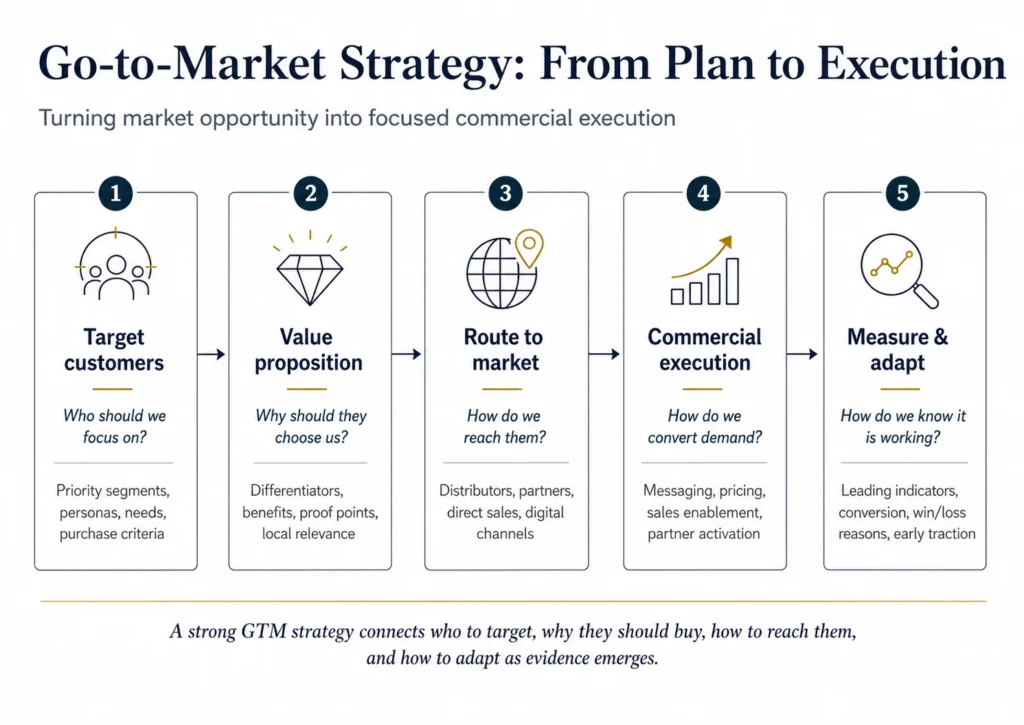
Figure 1. Midas Go-to-Market Strategy Process: A strong GTM strategy connects who to target, why they should buy, how to reach them, and how to adapt as market evidence emerges.

Key Aspects of a Strong Go-To-Market Strategy in Brazil:
| Key Component | Description |
|---|---|
| Market Analysis | Comprehensive analysis of industry trends, local demand, and competitive landscape |
| Value Proposition Development | Crafting a compelling message that differentiates your offering for Brazilian customers |
| Sales & Distribution Strategy | Identifying the most effective channels, partners, and market entry tactics |
| Competitive Benchmarking | Assessing key players, pricing strategies, and industry positioning in Brazil |
| Marketing & Demand Generation | Developing targeted campaigns that resonate with Brazil’s diverse customer segments |
| Go-to-Market Optimization | Enhancing strategies to improve efficiency, market penetration, and revenue growth |
| Product Launch Execution | Ensuring a data-driven approach to introducing new products successfully |
What Makes Go-to-Market Strategy in Brazil Different?
Brazil rewards ambition, but it punishes generic execution. Companies need to translate national opportunity into practical commercial choices.
| Brazil GTM issue | Why it matters | Executive implication |
| Scale and regional diversity | Customer behavior, infrastructure, service expectations, and competition can vary significantly across regions. | GTM should prioritize regions, states, cities, or customer clusters rather than assume a single national rollout. |
| Route-to-market complexity | Direct sales, distributors, retailers, integrators, digital channels, and strategic partners can produce very different economics and control. | The channel model should be selected based on coverage, capabilities, incentives, cost to serve, and strategic control. |
| Local competition | Local and regional players may adapt faster, bundle services differently, or compete aggressively on price. | The value proposition must be clear, defensible, and easy for sales teams and partners to communicate. |
| Tax, regulatory, and operating complexity | Brazil’s business environment can affect pricing, logistics, invoicing, import decisions, and service models. | GTM planning should connect commercial strategy with operational feasibility. |
| Execution alignment | Brazil can require coordination across sales, marketing, finance, operations, legal, and local partners. | GTM must define owners, milestones, metrics, and decision rights. |
From National Ambition to Priority Segments
In Brazil, one of the most important GTM decisions is focus. Trying to cover the whole market too quickly can dilute resources and create uneven execution.
Midas helps companies decide:
- Which regions or customer clusters should be prioritized first.
- Which segments have the strongest combination of need, accessibility, profitability, and strategic fit.
- Which channel model provides the best balance of reach, control, cost, and speed.
- Which competitors or substitutes shape the customer’s decision.
- Which sales messages and service attributes can create differentiation beyond price.
The result is a GTM roadmap that is specific enough for Brazil’s complexity and practical enough for local teams to execute.
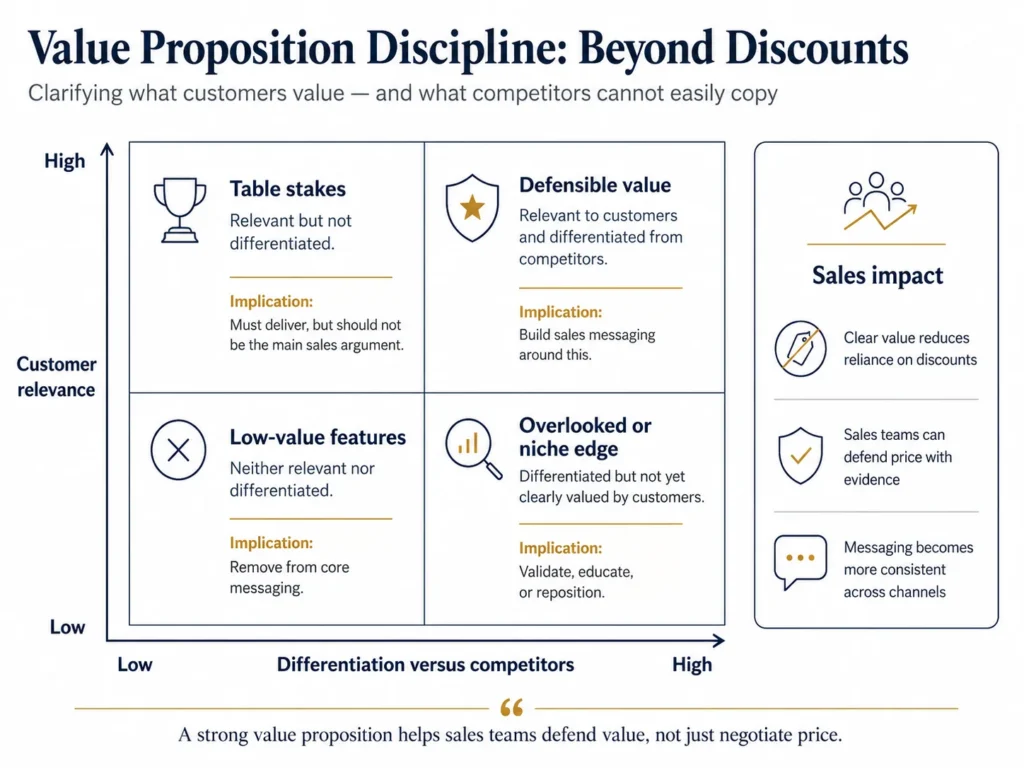
Figure 2. Value Proposition Discipline: In Brazil, a strong GTM strategy helps clarify which differentiators matter most by segment, channel, and region.
Challenges in Developing a Successful Go-To-Market Strategy in Brazil
Brazil presents unique opportunities, but also significant hurdles. Companies expanding or launching in the country often face:
- Standing Out in a Competitive Landscape. Brazil has strong local and international competition, requiring a well-defined value proposition
- Understanding Regional Differences. Consumer behavior, infrastructure, and market potential vary greatly between São Paulo, Rio de Janeiro, and other regions
- Choosing the Right Distribution and Sales Channels. Selecting between direct sales, local partnerships, e-commerce, and retail networks is crucial for success
Access our detailed guide on turning a go-to-market plan into execution.

How Midas Helps You with Go-to-Market Consulting in Brazil
At Midas, we provide customized go-to-market consulting services specifically designed for multinational firms operating in Brazil. Our expertise includes:
- Local Market Analysis & Customer Insights. Our on-the-ground experts analyze Brazil’s economic landscape, purchasing behaviors, and emerging trends to refine your strategy
- Competitive & Industry Benchmarking. We assess market leaders, pricing strategies, and competitive positioning to help you differentiate effectively
- Overall Go-to-Market Strategy Development. We identify the best channels, optimize pricing models, and establish key partnerships for efficient market penetration.

Looking to refine your go-to-market strategy or optimize a product launch in Brazil?
Some of Our Go-to-Market Consulting in Brazil Customers:





How We Build the Evidence Base in Brazil
Depending on the business challenge, our Brazil GTM work can include:
- Executive interviews with regional leadership, country managers, sales teams, distributors, partners, and local experts.
- Market analysis to understand customer segments, regional demand, barriers, and channel structure.
- Competitor benchmarking to compare positioning, pricing, service levels, channel practices, and likely reactions.
- Distributor or partner assessment to evaluate coverage, capabilities, incentives, margins, and execution discipline.
- Customer or channel interviews to validate purchase criteria, objections, switching barriers, and service requirements.
- Executive working sessions to align priorities, sequencing, owners, and implementation metrics.
This helps leadership teams avoid treating Brazil as one uniform market and instead build a GTM model that reflects local execution realities.
Strengths and Limitations of Our GTM Approach in Brazil
A structured GTM process helps companies reduce complexity by focusing on the right segments, regions, channels, partners, and execution priorities.
Its limitation is that Brazil’s scale can create false confidence. A strong strategy on paper still needs local validation, partner alignment, operational feasibility, and disciplined follow-up. GTM should be treated as a sequence of choices, tests, and adjustments, not only as a launch plan.
Case Example, Winning in Brazil: Overcoming Counterfeit Challenges to Drive Market Share
Background and challenges
A multinational laser cartridge company faced two significant hurdles in Brazil: a limited market share and widespread presence of refill and counterfeit products eating into sales. To turn things around, the company needed clear visibility into the size of the counterfeit market and a deeper understanding of competitor distribution policies and incentives


Approach
We employed a two-pronged approach, leveraging secondary research and conducting in-depth interviews with key industry stakeholders, including distributors, competitors, and cartridge re-fillers. By analyzing distribution networks and competitor strategies, we identified opportunities to strengthen legitimate sales channels and minimize the impact of counterfeit products
Results
Following our advice of fine-tuning its distribution strategy and aligning incentives with distributor needs, the company successfully diminished the influence of re-fillers. Within three years, it had more than doubled its market share and secured its position as the second-largest player in Brazil

Frequently Asked Questions About Go-to-Market Consulting in Brazil
What does go-to-market consulting in Brazil include?
It includes customer segmentation, regional prioritization, value proposition design, channel and partner assessment, competitor benchmarking, pricing implications, sales execution priorities, and GTM metrics.
Why does Brazil require a localized GTM strategy?
Because market conditions, customer needs, channel structures, service expectations, and competitive dynamics can vary significantly across regions and industries.
When should a company review its GTM strategy in Brazil?
When growth is below potential, expansion is too slow, channel partners are underperforming, sales teams rely heavily on discounts, or a national rollout needs sharper priorities.
How does Midas help companies choose the right route to market in Brazil?
We assess customer access, channel capabilities, cost to serve, partner incentives, competitive behavior, and execution feasibility to recommend the most practical route to market.
Is Your Brazil GTM Strategy Focused Enough?
Brazil can be too large, too diverse, and too competitive for a generic commercial model. The companies that perform better usually make sharper choices about where to compete, how to reach customers, how to differentiate, and how to align local execution.
Midas helps executive teams build that clarity.
Let’s talk about your Brazil go-to-market strategy.
About the Author:
By Adrian Alvarez, PhD. Adrian Alvarez is Managing Partner at Midas Consulting, a Wharton Alumnus, MBA Professor at Universidad Argentina de la Empresa (UADE), and Competitive Intelligence Fellow. He specializes in competitive strategy, growth strategy, and strategic decision-making under uncertainty across Latin America.
He has developed go-to-market strategies supporting product launches, commercial acceleration, and regional expansion initiatives. Access his published strategic insights.
View professional profile on LinkedIn
External References
This page is informed by Midas Consulting’s project experience and by selected external sources on go-to-market strategy, customer segmentation, and Brazilian market context: