

Expanding in Latin America is not only a market-entry decision, it is an execution challenge that we can solve with our go-to-market consulting.
The region offers attractive growth opportunities, but companies often underestimate how much go-to-market performance varies by country, city, channel, customer segment, distributor power, pricing dynamics, and competitor behavior. A GTM model that works in Mexico may need significant adaptation in Brazil, Argentina, Chile, Colombia, or Peru.
At Midas Consulting, we help C-level teams translate growth ambition into a practical go-to-market roadmap. We clarify which customers to prioritize, why they should choose your offer, which channels can actually deliver, which partners or distributors are required, and how execution should be measured and adjusted.
Our work is designed for companies that need more than a market report. They need a clear commercial model that can be implemented by leadership, sales, marketing, distributors, and local teams.
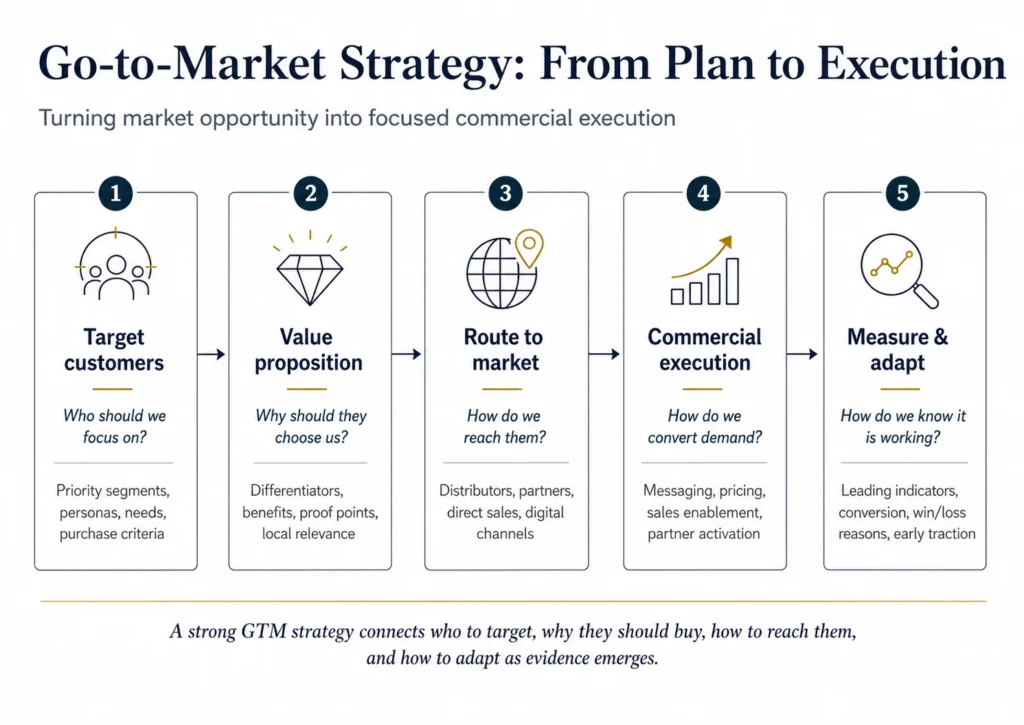
Figure 1. Midas Go-to-Market Strategy Process: A strong GTM strategy connects who to target, why they should buy, how to reach them, and how to adapt as market evidence emerges.

The Executive Questions a GTM Strategy Must Answer
For C-level executives, go-to-market strategy should answer five practical questions:
| Executive question | Why it matters in Latin America |
| Who should we target first? | Market size alone can be misleading if priority segments are difficult to access, expensive to serve, or already locked by competitors. |
| Why will customers choose us? | Without a differentiated value proposition, sales teams and distributors often default to discounts. |
| Which route to market can actually deliver? | Distributors, retailers, integrators, direct sales, digital channels, and hybrid models vary significantly by country and category. |
| How should the organization execute? | GTM only works when pricing, messaging, incentives, partner roles, and sales priorities are aligned. |
| How will we measure and adapt? | Early indicators such as qualified leads, conversion, distributor activation, objections, and win/loss reasons help refine the plan before resources are wasted. |
This turns GTM from a planning document into an execution discipline.
Key Aspects of a Strong Go-To-Market Strategy in Latin America:
| Key Component | Description |
|---|---|
| Market Analysis | Comprehensive analysis of industry trends, local demand, and competitive landscape |
| Value Proposition Development | Crafting a compelling message that differentiates your offering for Latin American customers |
| Sales & Distribution Strategy | Identifying the most effective channels, partners, and market entry tactics |
| Competitive Benchmarking | Assessing key players, pricing strategies, and industry positioning in Latin America |
| Marketing & Demand Generation | Developing targeted campaigns that resonate with Latin America’s diverse customer segments |
| Go-to-Market Optimization | Enhancing strategies to improve efficiency, market penetration, and revenue growth |
| Product Launch Execution | Ensuring a data-driven approach to introducing new products successfully |
Why Latin America Requires Local GTM Adaptation
Latin America should not be managed as one homogeneous market. Even within the same region, the right GTM model can change dramatically depending on the country, channel structure, customer needs, regulation, logistics, and competitor intensity.
| GTM decision | Why it varies across Latin America | What Midas helps decide |
| Priority market | Market attractiveness depends on more than size; access, regulation, competition, and channel feasibility matter. | Which country, segment, or city should be prioritized first. |
| Route to market | Distributor power, retail concentration, direct-sales feasibility, and partner quality vary by market. | Whether to use distributors, direct sales, hybrid coverage, digital channels, or strategic partners. |
| Value proposition | Customers may value price, availability, service, financing, technical support, brand, or local adaptation differently. | Which differentiators should be emphasized and which are only table stakes. |
| Pricing and incentives | Inflation, FX exposure, tax structure, payment terms, and discount behavior can change GTM economics. | How to align pricing, discounts, and channel incentives without destroying margins. |
| Execution metrics | A launch can look successful in revenue terms but fail in coverage, conversion, or distributor activation. | Which leading indicators should be tracked after launch. |
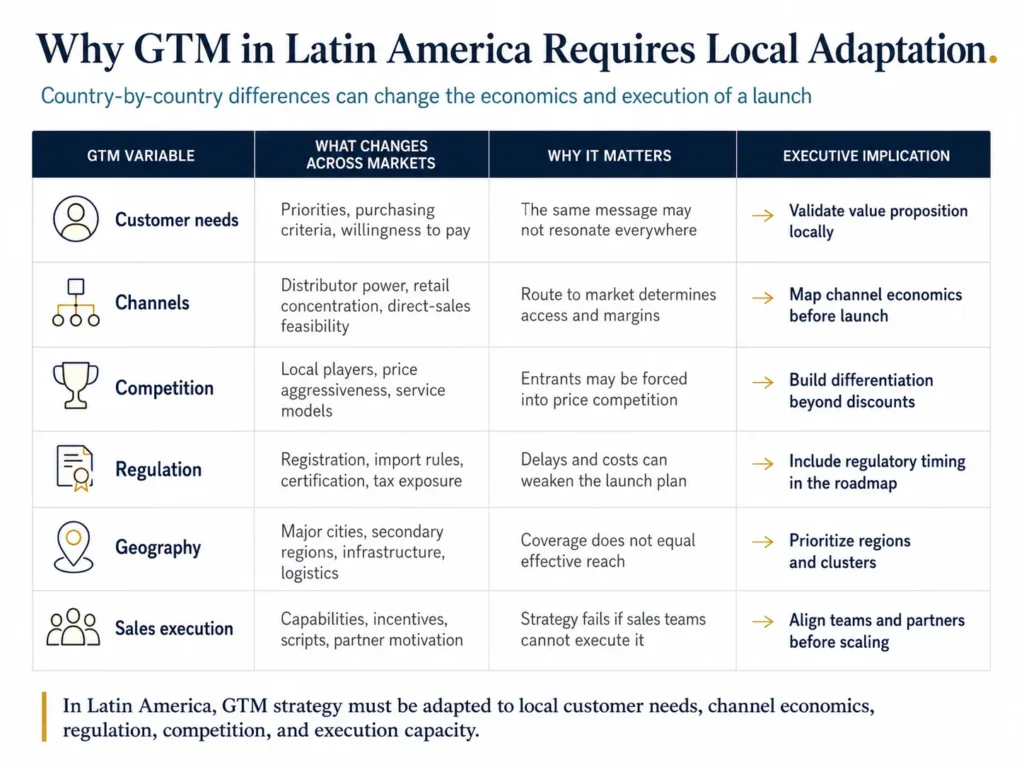
Figure 2. Why GTM in Latin America Requires Local Adaptation: GTM strategy must be adapted to customer needs, channel economics, regulation, competition, and execution capacity.
Challenges in Developing a Successful Go-To-Market Strategy in Latin America
Latin America offers strong potential, but companies expanding into the region often face critical challenges, including:
- Optimizing Regional Supply Chain and Distribution. Logistics and distribution strategies must be adapted to each country’s infrastructure, regional disparities, and market conditions
- Navigating Economic and Political Volatility. Countries within Latin America experience fluctuating inflation rates, exchange rates, and regulatory shifts that impact long-term planning
- Understanding Market-Specific Consumer Behavior. Each country has distinct cultural and economic factors influencing purchasing decisions and brand perception.
Learn how to move from market plan to execution in our guide to go-to-market strategy in Latin America

How Midas Helps You with Go-to-Market Consulting in Latin America
At Midas, we provide customized go-to-market consulting services tailored to multinational firms operating across Latin America. Our expertise includes:
- Local Market Analysis & Customer Insights. Our experts delve into economic landscapes, purchasing behaviors, and industry trends to fine-tune your strategy
- Competitive & Industry Benchmarking. We evaluate market leaders, pricing strategies, and competitive positions to help you stand out effectively
- Overall Go-to-Market Strategy Development. We identify the optimal sales channels, refine pricing models, and establish key partnerships to maximize market penetration in each country

Looking to refine your go-to-market strategy or optimize a product launch in Latin America?
Some of Our Go-to-Market Consulting in Latin America Customers:





How We Build the Evidence Base
Our GTM recommendations are based on a practical fact base, not generic assumptions. Depending on the project, we combine:
- Executive interviews with client leadership, sales, marketing, local teams, and regional managers.
- Market analysis to understand demand, customer segments, barriers, channel structure, and growth potential.
- Competitor analysis to assess positioning, pricing, channel strategy, incentives, and likely moves.
- Distributor or partner assessment when market access depends on local intermediaries.
- Customer or channel interviews to validate purchase criteria, objections, service expectations, and adoption barriers.
- Executive working sessions to align strategic choices, owners, milestones, and implementation priorities.
The goal is to help leadership teams decide where to play, how to win, which route to market to use, and how to execute with discipline.
Strengths and Limitations of Our GTM Approach
A structured GTM process helps companies reduce avoidable execution risk, align leadership teams, clarify the value proposition, choose the right channels, and focus resources on the most attractive opportunities.
However, GTM work is not a substitute for execution. It requires local validation, internal alignment, disciplined follow-up, and adaptation as the market reacts. In Latin America, assumptions about customers, channels, pricing, regulation, and competitors should be revisited regularly.
This is why Midas treats GTM as an iterative process: define the plan, test the assumptions, execute, measure, learn, and adjust.
Case Example, Achieving Market Growth Across Latin America
Background and challenges
A multinational laser cartridge manufacturer aimed to strengthen its position across three key Latin American markets: Argentina, Brazil, and Chile. However, two major challenges stood in the way: low market share and the widespread presence of counterfeit and refill products. Without reliable data on the size of the counterfeit market and limited insight into competitor distribution strategies, the company faced difficulties in optimizing its sales approach


Approach
To provide actionable insights, we conducted a multi-country market analysis, combining secondary research with direct interviews across Argentina, Brazil, and Chile. We engaged distributors, competitors, and re-fillers to understand local market dynamics, assess the impact of counterfeits, and identify the most effective distribution and incentive strategies for each country
Results
Through a refined distribution strategy and localized incentives, the company successfully diminished the influence of re-fillers and strengthened its market position. In just three years, it had risen to become the second-largest player across all three countries, securing a competitive advantage in Latin America

Frequently Asked Questions About Go-to-Market Consulting in Latin America
What does go-to-market consulting in Latin America include?
It includes customer segmentation, market prioritization, value proposition design, channel strategy, distributor or partner assessment, pricing implications, competitor analysis, sales execution priorities, and launch metrics.
How is GTM consulting different from market entry consulting?
Market entry consulting helps decide where and whether to enter. GTM consulting focuses on how to execute once the opportunity is selected: which customers to target, which channels to use, how to position the offer, and how to measure traction.
When should a company review its GTM strategy in Latin America?
A company should review its GTM strategy when growth is below expectations, distributors are underperforming, the sales team relies too heavily on discounts, competitors are gaining share, or a regional expansion requires clearer execution priorities.
Why does GTM strategy need to be country-specific in Latin America?
Because customer needs, channel economics, distributor power, regulation, pricing, competition, and sales execution vary significantly by country and sometimes by city or region.
Ready to Strengthen Your Go-to-Market Strategy in Latin America?
The question is not whether Latin America offers growth potential. The question is whether your current GTM model is specific enough for the countries you are targeting, clear enough for your sales teams, and disciplined enough to convert opportunity into profitable growth.
At Midas Consulting, we help executive teams build go-to-market strategies based on customer insight, channel analysis, value proposition design, competitive intelligence, and practical execution planning.
Let’s talk about your next GTM decision.
About the Author:
By Adrian Alvarez, PhD. Adrian Alvarez is Managing Partner at Midas Consulting, a Wharton Alumnus, MBA Professor at Universidad Argentina de la Empresa (UADE), and Competitive Intelligence Fellow. He specializes in competitive strategy, growth strategy, and strategic decision-making under uncertainty across Latin America.
He has developed go-to-market strategies supporting product launches, commercial acceleration, and regional expansion initiatives. Access his published strategic insights.
View professional profile on LinkedIn
External References
This page is informed by Midas Consulting’s project experience and by selected external sources on go-to-market strategy, customer segmentation, and Latin American market context: