
Strategy Consulting for achieving market success.
When your market is changing faster than your organization can respond, you do not need another strategy presentation. You need clarity about where to compete, what to prioritize, what to stop doing, and how your team will turn those choices into results.
At Midas Consulting, we help you develop practical, evidence-based strategies that fit your market, your organization, and your ability to execute. We work directly with your leadership team to challenge assumptions, evaluate strategic options, align decision-makers, and translate your choices into a clear implementation roadmap.
Our approach is collaborative, but it is not unstructured. We combine external market evidence, your team’s experience, disciplined facilitation, and explicit decision criteria so you can move from competing opinions to shared priorities and accountable action.
You bring the knowledge of your business. We bring the outside perspective, evidence, structure, and challenge needed to turn that knowledge into better strategic decisions.

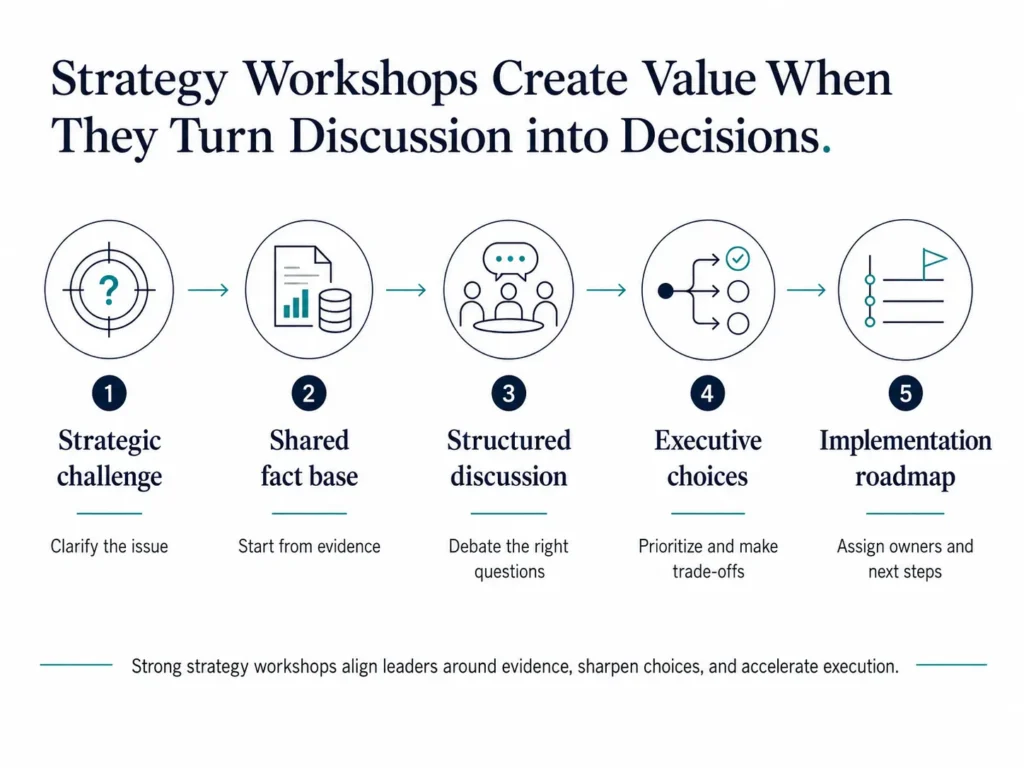
Figure 1. From strategic challenge to implementation: Midas combines evidence, executive alignment, and structured decision-making to help your team move from discussion to action.
Strategy Consulting for Decisions That Cannot Be Left to Assumption
Most leadership teams do not lack ideas. They struggle with too many initiatives, conflicting interpretations of the market, unclear trade-offs, and limited time to decide what matters most.
You may recognize some of these situations:
- Your existing strategy no longer reflects the market you are facing.
- Growth has slowed, but your team does not agree on the underlying causes.
- Business units or countries are pursuing different priorities.
- Your company has more initiatives than it can realistically fund or execute.
- Competitor moves are creating uncertainty about where to invest.
- You need to enter a market, accelerate growth, reposition an offer, or defend your position.
- Leadership has discussed the same issue repeatedly without reaching a clear decision.
- Your strategic plan identifies ambitions but does not define owners, milestones, or measures of success.
In these situations, the value of strategy consulting is not simply producing more analysis. It is helping you determine which evidence matters, compare realistic alternatives, make explicit choices, and create the organizational alignment required to act.
Harvard Business Review has highlighted that execution frequently breaks down because organizations struggle to coordinate across functions and adapt their strategy as conditions change. That is why we treat strategy and execution as connected parts of the same management process—not as separate assignments.
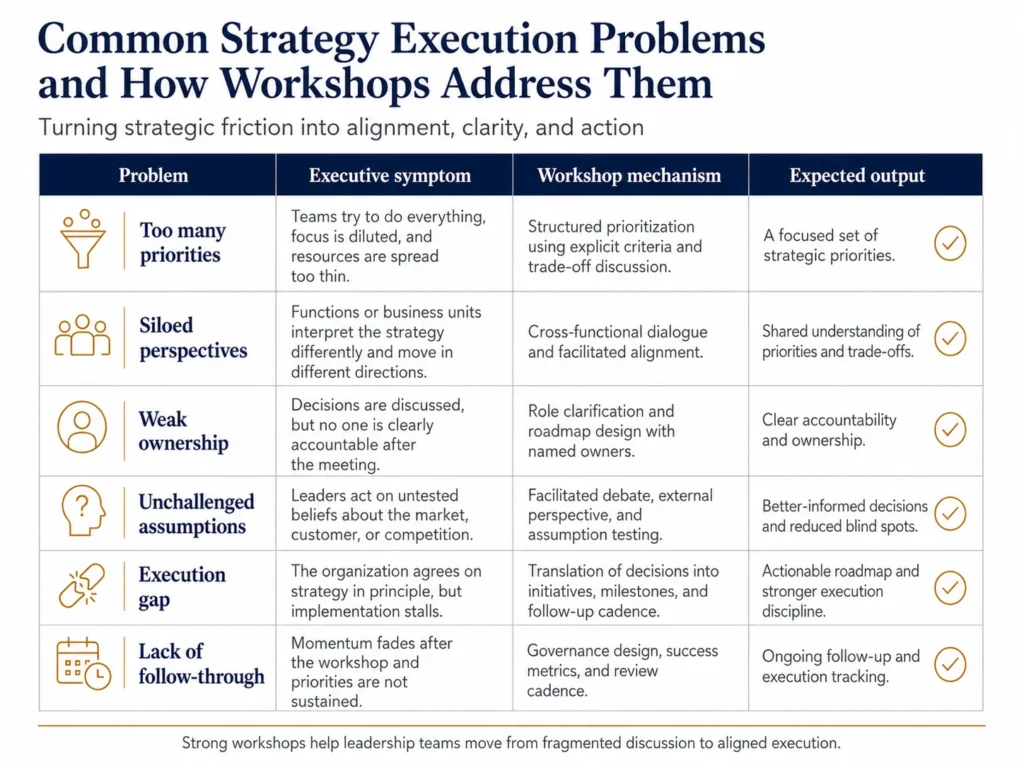
Figure 2. Strategy problems usually become visible through fragmented priorities, untested assumptions, unclear ownership, or weak follow-through. Our process addresses the underlying decision and alignment problem—not only the symptoms.

What You Will Achieve Through Our Strategy Consulting
Every engagement is tailored to the decision you need to make. Depending on your situation, we can help you:
Clarify the real strategic issue
We help you distinguish the underlying problem from its most visible symptoms. That may mean separating a market problem from a commercial-execution problem, a positioning problem from a channel problem, or an external competitive threat from an internal alignment issue.
Build a shared fact base
We bring together relevant market, customer, competitor, operational, and financial evidence so your leadership team can begin from a common view of reality rather than from disconnected assumptions.
Compare realistic strategic options
We help you define and evaluate alternatives using explicit criteria such as strategic impact, feasibility, investment requirements, risk, organizational readiness, time to impact, and fit with your capabilities.
Make trade-offs visible
A strategy becomes meaningful when it establishes what your company will prioritize, and what it will not pursue. We help your team identify those trade-offs before resources are committed.
Align the leaders who must execute the strategy
Because your executives and key functions participate in the process, they gain a shared understanding of the choices, assumptions, responsibilities, and measures behind the strategy.
Translate choices into an implementation roadmap
Your engagement does not end with a list of recommendations. We help you define the initiatives, owners, milestones, metrics, decision rights, and governance routines required to move forward.
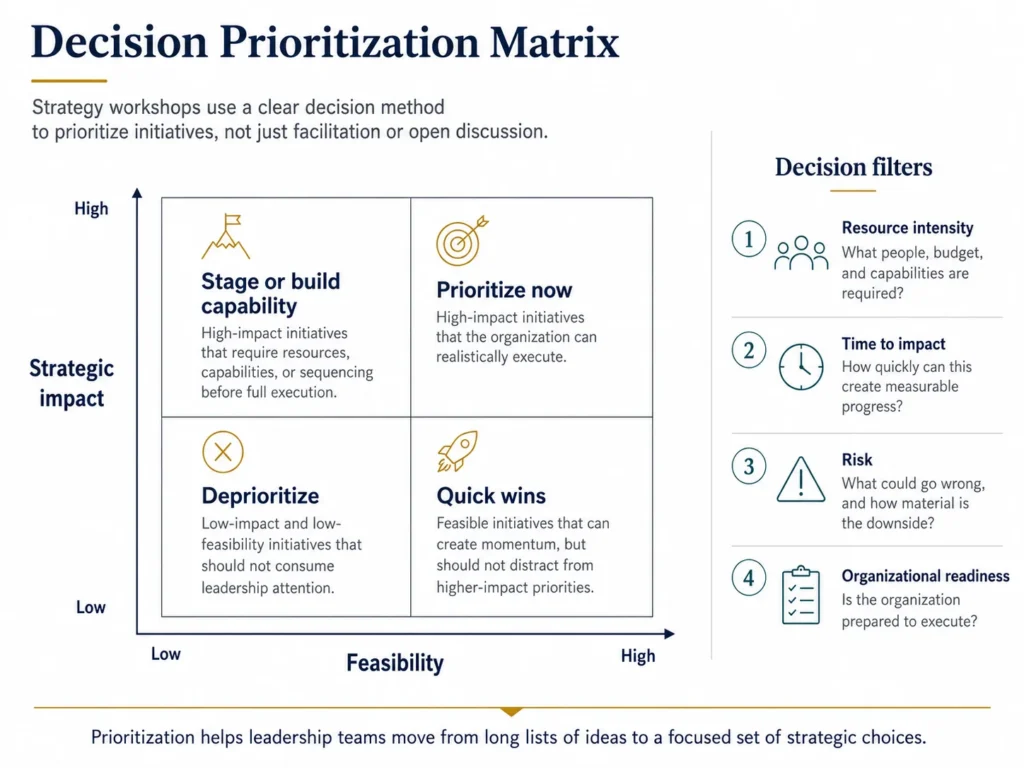
Figure 3. Explicit evaluation criteria help your leadership team move from a long list of possibilities to a focused set of strategic choices.

What Our Strategy Consulting Can Address
We support leadership teams facing a broad range of strategic decisions, including:
Corporate and business-unit strategy
Clarify where your company or business unit will compete, how it will create value, and which capabilities and investments will be required.
Growth strategy
Identify and prioritize growth opportunities across customers, segments, products, channels, geographies, and business models.
Competitive strategy
Understand your relative position, anticipate likely competitor responses, expose strategic blind spots, and develop moves that strengthen your advantage.
Market-entry and geographic expansion strategy
Evaluate attractive markets, entry alternatives, local conditions, partners, investment requirements, risks, and the sequence of expansion.
Go-to-market strategy
Define how your offer will reach the right customers through the right channels, commercial model, value proposition, resources, and execution priorities.
Strategic repositioning
Reassess your position when customer expectations, technology, regulation, competition, or market economics have changed.
Portfolio and resource prioritization
Determine which businesses, markets, products, brands, customers, or initiatives deserve greater investment—and which should be reduced, redesigned, or discontinued.
Strategic alignment and execution planning
Bring functions, business units, or country teams around a shared direction and convert that direction into initiatives, owners, metrics, and governance.
Our Strategy Consulting Process
We adapt every engagement to your strategic question, but our work typically follows five stages.
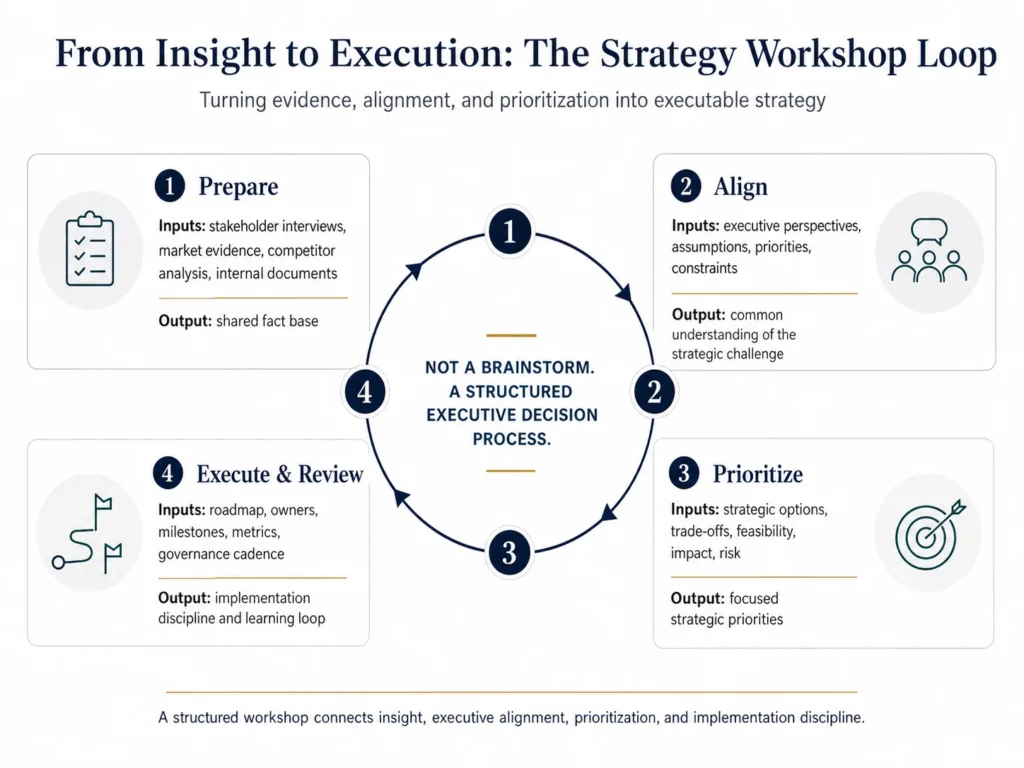
Figure 4. Our process connects strategic definition, external evidence, pressure-testing, executive choices, and implementation discipline.
1. Define the decision
We begin by clarifying what leadership must decide, why the decision matters now, and which stakeholders need to participate.
This step prevents the engagement from expanding into a general review of everything that could potentially affect the business. It gives the project a clear executive purpose.
Typical questions include:
- Which markets should you prioritize?
- How should you respond to a new competitor?
- Where should you concentrate growth investment?
- Which strategic initiatives should move forward?
- How should you adapt your value proposition or go-to-market model?
- What should your organization stop doing to protect focus and resources?
2. Build the fact base
We review the information required to make the decision responsibly. Depending on your challenge, this may include:
- Leadership and stakeholder interviews
- Internal strategies, plans, and performance information
- Market and customer analysis
- Competitor and channel analysis
- Benchmarking
- Win-loss interviews
- Regulatory and macroeconomic assessment
- Scenario development
- Capability and organizational-readiness assessment
The purpose is not to collect every available piece of information. It is to reduce the uncertainties that could materially change the decision.
3. Develop and pressure-test strategic options
We develop realistic alternatives and examine the assumptions behind each one.
Your strategy may be pressure-tested from several perspectives:
- Customer response
- Competitor response
- Channel and partner implications
- Financial and resource requirements
- Operational feasibility
- Organizational readiness
- Regulatory exposure
- Execution risk
- Potential unintended consequences
When competitor reactions are central to the decision, we may incorporate a competitive wargame. When the external environment is especially uncertain, we may use scenario planning to test whether the strategy remains viable under different conditions.
4. Align your leadership team and make choices
We design structured executive working sessions around the decisions your team needs to make.
Unlike an ordinary strategy meeting, the discussion is guided by:
- A shared fact base
- Clearly defined strategic alternatives
- Explicit evaluation criteria
- Facilitated challenge and debate
- Visible trade-offs
- Clear decision roles
- A documented conclusion
Our role is not to impose an answer from outside. It is to make sure that your team confronts the evidence, challenges its assumptions, considers meaningful alternatives, and reaches decisions that can be explained and implemented.
5. Translate the strategy into execution
We convert the agreed direction into an actionable roadmap. Depending on the engagement, this may include:
- Three to five strategic priorities
- Defined initiatives and workstreams
- Accountable owners
- Decision rights
- Key milestones
- Success measures
- Resource requirements
- Interdependencies
- Key risks and mitigation actions
- A 30-, 60-, or 90-day action plan
- A governance and review cadence
Strategy should not be treated as a static annual document. MIT Sloan Management Review describes strategy as an iterative process in which organizations interpret changing circumstances, make choices, act, and revise their direction as new information emerges. Your roadmap should therefore provide discipline without preventing adaptation.
What You Receive with Our Strategy Consulting
Your deliverables will depend on the strategic question and agreed scope. Typical outputs include:
| Deliverable | What it gives your leadership team |
| Executive diagnosis | A fact-based view of the central strategic challenge |
| Market and competitive fact base | Evidence for evaluating opportunities, risks, and assumptions |
| Strategic alternatives | A clear set of realistic choices rather than one predetermined answer |
| Evaluation criteria | A transparent basis for comparing alternatives |
| Strategic priorities | Focus on the small number of issues that matter most |
| Explicit trade-offs | Clarity about what your company will and will not pursue |
| Strategic roadmap | Initiatives, sequence, milestones, and dependencies |
| Accountable owners | Clear responsibility for implementation |
| Metrics and governance | A mechanism for tracking progress and adapting the strategy |
| Executive presentation | A concise, decision-ready summary for leadership or board discussion |
We define the deliverables with you at the beginning of the engagement, so you know what decisions the project is intended to support and what management outputs you should expect.
Why Leadership Teams Choose Midas for Strategy Consulting
More than 25 years working with strategic decisions
For more than two decades, we have worked with leadership teams in complex B2B, consumer, pharmaceutical, healthcare, industrial, technology, packaging, energy, construction, automotive, and agribusiness markets.
Experience across Latin America
Strategy cannot simply be transferred from one country to another. Market maturity, regulation, inflation, channel structures, customer behavior, competitive intensity, and organizational capabilities differ significantly across the region.
We combine a regional perspective with the local analysis needed to make each strategy relevant to the market where it will be implemented.
More than 70 strategy workshops
Our methodology has been refined through more than 70 strategy workshops involving different industries, functions, countries, and strategic challenges.
Evidence before opinion
We do not begin with a generic framework or a predetermined recommendation. We determine which evidence is necessary for your decision and build the process around it.
Collaborative, but willing to challenge you
We work closely with your team because they understand the business and will ultimately execute the strategy. At the same time, we provide the independence required to question assumptions, make disagreement visible, and address uncomfortable trade-offs.
Designed for implementation
We connect strategic choices with initiatives, owners, metrics, milestones, and governance. Our objective is not simply to help you reach agreement during a meeting. It is to help your organization act differently afterward.
Strong client advocacy
Between 2020 and 2025, Midas achieved a Net Promoter Score of 82.2.
The NPS is calculated from client responses collected after Midas engagements completed between 2020 and 2025. The underlying project-level information is confidential.
A Strategy Consulting Approach Grounded in Practice and Executive Education
Our collaborative approach to strategy is not only the result of decades of consulting work. Adrian Alvarez, Managing Partner of Midas Consulting, has also developed and shared these principles through his academic and executive-education work.
In his article Strategy Workshops: From Vision to Action, published by the Faculty of Economic Sciences at the Universidad de Buenos Aires (UBA), Adrian explores how organizations can close the gap between strategy design and execution. The article highlights the importance of involving the people who will implement the strategy, creating shared understanding across functions, making priorities explicit, and translating strategic choices into initiatives with clear owners, metrics, and milestones.
That thinking is also embedded in the way we work with you. Rather than handing your leadership team a strategy created from the outside, we combine market evidence, structured challenge, and facilitated workshops to help your team make better strategic choices, build genuine alignment, and leave with a strategy you can actually execute.
Strategy Consulting Experience Across Industries and Business Models
We have helped clients succeed across numerous sectors, including:










Case Example: Helping a Multinational Respond to a Growing Competitive Threat
The situation
A multinational B2B company was facing increasing pressure from a global competitor that had steadily gained market share.
The competitor had strong customer loyalty, an established position in the United States, and plans to develop regional production capacity in Latin America. Leadership needed to understand how the competitor could expand, where the client was most vulnerable, and how its response should differ by country.
What we did
Midas designed a strategy engagement combining competitive analysis and structured executive workshops.
The process included three perspectives:
- The client’s position: We examined the company’s capabilities, vulnerabilities, strategic priorities, and country-level differences.
- The competitor’s position: We assessed the competitor’s likely objectives, advantages, constraints, potential investments, and possible market moves.
- The strategic response: We helped cross-functional and country teams develop and evaluate defensive and offensive alternatives.
The leadership team then prioritized the alternatives based on market impact, feasibility, urgency, investment requirements, and likely competitor reactions.
What the client received
The engagement produced:
- Country-specific strategic priorities
- A differentiated response based on the threat level in each market
- Identification of previously unrecognized blind spots
- Greater coordination across business units and countries
- Owners and next steps for the priority initiatives
- An innovative option designed to leapfrog the competitor in selected areas
The result
The client completed the process with a coordinated regional direction and locally relevant actions. Instead of applying one general response across Latin America, leadership could focus resources according to the competitive conditions and opportunities in each country.
The client’s identity and certain commercial details have been withheld to protect confidentiality.
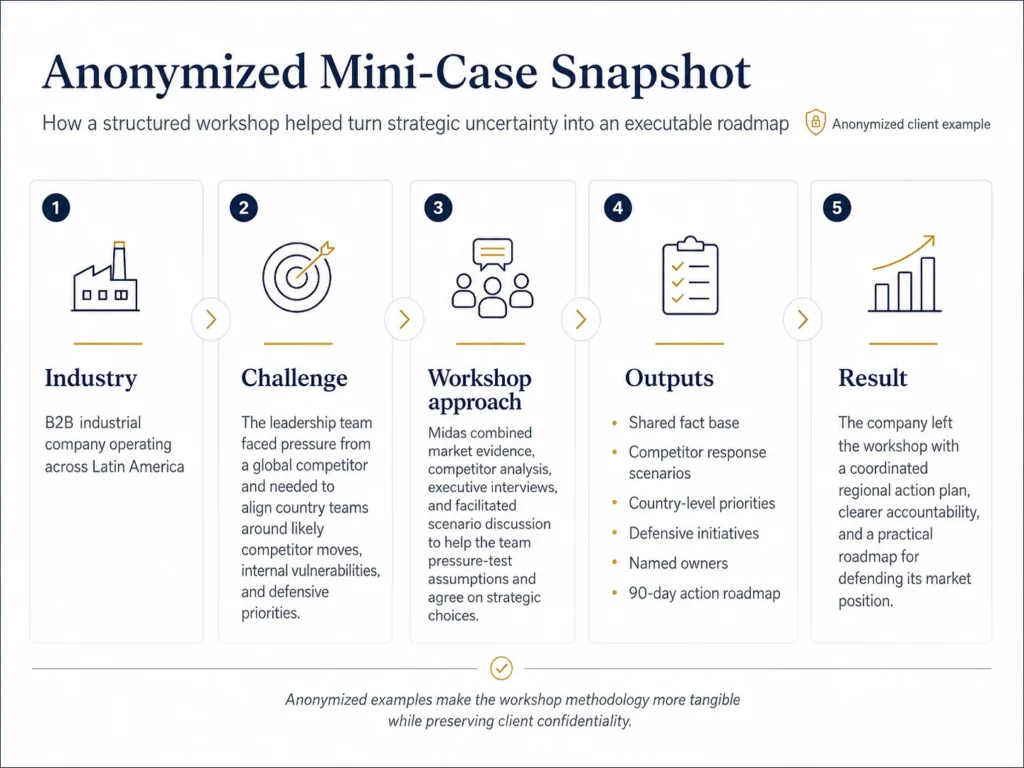
Figure 5. An anonymized case illustrates how evidence, competitive perspective, and executive alignment can produce country-specific strategic action while protecting client confidentiality.
Strategy Consulting, Management Consulting, and Strategy Workshops: What Is the Difference?
These terms often overlap, but they do not always refer to the same need.
Strategy consulting
Strategy consulting helps you make choices about where to compete, how to create value, which opportunities to prioritize, and what capabilities or investments will be required.
It is appropriate when your central challenge concerns direction, growth, positioning, competition, markets, customers, or resource allocation.
Management consulting
Management consulting is broader. It can address strategic direction, organizational alignment, operating models, decision processes, performance improvement, and implementation challenges.
Our management consulting services are especially relevant when the problem extends beyond a specific strategic choice and involves how different parts of the organization work together.
Strategy workshops
A strategy workshop is one of the mechanisms we may use within a strategy or management consulting engagement. It is a structured executive working session designed to challenge assumptions, compare options, make decisions, and create ownership.
A workshop may be sufficient when the necessary evidence already exists and the main need is alignment and decision-making. When important market, customer, or competitor information is missing, research and analysis should usually take place first.
Learn more about:
- Management consulting in Latin America
- Strategy workshops that turn insights into action
- Applied strategic intelligence for executives
When a Strategy Workshop Is, and Is Not, the Right Tool
A workshop can be highly effective when your leadership team needs to:
- Align around the same strategic issue
- Evaluate clearly defined alternatives
- Challenge assumptions
- Agree on priorities and trade-offs
- Coordinate across functions, countries, or business units
- Convert strategic choices into an implementation roadmap
However, a workshop should not be used as a substitute for missing evidence.
It may not be the right first step when:
- The market or customer problem is not yet understood
- Critical competitor information is missing
- The participants do not have authority to make the required decisions
- Leadership is unwilling to discuss trade-offs
- The outcome has already been predetermined
- There is no commitment to implementation or follow-through
In these cases, we may recommend beginning with market analysis, competitor analysis, stakeholder interviews, benchmarking, win-loss analysis, scenario planning, or another focused diagnostic before bringing the leadership team together.
Being transparent about what a workshop can and cannot achieve is part of responsible strategy consulting.
Frequently Asked Questions About Strategy Consulting
What does a strategy consultant actually do?
A strategy consultant helps your leadership team define the decision it needs to make, gather and interpret relevant evidence, develop realistic alternatives, evaluate trade-offs, and translate the selected direction into an actionable roadmap.
The consultant should bring an independent perspective and a structured process, while recognizing that your executives and employees hold essential knowledge about the organization.
When should you hire a strategy consulting firm?
You should consider external strategy support when the decision is important, complex, politically sensitive, cross-functional, or dependent on evidence and capabilities your team does not currently possess.
External support may also be valuable when leadership is too close to the issue, internal discussions have stalled, or different units are interpreting the situation in incompatible ways.
How is your approach different from receiving a traditional strategy presentation?
We do not develop a recommendation in isolation and reveal it at the end of the project.
We involve the right leaders throughout the process, make assumptions and criteria visible, evaluate alternatives collaboratively, and connect the strategy with implementation responsibilities. You receive analysis and recommendations, but you also gain the alignment and ownership needed to act on them.
Do you work only through strategy workshops?
No. A workshop is one component that may be included when executive alignment and decision-making are required.
Depending on your situation, the engagement may also include research, stakeholder interviews, market analysis, competitor analysis, benchmarking, strategic intelligence, scenario planning, financial evaluation, or implementation support.
Who should participate?
Participation depends on the decision.
Most engagements involve an executive sponsor and leaders from the functions, business units, or country operations that understand the issue or will be responsible for implementation. We help you determine who should be involved and at which stage, avoiding unnecessarily large meetings.
What information will you need from our company?
We normally request relevant strategic plans, performance information, market studies, customer data, organizational information, and access to key stakeholders.
However, we tailor the request to the question being addressed. We do not ask for information merely because it is available.
Can you help us if we do not yet have sufficient market information?
Yes. We can build the required fact base through market analysis, competitor analysis, customer interviews, benchmarking, win-loss analysis, or other forms of strategic intelligence before facilitating the decision process.
Can strategy consulting be conducted virtually?
Yes. Research, interviews, analysis, and many executive sessions can be conducted virtually. In-person workshops may be preferable when the issue involves a large cross-functional group, complex negotiation, sensitive disagreement, or extensive collaborative exercises.
We recommend the format based on the decision and participants rather than applying one standard delivery model.
How long does a strategy consulting engagement take?
The timeframe depends on the decision, geographic coverage, research requirements, number of stakeholders, and level of implementation detail required.
A focused leadership alignment assignment may take several weeks. A multi-country engagement involving primary research, competitor assessment, strategic alternatives, and an implementation roadmap may require several months. We define the workplan, milestones, and required inputs in the proposal.
What deliverables should we expect from a strategy consulting engagement?
Typical deliverables include an executive diagnosis, market and competitor fact base, strategic alternatives, evaluation criteria, priorities, trade-offs, initiative roadmap, accountable owners, metrics, risks, and governance recommendations.
The exact outputs are agreed with you before the engagement begins.
How do you protect confidential information?
We treat client information and project findings as confidential and can work under a nondisclosure agreement when required.
Case examples are anonymized unless the client has explicitly authorized public disclosure. We also limit access to project information to the team members who require it for the engagement.
How do you measure whether the engagement was successful?
Success measures should be linked to the purpose of the engagement.
During the project, we may assess whether leadership reached the required decisions, whether priorities and ownership are clear, and whether the implementation roadmap has been approved.
Afterward, relevant measures may include milestone completion, commercial results, market share, customer outcomes, operational indicators, investment performance, or another business metric connected to the strategy.
Do you implement the strategy after the project?
Our primary role is helping you develop, pressure-test, align around, and operationalize the strategy. We can also support implementation governance, initiative design, follow-up workshops, progress reviews, and selected workstreams.
The implementation support required is defined with you based on your internal capabilities and the complexity of the roadmap.
Do you provide strategy consulting throughout Latin America?
Yes. We support companies with regional and country-specific strategy challenges across Latin America, including Argentina, Brazil, Chile, Colombia, Mexico, and Peru.
Our regional experience helps us identify patterns across markets, while our local analysis accounts for differences in customers, competitors, regulation, channels, economic conditions, and organizational readiness.
Related Strategy and Management Consulting Services
Your strategic challenge may require more than one methodology. Depending on the decision, you may also benefit from:
- Management Consulting in Latin America. For leadership challenges involving strategic clarity, cross-functional alignment, organizational focus, and implementation across the region.
- Strategy Workshops. For structured executive sessions that turn evidence and strategic options into priorities, decisions, owners, and an implementation roadmap.
- Strategic Intelligence. For building the market, competitor, customer, and external-environment evidence required to make high-stakes decisions with greater confidence.
- Competitive Wargaming. For anticipating competitor responses, pressure-testing strategic moves, and identifying vulnerabilities before committing resources.
- Scenario Consulting. For testing strategic choices across multiple plausible futures when regulation, economics, technology, or competitive behavior is especially uncertain.
- Go-to-Market Consulting. For translating strategic direction into channels, customer priorities, commercial capabilities, resources, and market execution.
- Market-Entry Consulting. For selecting attractive markets and evaluating entry modes, partners, risks, investment requirements, and implementation priorities.
Ready to Make the Strategic Choices That Will Move Your Business Forward?
You may already have extensive analysis, capable executives, and more ideas than you can pursue.
The difficult part is deciding which opportunities deserve your attention, which assumptions need to be challenged, which trade-offs you are willing to make, and how your organization will execute the chosen direction.
That is where we can help.
In an initial conversation, we will discuss:
- The decision your leadership team needs to make
- Why that decision has become urgent
- What evidence is already available
- Where important uncertainties remain
- Who needs to participate
- What a useful outcome would look like
You will not receive a generic presentation. We will recommend a process built around your decision, your market, and your organization.
Tell us what your leadership team needs to decide.
About Midas Strategy Consulting
Midas Consulting is a strategy and market-intelligence consulting firm that helps leadership teams make complex growth, competitive, market-entry, go-to-market, and strategic-prioritization decisions.
For more than 25 years, we have worked with multinational and regional companies across Latin America and other international markets. Our approach combines external evidence, structured strategic analysis, executive facilitation, and implementation planning.
Our work is supported by Midas’s Applied Strategic Intelligence Hub, where we share frameworks, research, and practical lessons on strategy, competitive simulation, market decisions, and execution.
Last reviewed: August 2026