

Introduction: The Blind Spot in Strategy
Most executives track their competitors. They monitor product launches, pricing moves, market share shifts, partnerships, and regulatory signals. Yet when leadership teams build strategy, competitor reactions are often treated as something to monitor later, not something to anticipate before the decision is made.
At Midas Consulting, we define a business wargame as a structured strategic simulation that helps executives pressure-test a strategy by role-playing how competitors, customers, regulators, distributors, or other market actors may respond. The purpose is not to predict the future perfectly. It is to reveal blind spots, test assumptions, and prepare better countermoves before resources are committed.
This matters because competitor reaction is one of the most common blind spots in strategy. Harvard Business Review’s article “Predicting Your Competitor’s Reaction” argues that understanding how rivals may respond should be a critical part of strategic decision-making, yet many companies still fail to incorporate it seriously when developing strategy.
For C-level executives, the question is not only “Is our strategy attractive?” It is “How will competitors react, how exposed are we if they move aggressively, and what should we do now to make the strategy more resilient?” That is where business wargames create value: they turn competitor uncertainty into a disciplined executive conversation about risk, response, and action.
A wargame is strongest when it is built on a solid fact base. Depending on the strategic question, that fact base may come from competitor analysis, market analysis, benchmarking, win-loss analysis, or strategic foresight. The wargame then turns those insights into a simulation of moves, countermoves, risks, and response options.
Real-world competitive responses show why anticipation matters. In the Midas Import Competition Monitor 2026, we analyzed 151 business decisions made in response to the same shift in Argentina’s competitive environment and found very different strategic responses: investing to defend local production, reconfiguring operations, importing, regionalizing, reducing capacity, or exiting the market. Forbes Argentina used Midas Consulting’s Monitor to examine these different strategic responses. In a wargame, understanding this kind of real-world behavior helps build stronger hypotheses about how a competitor might respond.
Real-world competitive responses show why anticipation matters. In the Midas Import Competition Monitor 2026, we analyzed 151 business decisions made in response to the same shift in Argentina’s competitive environment and found very different strategic responses: investing to defend local production, reconfiguring operations, importing, regionalizing, reducing capacity, or exiting the market. Forbes Argentina used Midas Consulting’s Monitor to examine these different strategic responses. In a wargame, understanding this kind of real-world behavior helps build stronger hypotheses about how a competitor might respond.
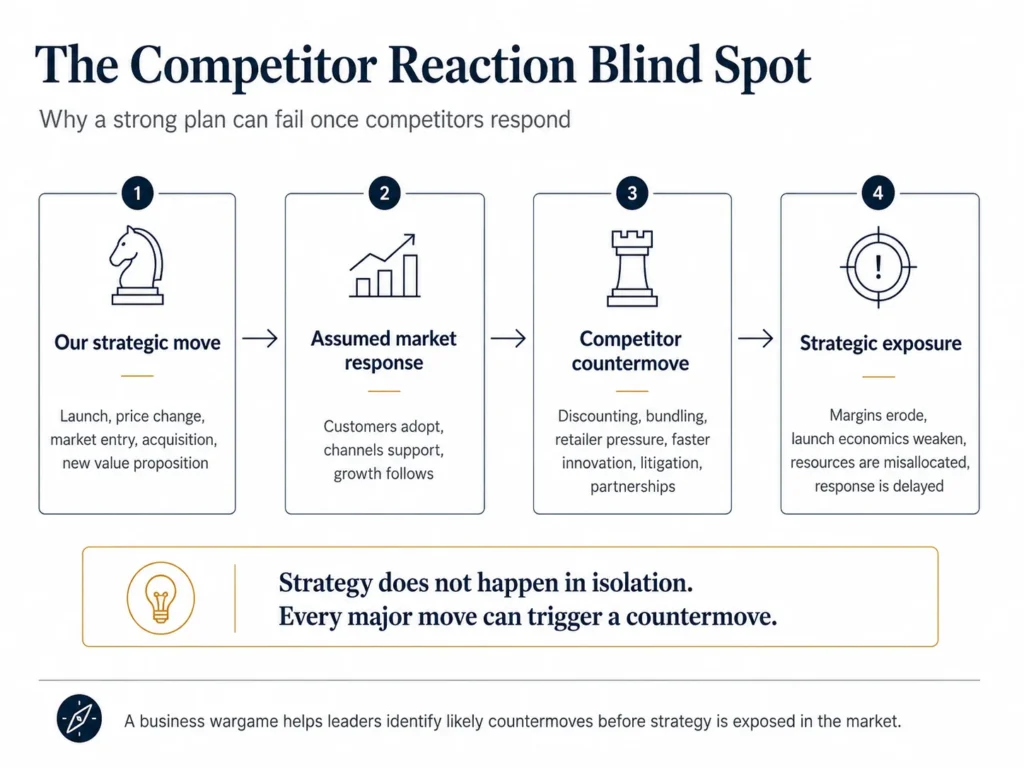
Figure 1. The Competitor Reaction Blind Spot: A business wargame helps leaders identify likely countermoves before strategy is exposed in the market.
Why Ignoring Competitor Reactions Is So Expensive
Ignoring competitor reactions is expensive because strategy does not happen in isolation. Every major move, a launch, price change, market entry, acquisition, partnership, capacity expansion, or new value proposition, can trigger a countermove. If those countermoves are not anticipated, the strategy may look attractive on paper but fail in execution.
- Overestimating your own advantage. Companies often assume their competitive edge will last longer than it really does. A new product, channel model, or pricing strategy may look strong until a rival responds with a discount, a bundled offer, a retailer incentive, litigation, or a faster innovation cycle.
- Misallocating resources. If leadership assumes competitors will remain passive, investment plans can become too optimistic. The true cost of a strategic move is not only the company’s own investment, but also the escalation that may be triggered by competitor responses.
- Eroding credibility with stakeholders. Boards, investors, employees, and commercial teams lose confidence when a strategy looks robust internally but stumbles once competitors react. The pattern is often the same: the plan underestimated how rivals would defend their position.
- Reacting too late. Without pre-defined countermoves, companies often lose time debating what to do after the competitor has already acted. A wargame helps leadership teams define early warning signals, response options, and decision triggers before the pressure is real.
As one client (Head of Strategy of a B2B company) told us after a previous experience in 2024:
“We avoided being blindsided by our competitors.”
When a Business Wargame Is the Right Tool
A business wargame is especially useful when the strategic decision depends on how other players may react. At Midas, we use wargames when executives need to pressure-test a strategy before committing significant resources, launching a new product, entering a new market, defending share, changing pricing, responding to a disruptive competitor, or preparing for regulatory or channel shifts.
Wargames are most valuable when three conditions are present: the decision is important, competitor behavior is uncertain, and the cost of being wrong is material. In those cases, a wargame can help leadership teams move from “What do we want to do?” to “What will others do when we make our move, and how should we prepare?”
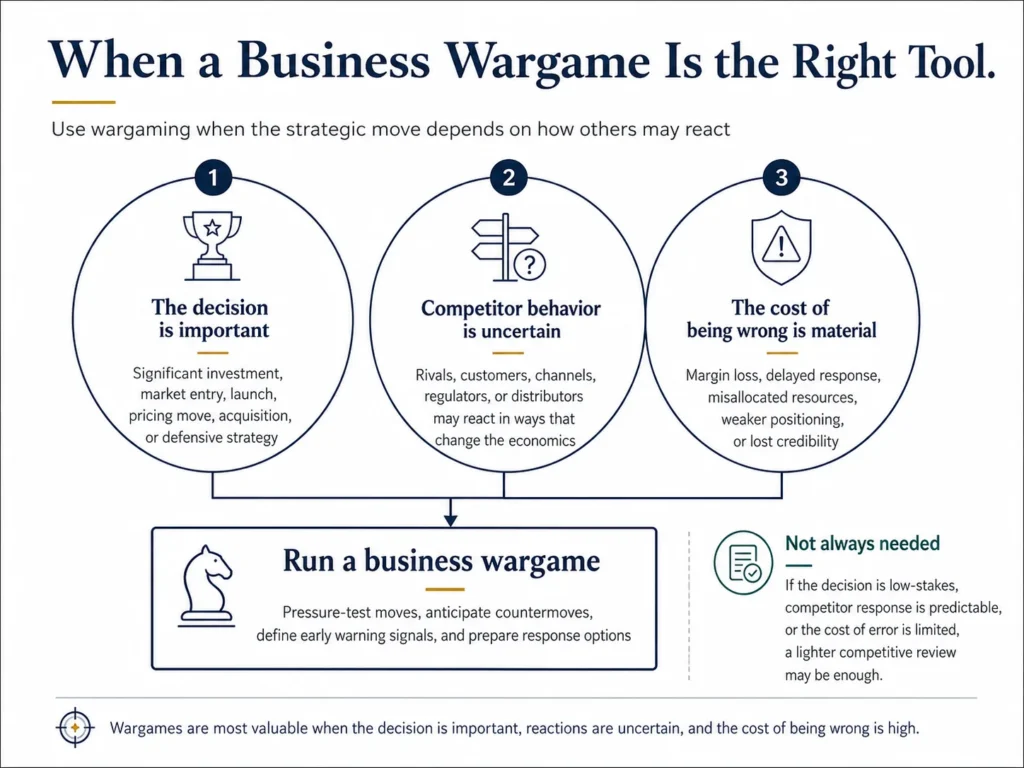
Figure 2. When a Business Wargame Is the Right Tool: Wargames are most valuable when the decision is important, reactions are uncertain, and the cost of being wrong is high
Business wargames can also complement other strategic tools. For example, companies entering a new country may combine wargaming with market entry consulting. Companies launching or repositioning an offer may combine it with go-to-market consulting, value proposition design and win-loss analysis to understand what customers value and why competitors are winning.. Teams planning under deep uncertainty may also benefit from scenario consulting.
How Wargames Reduce Those Costs
At Midas Consulting, we have facilitated wargames across industries including pharmaceuticals and healthcare, automotive, consumer goods, industrial products, packaging, and B2B technology. Across these engagements, the value usually falls into four categories:
- Sharper strategic assumptions. Wargames force executives to step into a competitor’s shoes. What would we do if we were losing share? How would we respond to a new entrant? Would we cut price, accelerate innovation, pressure distributors, launch litigation, or form a partnership? This process exposes assumptions that may otherwise remain unchallenged.
- Stronger leadership alignment. Teams often disagree on how competitors think and how aggressively they may respond. Role-playing rival perspectives surfaces those differences and helps executives build a shared view of the competitive landscape.
- Clearer countermoves. A good wargame should not end with interesting discussion. It should produce practical response options, early warning indicators, decision triggers, and owner-level accountability.
- Faster, more resilient decisions. When scenarios have already been pressure-tested, leaders can act faster under pressure. They know the likely risks, the potential reactions, and the countermoves available to them.
This is consistent with research on combining scenario planning and business wargaming, which argues that wargaming can help strategists explore moves, countermoves, and their consequences in competitive environments. See Futures: “Combining scenario planning and business wargaming to better anticipate future competitive dynamics”.
How Our Wargame Process Works
A business wargame should be structured enough to generate reliable insights, but practical enough to help executives make better decisions. At Midas, our process usually includes five stages:
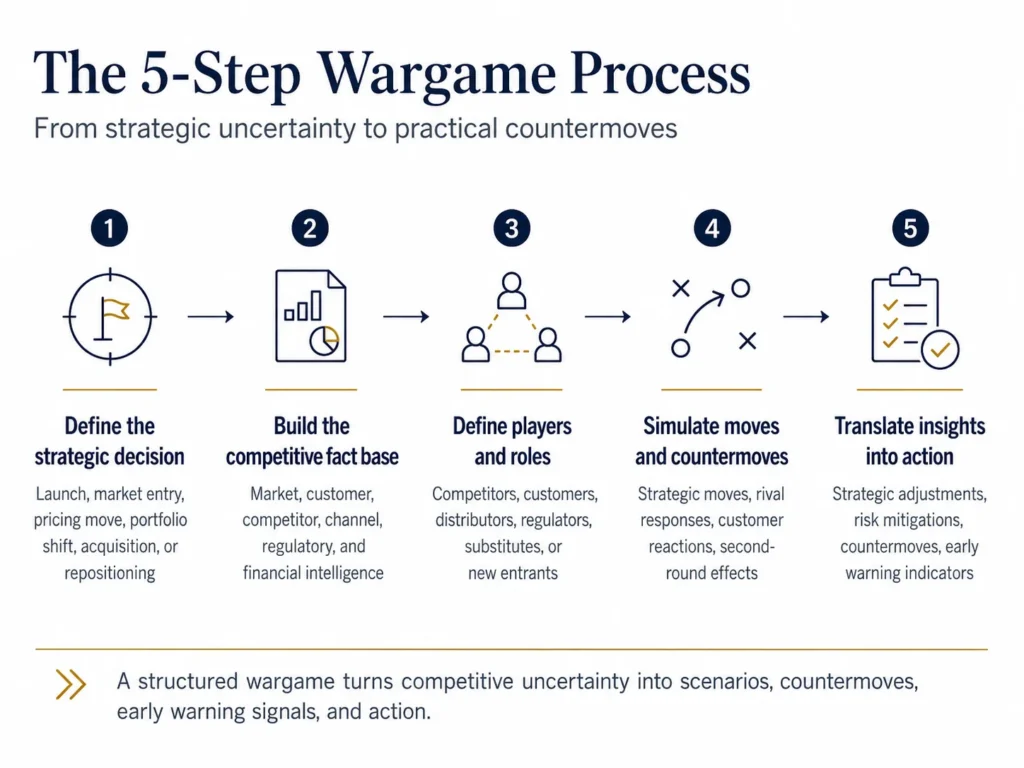
Figure 3. The Midas 5-Step Wargame Process: A structured wargame turns competitive uncertainty into scenarios, countermoves, early warning signals, and action
1. Define the strategic decision
We start by clarifying the decision to be tested: a launch, market entry, pricing move, portfolio shift, defensive plan, acquisition, or strategic repositioning. The clearer the decision, the more useful the wargame.
2. Build the competitive fact base
We collect and synthesize relevant market, customer, competitor, channel, regulatory, and financial information. This may include competitor analysis to understand rival incentives and likely moves, market analysis to clarify demand and market structure, and benchmarking to compare practices, capabilities, and performance gaps.
3. Define players and roles
We identify the actors whose reactions matter most: direct competitors, substitutes, distributors, retailers, regulators, customers, payers, or new entrants. Participants then role-play those actors to understand how they may respond.
4. Simulate moves and countermoves
The teams simulate strategic moves, competitor responses, customer reactions, and potential second-round effects. This is where hidden risks often emerge: price wars, channel conflict, retaliation, copycat offers, regulatory delays, or unexpected partnerships.
5. Translate insights into action
The final output is not a prediction. It is a practical playbook: strategic adjustments, risk mitigations, countermoves, early warning indicators, decision triggers, and follow-up actions.
This methodology is also grounded in Midas Consulting’s applied research on competitive simulation and business wargaming. You can explore our related publications and executive frameworks in the Midas Applied Strategic Intelligence Hub.
Practical Example of a Wargame
A Latin American consumer goods company approached us before a major product launch. The internal forecast assumed that competitors would not retaliate aggressively. That assumption mattered: if competitors responded with deep discounts or retailer incentives, the economics of the launch could change quickly.
During the wargame, one team role-playing a competitor responded with a major discount campaign and increased pressure on retail partners. The exercise revealed that the client’s pricing and channel assumptions were more fragile than expected.
The company adjusted the launch plan in three ways:
- It built a defensive pricing strategy.
- It strengthened retailer relationships before the launch.
- It allocated budget for a rapid-response promotion.
When the launch went live, competitors did respond with discounts, just as the wargame had suggested. But this time, the client was prepared. Instead of reacting late, the team had already aligned on countermoves and protected the economics of the launch.
In situations like this, a wargame can be strengthened by prior competitor analysis and market analysis. These inputs help teams understand which competitors matter most, how channels work, what customers value, and which reactions are plausible rather than speculative.
“The wargame saved us millions. We didn’t just predict the reaction. We had the counter-move ready.”
Marketing VP, Consumer Goods Company, Wargame Project, 2024
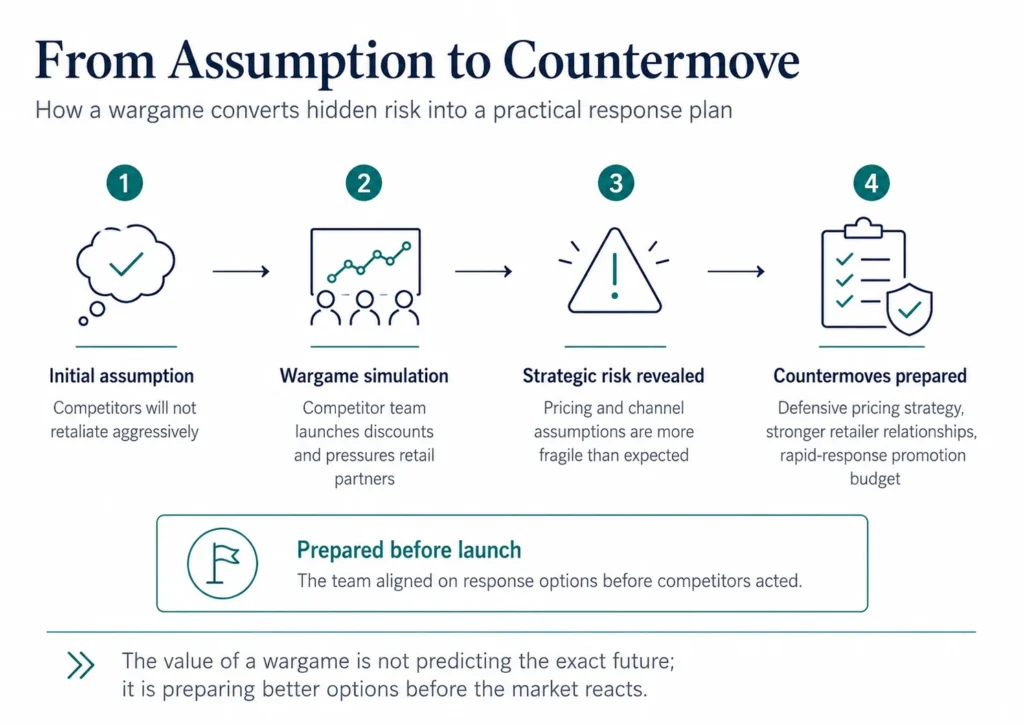
Figure 4. Midas From Assumption to Countermove: The value of a wargame is not predicting the exact future; it is preparing better options before the market reacts.
Strengths and Limitations of Wargames
Like any strategic tool, wargames have strengths and limitations. Understanding both helps executives use them in the right context and avoid overclaiming what a simulation can do.
Strengths
- Realism. Wargames expose teams to how competitors, customers, channels, and regulators may actually behave, not how the company hopes they will behave.
- Engagement. Leaders are usually more invested when they role-play competitors and market actors than when they only review static reports.
- Actionability. A strong wargame produces countermoves, early warning indicators, and strategic adjustments, not just abstract insights.
- Alignment. Wargames help leadership teams build a shared view of competitor incentives, likely reactions, and strategic vulnerabilities.
Limitations
- Quality of inputs. A wargame is only as good as the intelligence used to design it. Weak competitor insight can turn the exercise into speculation. For that reason, wargames often need to be supported by competitor analysis, market analysis, or strategic foresight.
- Preparation requirements. Effective wargames require clear objectives, strong facilitation, relevant participants, and a well-prepared fact base.
- Overconfidence risk. A simulation cannot capture every possible future. Wargames should guide strategic thinking, not replace judgment.
- Need for follow-through. If insights are not translated into decisions, owners, and actions, the wargame becomes an engaging workshop rather than a strategic tool.
“The value was not in predicting the exact future. It was in building a playbook for how to react, no matter what happened.”
Industrial Equipment Executive, Wargame Workshop, 2024
The Strategic Payoff
The real cost of ignoring competitor reactions is not only lost revenue. It is wasted time, credibility, and momentum. By contrast, companies that incorporate wargaming into strategic planning can build strategies that are more realistic, resilient, and easier to execute under pressure.
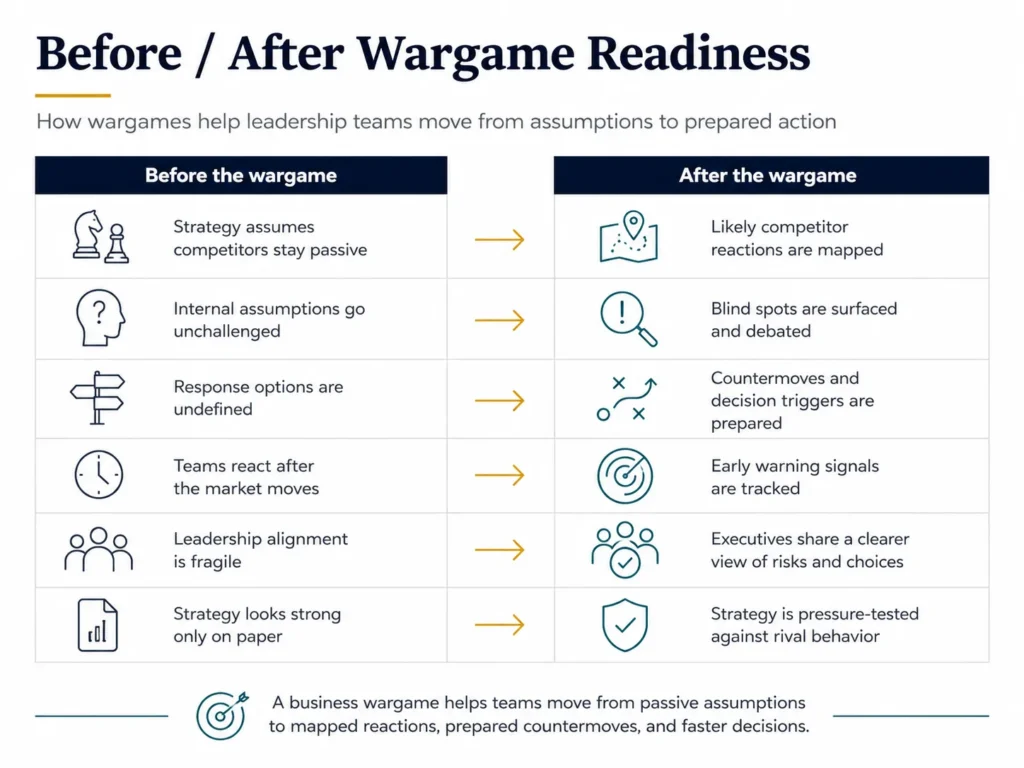
Figure 5. Before and After Midas Wargame Readiness: A business wargame helps teams move from passive assumptions to mapped reactions, prepared countermoves, and faster decisions
The payoff usually appears in three areas:
- Lower risk of avoidable surprises. Teams identify likely competitor reactions before committing resources.
- More resilient strategies. Plans are tested against likely countermoves, second-round effects, and market responses.
- Greater organizational confidence. Leadership teams align not only on what they want to do, but also on how they will respond if the market pushes back.
The payoff is even stronger when the wargame is connected to the next execution step. If the exercise reveals that the offer is not differentiated enough, the next step may be value proposition design. If it reveals that buyers are choosing competitors for reasons the company does not fully understand, the next step may be win-loss analysis. If it reveals that leadership alignment is the main barrier, a strategy workshop can help translate wargame findings into priorities, owners, and action.
“Wargames forced us to think like our competitors, and in doing so, we became far better at thinking like ourselves.”
Global Pharma Executive, Wargame Sessions, 2023
Conclusion: Don’t Pay the Price of Ignoring Competitors
Markets are not static. Every move you make triggers a countermove. The question is whether you anticipate it, or pay the price for ignoring it
Wargames give you a disciplined, practical way to anticipate competitor reactions before committing resources. They help you avoid the costliest mistake in strategy: assuming your competitors will stand still.
About the Author:
By Adrian Alvarez, PhD. Adrian Alvarez is Managing Partner at Midas Consulting, a Wharton Alumn’us, MBA Professor at Universidad Argentina de la Empresa (UADE), and Competitive I’ntelligence Fellow. He specializes in competitive strategy, growth strategy, business wargaming, competitor analysis, and strategic decision-making under uncertainty across Latin America.
He has designed dozens of strategic wargaming simulations to help executive teams anticipate competitor actions, pressure-test strategies, and prepare countermoves before committing resources. You can explore more of his thinking in Midas Consulting’s strategic intelligence insights.
Selected External References
This article is informed by Midas Consulting’s experience facilitating business wargames across industries and by respected sources on competitor reactions, strategic decision-making, and competitive dynamics.
- Harvard Business Review: Predicting Your Competitor’s Reaction
- Futures: Combining Scenario Planning and Business Wargaming to Better Anticipate Future Competitive Dynamics
- Wharton Executive Education: Making Strategic Decisions: Do You Have What It Takes?
Midas Thought Leadership on Business Wargaming
Midas Consulting’s wargaming methodology is supported by a broader body of applied research, executive publications, and real-world experience in competitive simulation, competitor response analysis, and strategic decision-making under uncertainty.
For executives who want to go deeper, these Midas-related publications provide additional context on how business wargames help companies anticipate competitor reactions, pressure-test strategic assumptions, and prepare more resilient countermoves:
- Midas Applied Strategic Intelligence Hub. A curated collection of Midas frameworks, publications, and applied strategic intelligence resources for executives.
- Wargames: Pensar la Estrategia Sabiendo que el Competidor también Juega. An article published by the University of Buenos Aires that explains why strategies often fail when companies assume competitors will not react.
- Business Wargaming to Strengthen Corporate Strategy. A publication explaining how wargames can be used to evaluate competitor reactions, improve strategic decisions, and refine business strategy.
- Knowing the Enemy: Competitive Response Analysis. An executive article on competitor response analysis and how companies can better anticipate rival behavior.
Related Midas Insights and Services
Business wargames often sit at the intersection of competitive intelligence, market analysis, strategy design, and execution. These related Midas resources can help executives explore the analytical inputs and follow-up actions that make wargames more effective:
- Wargames and Competitive Simulations: When your company needs to anticipate competitor reactions, pressure-test a strategy, prepare countermoves, and align teams before acting.
- Competitor Analysis: When your team needs to understand competitor goals, assumptions, capabilities, constraints, and likely moves before designing the wargame.
- Market Analysis: When the wargame requires a stronger fact base on market size, customer needs, channels, barriers, demand, and opportunity attractiveness.
- Market Entry Analysis: When your company needs to decide which markets to enter and then test how incumbents, distributors, customers, or regulators may react.
- Benchmarking: When leadership teams need to compare practices, capabilities, performance, or strategic choices before pressure-testing a plan.
- Value Proposition Design: When wargame findings show that the offer needs sharper differentiation, stronger proof points, or a clearer customer reason to buy.
- Win-Loss Analysis: When the team needs buyer feedback to understand why customers choose, reject, switch from, or stay with specific competitors.
- Strategy Workshops: When leadership teams need to convert wargame findings into decisions, priorities, ownership, and implementation roadmaps.
- Strategic Foresight and Competitive Response: When uncertainty is high and the team needs to explore alternative futures, weak signals, competitor reactions, and potential disruptions.
Together, these resources show how wargames connect with the broader strategy process: first building the fact base, then simulating reactions, and finally converting insights into better decisions and execution.
If your strategy depends on how competitors, customers, channels, or regulators may react, it is worth pressure-testing before resources are committed. At Midas Consulting, we help leadership teams across Latin America and beyond transform uncertainty into foresight, and foresight into practical countermoves.
Want to pressure-test your strategy before the market does?
Understanding how wargames work is one thing. Designing and facilitating them so they produce better strategic decisions is another.
We help you pressure-test your strategy before the market does
We support leadership teams before, during, and after the wargame: defining the strategic decision, building the competitive fact base, designing realistic scenarios, facilitating the simulation, and translating insights into concrete countermoves.
With more than 70 wargames completed, we have refined an approach that helps companies reveal blind spots, align leadership teams, and prepare for competitive moves before they happen.
Some of Our Customers:






Benefits You Can Expect from Our Wargame Consulting
Reveal strategic blind spots
Align the leadership team
Make more resilient decisions
By stepping into a competitor’s shoes, teams challenge assumptions and identify risks that may not surface in a traditional planning meeting.
Wargames help executives build a shared understanding of how competitors think, where the strategy is vulnerable, and which countermoves should be prepared.
When a strategy has been pressure-tested, leaders can move faster and more confidently because they have already explored likely reactions and response options.
Ready to Develop or Test a Winning Strategy?
Schedule a focused conversation
We discuss the strategic decision you need to test, the competitors or market actors that matter, and the risks you want to anticipate.
Design the right wargame
We build a tailored simulation based on your market, competitors, channels, customers, regulatory context, and strategic objectives.
Run the wargame with your team
We facilitate the session so participants can role-play competitors, pressure-test assumptions, and identify likely countermoves.
Translate insights into action
We help your team convert the wargame outputs into strategic adjustments, early warning indicators, response options, and next steps.
Let’s work together to test your strategy before competitors test it for you.