

Launching or expanding in Latin America is one of the most attractive growth opportunities for companies today. But growth in the region rarely comes from simply having a good product, a sales target, or a distributor. Regulations, customer expectations, channel power dynamics, pricing practices, and competitive behavior can vary not only from country to country, but also from city to city.
That is why go-to-market strategy matters. At Midas Consulting, we define go-to-market strategy as the set of choices, actions, and alignments that determine how a company reaches the right customers, communicates its value, activates the right channels, and converts demand into profitable growth.
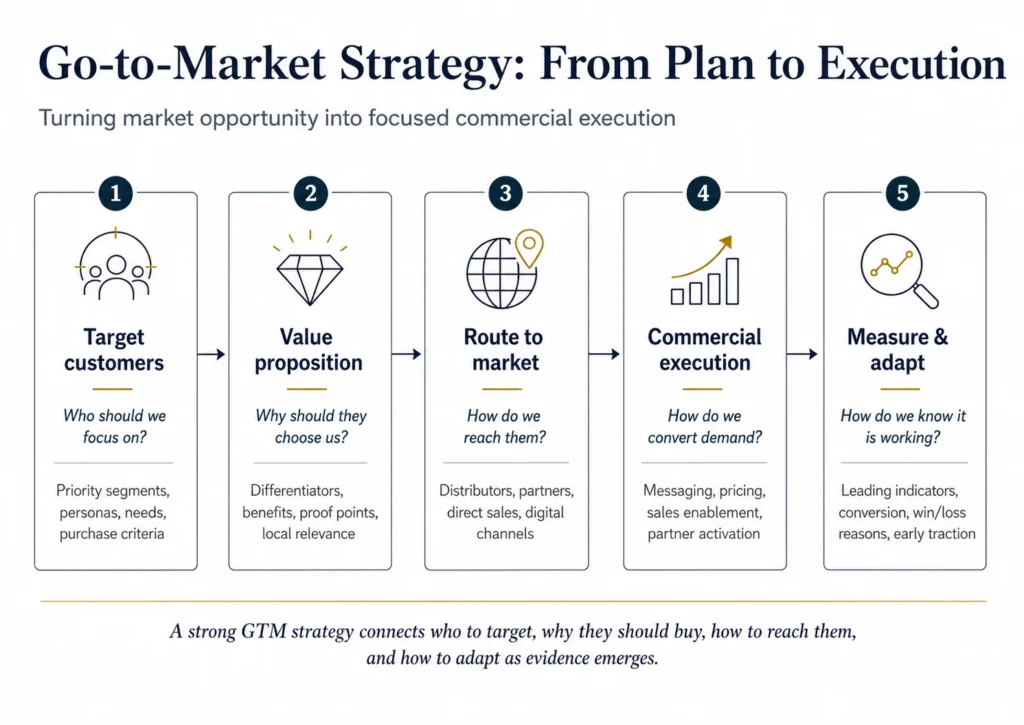
Figure 1. Midas Go-to-Market Strategy Process: A strong GTM strategy connects who to target, why they should buy, how to reach them, and how to adapt as evidence emerges.
For C-level executives, the questions are “Who should we target first, why will they choose us, which channels can actually deliver, how should we align the organization, and how will we measure whether the strategy is working?” Those questions transform go-to-market into an execution discipline.
This is especially important in Latin America, where market fragmentation, channel complexity, distributor power, local competitors, and pricing pressure can quickly weaken a strategy that looked strong on paper. A structured GTM process helps companies move from a broad growth ambition to a practical commercial roadmap.
A strong GTM strategy should be built on a clear fact base. Depending on the challenge, this may require market analysis to understand demand, customer segments, barriers, and channel structure; competitor analysis to understand incumbent positioning, pricing, and likely moves; and value proposition design to clarify why customers should choose the offer instead of alternatives.
For companies that are also evaluating where to expand, GTM strategy often connects directly with market entry consulting. Once the target market is selected, the next challenge is execution: defining the right customers, value proposition, channels, partners, sales model, and launch priorities.
Why Have a Process for Go-to-Market?
Too often, GTM strategies are improvised or adapted from playbooks designed for very different markets. In Latin America, that can create avoidable execution risk. A disciplined GTM process helps leadership teams make explicit choices about customers, channels, value proposition, pricing, partners, and sales execution.
From our 25+ years working across Latin America, three benefits stand out:
- Clarity on the right customer. A structured GTM process helps identify which segments are most attractive, reachable, profitable, and ready to buy. This reduces wasted commercial effort and helps sales teams focus on the opportunities with the highest potential.
- Alignment across channels. Many companies underestimate the complexity of Latin America’s distribution networks. Mapping channel power, capabilities, costs, margins, and incentives helps prevent surprises and ensures the route to market is commercially sustainable.
- A differentiated value proposition. Without a clear articulation of what makes the offer relevant and different, sales teams often default to discounts. A robust GTM process clarifies why customers should choose the company, which differentiators matter most, and how to communicate them without eroding margins.
This is why GTM should be treated as a cross-functional execution process, not only as a sales or marketing plan. It connects strategy, customer insight, channel economics, positioning, sales enablement, and performance tracking.
When the GTM challenge is mainly about customer targeting and demand potential, market analysis can strengthen the fact base. When the challenge is how to stand apart from local or regional rivals, competitor analysis and benchmarking can help identify gaps, risks, and opportunities. When the issue is conversion, messaging, or sales effectiveness, win-loss analysis can reveal why buyers choose, reject, or stall.
This focus on customer targeting and execution is consistent with Harvard Business School Online’s go-to-market strategy framework, which emphasizes identifying the target customer, defining the value proposition, and choosing the right channels to reach and support the market.
As one of our clients put it:
“Midas helped us improve our go-to-market approach in an extremely effective way. We grew our sales 30%. Kudos!”
Business Unit Director, Consumer Goods Company, Latin America GTM project, 2025
The Challenges of Go-to-Market in Latin America
Latin America offers substantial growth potential, but companies should not treat the region as a single homogeneous market. GTM execution can vary significantly by country, city, channel, customer segment, and category. The same value proposition, pricing model, or distributor strategy that works in one market may underperform in another.
The three challenges we see most often are:
- Fragmented markets. What works in Mexico City may not resonate in Monterrey. A product loved in São Paulo might struggle in Recife. Regional differences in customer needs, income levels, infrastructure, regulation, and channel structure are a major reason launches underperform.
- Channel complexity. Power often lies with distributors, retailers, integrators, or local intermediaries, not only with manufacturers. Negotiating favorable terms requires understanding who controls access, who influences the customer, how margins are distributed, and where the real bottlenecks are.
- Aggressive competition. Local and regional players may move faster, discount deeper, bundle services differently, or adapt more quickly to market shifts. Without a clear value proposition, entrants can end up competing mainly on price.
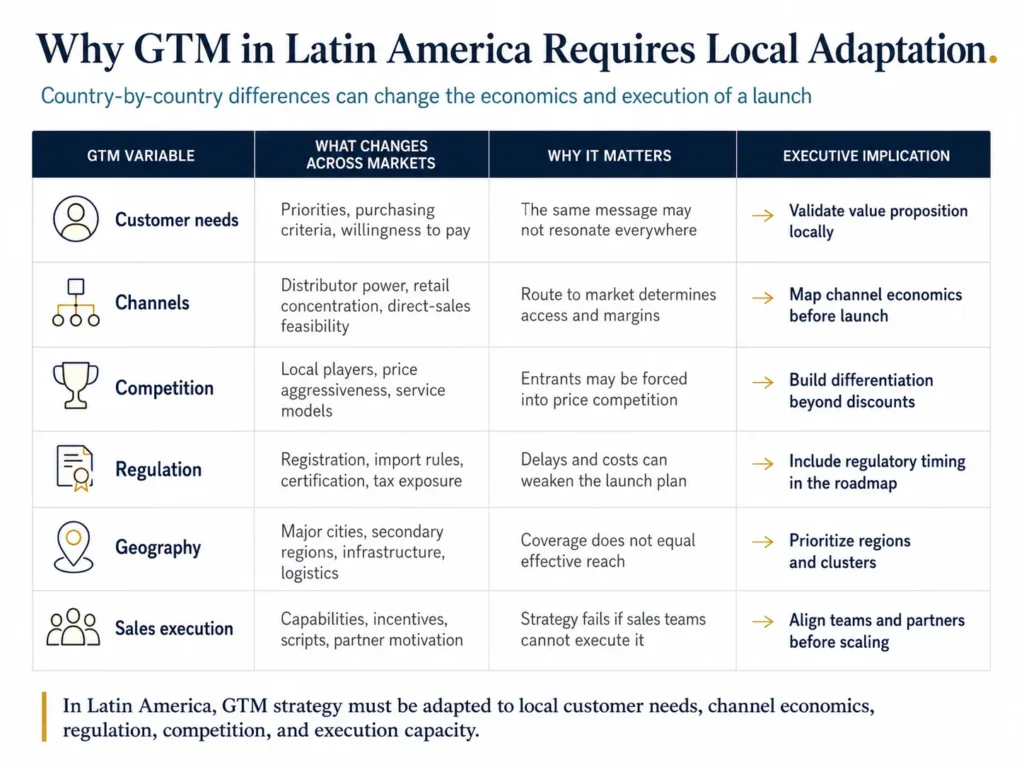
Figure 2. Why GTM in Latin America Requires Local Adaptation: GTM strategy must be adapted to local customer needs, channel economics, regulation, competition, and execution capacity.
For executive teams, the implication is clear: a GTM strategy for Latin America must be built country by country and channel by channel. It should be based on customer insight, competitor behavior, channel economics, and local execution realities, not only on market size estimates.
If the main uncertainty is which country, segment, or opportunity to prioritize, the work may need to start with market entry consulting. If the main bottleneck is access to customers through the right local partners, it may require distributor search consulting. If the main risk is competitor retaliation, pricing pressure, or channel conflict, wargame consulting can help pressure-test the GTM plan before execution.
A CEO from a technology company we worked with in 2024 summed it up:
“We doubled our sales after defining our value proposition because customers now understand our differentiators.”
A Step-by-Step Guide to a Strong GTM Strategy
Based on Midas Consulting’s experience designing GTM strategies across Latin America, companies can approach GTM systematically through five practical steps:
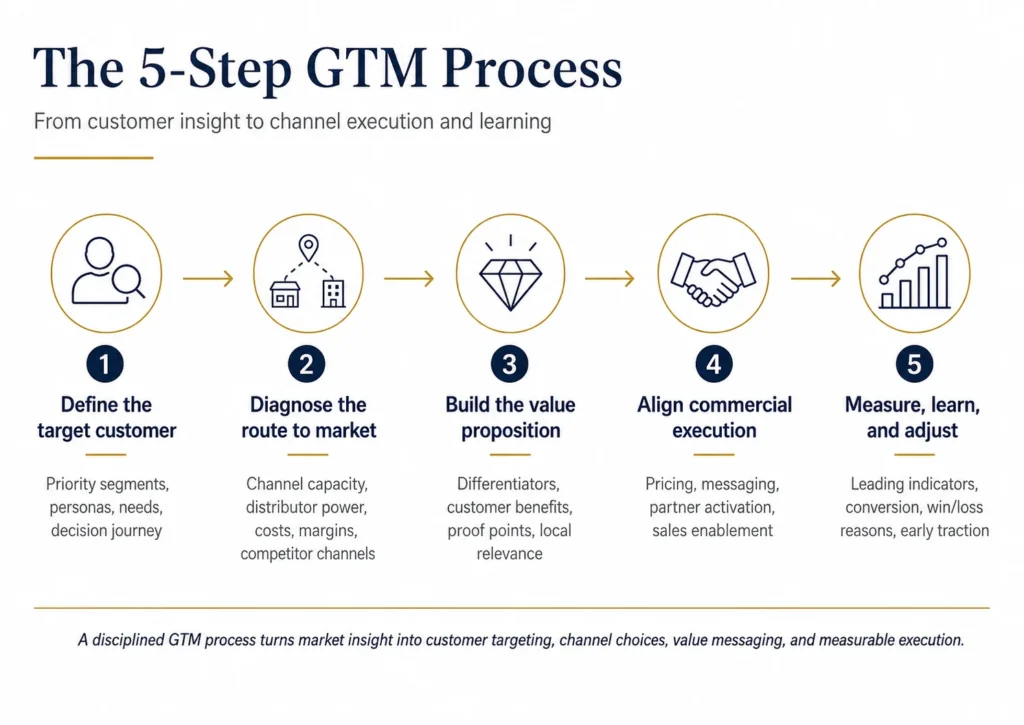
Figure 3. The Midas 5-Step GTM Process: A disciplined GTM process turns market insight into customer targeting, channel choices, value messaging, and measurable execution.
1. Define the target customer and priority segment
- Identify the customer segments with the strongest combination of need, accessibility, profitability, and strategic fit.
- Build customer profiles based on evidence from the sales team, market research, interviews, and local experts.
- Map the customer journey to understand who influences the decision, who approves the purchase, and what barriers slow adoption.
- This step is often strengthened by market analysis, especially when leadership teams need to validate customer needs, demand concentration, purchase criteria, adoption barriers, and segment attractiveness before committing commercial resources.
2. Diagnose the route to market
- Assess the capabilities, incentives, costs, and power of distributors, retailers, integrators, sales agents, digital channels, or direct sales teams.
- Understand where value is created and captured across the channel.
- Benchmark competitors’ channel strategies to identify gaps, risks, and opportunities.
- When route-to-market success depends on local partners, distributor search consulting can help identify, evaluate, and approach distributors or channel partners with the right access, capabilities, incentives, and execution discipline. Benchmarking can also help compare channel practices, service levels, margins, coverage models, and competitor approaches.
3. Build a differentiated value proposition
- Compare customer needs against your offer, competitors’ offers, and the alternatives customers already use.
- Separate features that are truly valuable from features that do not influence purchase decisions.
- Translate differentiators into clear commercial messages that sales teams can use consistently.
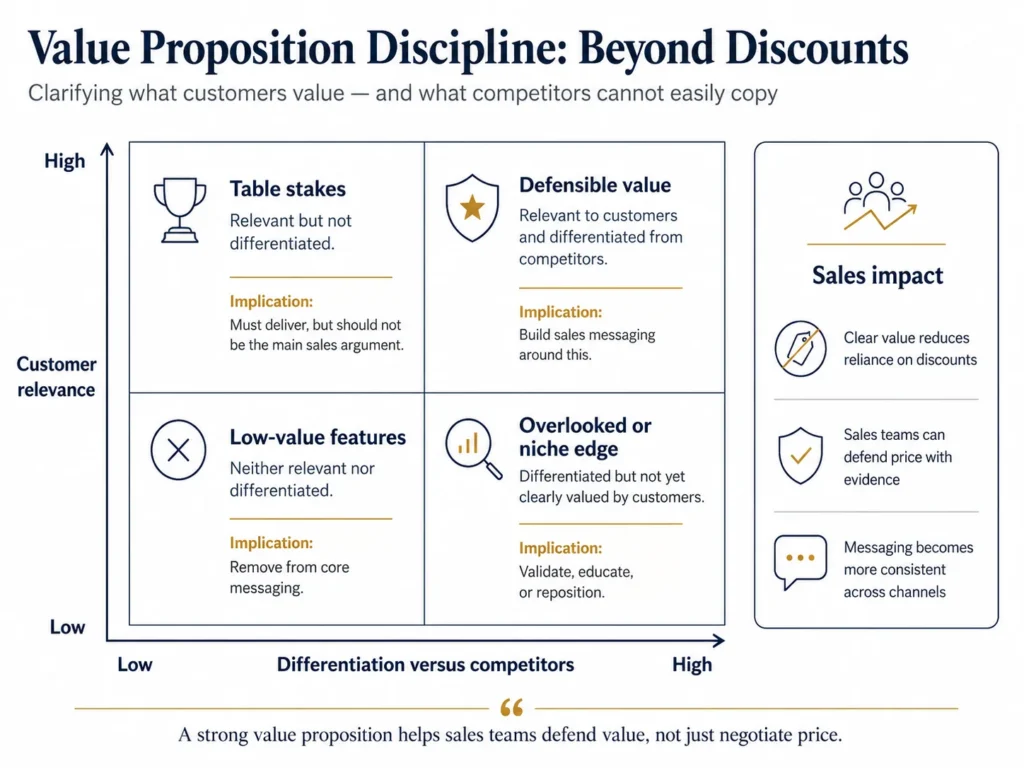
Figure 4. Midas Value Proposition Discipline: A strong value proposition helps sales teams defend value, not just negotiate price.
If you want to explore this topic further, Midas’ article on value proposition design explains how to clarify why customers should choose an offer, while win-loss analysis can reveal whether buyers actually understand, believe, and value the proposition in real sales situations.
4. Align pricing, messaging, and sales execution
- Define how the value proposition should be reflected in pricing, discount policy, sales arguments, commercial materials, and partner incentives.
- Adapt product, service, or support elements where local conditions require it.
- Co-create the plan with local teams to increase adoption and reduce execution resistance.
- If pricing, messaging, or channel incentives could trigger competitor reactions, a business wargame can help leadership teams anticipate possible countermoves and prepare responses before the GTM plan is implemented.
5. Measure, learn, and adjust
- Define leading indicators such as qualified leads, conversion rates, distributor activation, customer objections, win/loss reasons, and early revenue traction.
- Review what is working and what needs adjustment after the first commercial cycles.
- Refine the GTM strategy based on evidence from the market, not internal assumptions.
This final step matters because GTM execution is not a one-time launch plan. It is an iterative process of action, learning, and adjustment. MIT Sloan Management Review’s work on closing the gap between strategy and execution reinforces the importance of connecting strategic choices with action and revision.
In practice, this feedback loop can be supported by win-loss analysis to understand why buyers choose, reject, or delay decisions, and by competitor analysis to monitor how rivals adapt after the GTM plan is launched.
As one client shared after a product launch supported by this process:
“Thanks to the workshop, we identified and added key attributes to the product, which significantly boosted sales.”
Business Unit Director, B2B Company, Product Launch Project, 2024
Strengths and Limitations of This Go-to-Market Approach
No GTM process is perfect. Understanding the strengths and limitations helps executives use it in the right way and avoid treating the output as a static plan.
Strengths
- Customer-centric. The process is grounded in real customer needs, purchase criteria, objections, and decision journeys rather than internal assumptions.
- Commercially practical. It translates strategy into channel choices, messaging, pricing implications, partner requirements, and sales actions.
- Evidence-based. It combines internal knowledge with external market validation, competitor insight, channel assessment, and local context.
- Proven in Latin America. Midas has tested and refined this approach across more than 200 projects in the region.
Limitations
- It requires upfront effort. Proper GTM design requires research, interviews, analysis, and internal alignment before launch. Skipping this work can lead to faster action, but also higher risk.
- It requires change management. Teams may resist new positioning, channel changes, revised sales messages, or a more disciplined approach to discounts.
- It must evolve with the market. Latin America changes quickly. Competitor moves, channel behavior, customer expectations, regulation, and macroeconomic conditions can shift, so GTM strategies should be revisited regularly.
A Practical Go-to-Market Case
One of our clients, a multinational in the industrial equipment sector, faced stagnating sales despite strong technical capabilities. Competitors were gaining ground with more flexible service models, and the company needed to understand whether the problem was product, channel, pricing, messaging, or execution.
Through our GTM process, we discovered that customers valued not only the equipment itself, but also the availability of tailored solutions, responsive service, and local support. The issue was not simply product performance; it was how the value proposition was understood and delivered through the commercial model.
Midas helped the client reposition around these differentiators and align the distributor strategy with the new value proposition. The company moved from selling mainly technical attributes to selling a broader solution that better reflected what customers were willing to pay for.
The result was a stronger win rate in complex B2B deals. Within three years, the company became the second-largest player in its market.
Cases like this often require a combination of market analysis, competitor analysis, and value proposition design. The goal is to understand what customers value, how competitors are winning, and which differentiators can be translated into credible sales messages and channel execution.
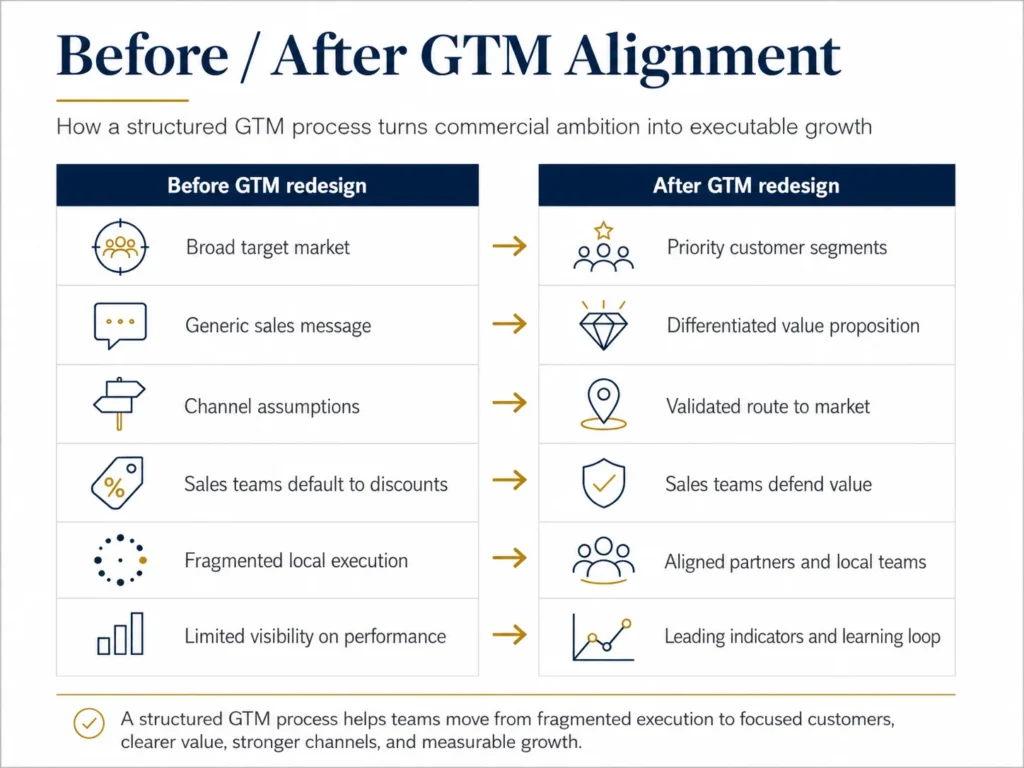
Figure 5. Before and After Midas’ GTM Alignment: A structured GTM process helps teams move from fragmented execution to focused customers, clearer value, stronger channels, and measurable growth.
Conclusion: Why the Go-to-Market Process Matters
In Latin America, growth does not come from visibility alone. It comes from being relevant to the right customers, reaching them through the right channels, and giving sales teams a value proposition they can defend without defaulting to discounts.
A strong GTM strategy helps leadership teams answer the questions that matter most: who to target, how to win, which channels to activate, how to differentiate, and how to measure whether execution is working.
For C-level executives, the value of a GTM process is not only a better launch plan. It is better commercial discipline: clearer priorities, stronger alignment, more consistent messaging, and a better chance of converting market opportunity into profitable growth.
Or, as one of our clients in FMCG put it:
“Now that we sell based on value, we offer far fewer discounts.”
Salesperson, FMCG Company, GTM Project, 2025
About the Author:
By Adrian Alvarez, PhD. Adrian Alvarez is Managing Partner at Midas Consulting, a Wharton Alumnus, MBA Professor at Universidad Argentina de la Empresa (UADE), and Competitive Intelligence Fellow. He specializes in competitive strategy, growth strategy, go-to-market strategy, market entry, and strategic decision-making under uncertainty across Latin America.
He has developed go-to-market strategies supporting product launches, commercial acceleration, value proposition design, channel strategy, distributor alignment, and regional expansion initiatives. You can also explore more of his thinking in Midas Consulting’s strategic intelligence insights.
Selected External References
This guide is informed by Midas Consulting’s go-to-market work across Latin America and by respected sources on customer targeting, execution discipline, segmentation, and strategic decision-making.
- Harvard Business School Online: How to Develop a Go-to-Market Strategy for Your Tech Venture
- MIT Sloan Management Review: Closing the Gap Between Strategy and Execution
- Wharton Executive Education: Customer Analytics & Market Segmentation
Midas Thought Leadership on Value Proposition and GTM Strategy
Midas Consulting’s go-to-market approach is supported by applied research and executive publications on value proposition design, strategic intelligence, and commercial execution. Our Applied Strategic Intelligence Hub provides additional perspective on how companies can clarify customer value, differentiate beyond price, and translate positioning into practical GTM execution.
Related Midas Resources for Go-to-Market Decisions
Go-to-market strategy often sits at the intersection of market entry, customer targeting, channel design, value proposition, competitor response, sales execution, and strategic alignment. These Midas resources can help executives connect GTM design with the next strategic decision:
- Go-to-Market Consulting: When your company needs to define priority customers, value proposition, pricing logic, channels, partners, sales priorities, and execution metrics.
- Market Entry Consulting: When GTM strategy depends on deciding which country, segment, or opportunity to prioritize before designing the commercial model.
- Distributor Search Consulting: When the route to market depends on identifying, evaluating, and selecting local distributors or partners who can actually support growth.
- Benchmarking Consulting: When leadership teams need to compare channel models, sales practices, pricing approaches, service levels, or commercial execution against competitors or reference companies.
- Wargame Consulting: When a GTM move could trigger competitor reactions, pricing pressure, channel conflict, imitation, or escalation.
- Strategy Workshops: When GTM findings need to be converted into leadership alignment, commercial priorities, owners, and implementation roadmaps.
- Strategy Consulting: When go-to-market decisions raise broader questions about growth priorities, resource allocation, positioning, capability building, and execution.
- Applied Strategic Intelligence: When executives need a stronger fact base to interpret market signals, competitor behavior, customer needs, channel dynamics, and local context.
For executives who want to explore the analytical foundations behind go-to-market strategy, these Midas articles provide additional context:
- Market Analysis: When GTM decisions depend on understanding demand, customer segments, market structure, barriers, channels, and opportunity attractiveness.
- Competitor Analysis: When companies need to understand incumbent positioning, pricing, capabilities, channels, likely reactions, and competitive vulnerabilities.
- Value Proposition Design: When the GTM challenge is clarifying why customers should choose the offer and how to defend value without relying only on discounts.
- Win-Loss Analysis: When buyer feedback is needed to understand why customers choose, reject, switch from, or stay with specific offers.
- Benchmarking: When leadership teams need to compare channel practices, sales models, service levels, pricing approaches, or commercial execution against competitors or reference companies.
Together, these resources show how GTM strategy connects with the broader growth process: understand the market, choose the right customers, define the value proposition, build the route to market, align the organization, and adapt based on evidence.
If your company is planning to launch, expand, or reposition in Latin America, the question is not whether you need a GTM strategy. The question is whether your current GTM approach is specific enough for the market, clear enough for your sales teams, and disciplined enough to drive profitable growth.
At Midas Consulting, we have spent more than 25 years helping companies answer that question through customer insight, channel analysis, value proposition design, competitive intelligence, and practical execution planning.
Are you ready to strengthen your go-to-market approach in Latin America?
Knowing the benefits and process of an effective go-to-market strategy is one thing. Designing and executing it successfully in Latin America is another.
We help you design and execute the right go-to-market strategy
We support leadership teams before, during, and after the GTM design process: defining priority customers, validating the value proposition, mapping the channel, aligning distributors or partners, and translating the strategy into practical commercial actions.
After conducting hundreds of go-to-market and growth strategy projects, we have refined an approach that helps companies move from broad commercial ambition to focused execution.
Some of our Clients:






Benefits You Can Expect:
Define Your Best Customers
Strengthen Sales Channels
Elevate Messaging & Positioning
Identify the customer segments with the strongest potential so commercial resources are focused where they can create the greatest impact.
Choose, assess, and fine-tune the most effective routes to market to improve coverage, profitability, and speed of expansion.
Build persuasive, differentiated messages that connect with customer needs and help sales teams defend value instead of relying on discounts.
Ready to Move Forward With Our Go-to-Market Consulting?
Schedule a focused conversation
We discuss your launch, expansion, or repositioning goals, the markets you are targeting, and the commercial questions you need to answer.
Receive a practical GTM strategy
We design a tailored approach that may include customer segmentation, value proposition testing, channel assessment, distributor alignment, competitor analysis, pricing implications, or sales enablement.
We translate the evidence into clear recommendations, priority actions, and a roadmap your team can implement.
Execute, measure, and refine
We help you define the right metrics, monitor early market signals, and adjust the GTM approach as evidence emerges.
Let’s work together to turn your go-to-market strategy into profitable growth.