Scenario Consulting to Make Stronger Decisions Under Uncertainty.
When the future is uncertain, relying on a single forecast can expose your company to unnecessary risk.
Customer behavior may change. A new technology may alter the economics of your industry. Regulation may reshape market access. A competitor may introduce a disruptive business model. Political, economic, or supply-chain developments may invalidate assumptions that once appeared reasonable.
You may not be able to predict exactly which future will emerge. But you can prepare your leadership team to make stronger decisions across several plausible futures.
At Midas Consulting, we help you identify the uncertainties that matter most, develop credible scenarios, test your strategic choices, and define the early-warning signals that tell you when it is time to act.
Our scenario consulting is designed for practical executive decisions—not theoretical discussions about the future.
You gain:
- A clearer view of the assumptions behind your current strategy
- A limited set of plausible and strategically relevant scenarios
- A better understanding of how each scenario could affect your business
- Strategic moves that remain attractive across different futures
- Contingency actions for conditions that require a different response
- Early-warning indicators, decision triggers, owners, and management actions
The result is a strategy that is more robust, more adaptable, and easier for your leadership team to execute with confidence.

Scenario Consulting Grounded in Strategy, Evidence, and Executive Experience
Midas Consulting combines applied strategic research, executive facilitation, competitive intelligence, and more than two decades of advisory experience to help leadership teams make decisions under uncertainty.
Our work is led by senior consultants and supported by:
- Experience advising multinational, regional, and specialized companies
- Projects across Latin America, Europe, and global markets
- Applied expertise in scenario planning, competitive intelligence, business wargaming, market entry, and strategy
- Published work on early-warning systems, competitive intelligence, strategic analysis, and decision-making
- A methodology designed to connect external evidence with practical management choices
Your engagement is not delegated to an inexperienced team using a generic workshop template. We adapt the process to your strategic decision, industry, planning horizon, and management context.
Our Scenario Consulting Approach
Your leadership team remains at the center of the process because the people who will implement the strategy must understand, challenge, and ultimately own it.
We combine independent research and structured analysis with collaborative executive workshops. This allows us to bring an objective external perspective without imposing a generic answer on your organization.
Depending on your needs, the engagement may include:
- Interviews with executives and subject-matter specialists
- Analysis of market, customer, competitor, regulatory, technological, and macroeconomic developments
- Identification of predetermined trends and critical uncertainties
- Assessment of the assumptions behind your current strategy
- Development of credible and internally consistent scenarios
- Quantification of selected business implications
- Evaluation of strategic options across the scenarios
- Definition of robust actions, contingent moves, and staged commitments
- Design of early-warning indicators and decision triggers
- Executive workshops to align your leadership team
- A practical roadmap for implementation and monitoring
This collaborative process helps your team develop a shared view of uncertainty, challenge established assumptions, and agree on what it should do now, what it should monitor, and what it should be prepared to change.
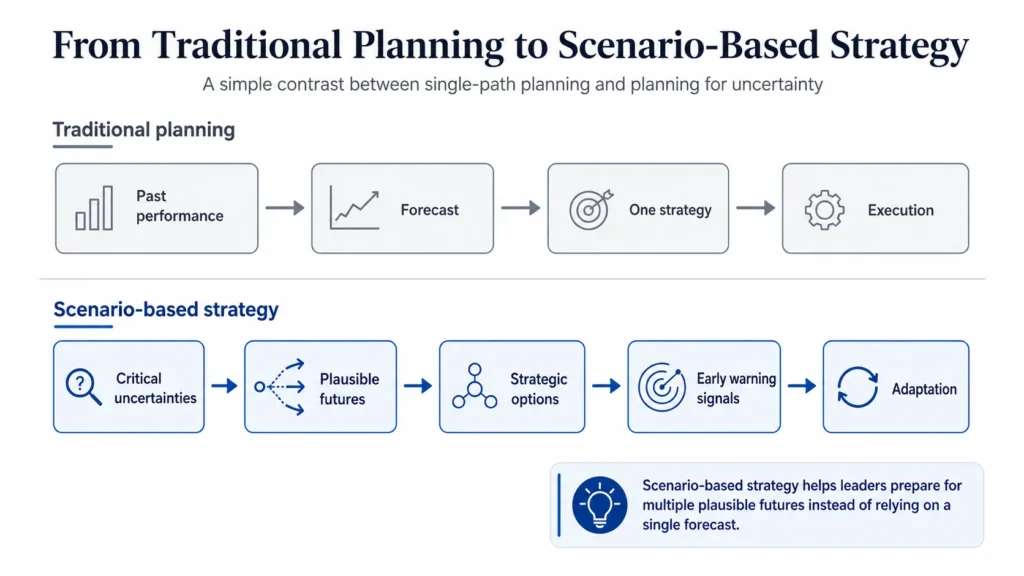
Figure 1. Forecasting helps you plan for the future you expect. Scenario planning helps you prepare for futures that could change the assumptions behind your strategy. You still need budgets and forecasts, but scenarios allow your leadership team to consider structural changes in customers, competitors, regulation, technology, channels, and industry economics.

What Scenario Planning Can Change for Your Leadership Team
Expose the assumptions behind your strategy
Every strategic plan depends on assumptions about customers, competitors, channels, regulation, technology, financing, talent, and execution capacity.
We help your team make those assumptions explicit and determine which ones are reasonably predictable, which remain uncertain, and which could cause the greatest damage if they prove wrong.
Move beyond one expected future
Traditional plans often assume that the future will remain sufficiently similar to the past. Scenario planning allows you to explore several credible environments in which the rules of competition may change.
This gives your team a broader and more realistic basis for making long-term decisions.
The same disruption can trigger very different strategic responses. In the Midas Import Competition Monitor 2026, we analyzed 151 business decisions made in response to Argentina’s new import competition environment. Forbes Argentina used our research to examine how different companies are responding to this competitive shift. This diversity of responses shows why preparing for a single future may not be enough.
Identify actions that work across several futures
Some strategic moves are attractive only under one scenario. Others strengthen your position across several possible environments.
We help you distinguish among:
- Actions you should take now
- Capabilities you should build
- Options you should preserve
- Experiments you should run
- Commitments you should stage or delay
- Contingencies you should prepare
Improve leadership alignment
Scenario planning gives your executives a structured way to discuss uncertainty without turning the conversation into competing opinions.
Your team develops a shared language, evaluates the same evidence, and understands why certain actions should be taken now while others depend on future developments.
Detect change earlier
A scenario is useful only if your company can recognize when the environment is moving toward it.
We help you translate scenarios into observable indicators, thresholds, responsibilities, and management responses so that your organization can act before a change becomes obvious to the entire market.
Make your strategy more adaptable
The objective is not to create a plan that never changes. It is to create a strategy with enough clarity to guide current action and enough flexibility to adapt as uncertainty resolves.
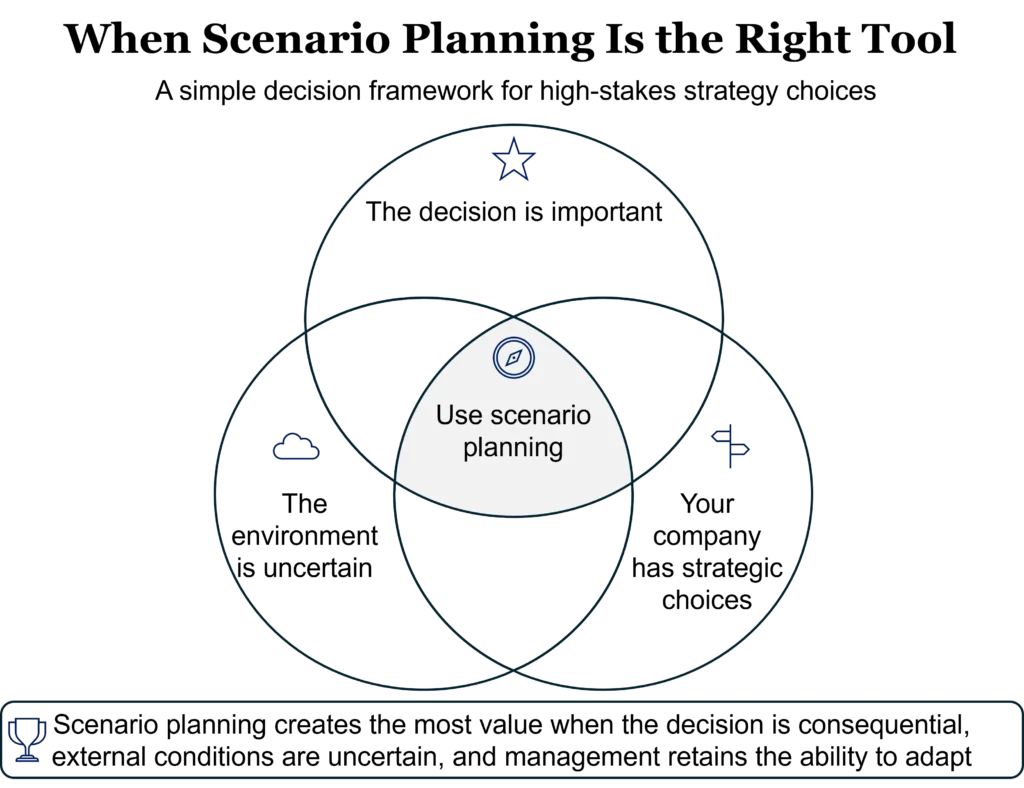
Figure 2. Scenario planning creates the most value when the decision is important, uncertainty could materially change the outcome, and your company still has meaningful choices. If the environment is stable and the decision is short term, conventional forecasting may be enough.
When Should You Consider Scenario Consulting?
Scenario consulting may be valuable when:
- You are making a significant investment with a multi-year horizon
- Your current strategy depends heavily on assumptions your team cannot validate
- Technology could alter your industry structure or basis of competition
- Regulation may change market access, costs, or competitive behavior
- Customer priorities or price sensitivity could move in different directions
- A new competitor, substitute, or business model could disrupt your position
- You are considering entering a market, launching a major product, acquiring a company, or changing your operating model
- Your leadership team has conflicting views about how the market may evolve
- Your company relies on one forecast despite significant external uncertainty
- You need to decide which investments to make now and which options to preserve
- Your planning process identifies risks but does not define clear actions
- Your organization detects market changes too late to respond effectively
Scenario planning is not necessary for every decision. We will tell you when a conventional forecast, focused market analysis, competitive assessment, or strategy workshop would be a more appropriate and efficient tool.
What Scenario Planning Is, and What It Is Not
A scenario is a coherent description of a plausible future business environment.
It is not:
- A prediction of exactly what will happen
- A financial forecast with optimistic, expected, and pessimistic cases
- A vision of the future your company wants to create
- A list of unrelated risks
- A creative story disconnected from evidence
- A substitute for strategic judgment
A useful scenario explores how several important forces could interact and create a meaningfully different environment for your company.
For example, changing a revenue forecast from plus 10% to minus 10% does not necessarily create two different scenarios. Both forecasts may still assume the same competitors, customer needs, channel structure, regulations, and sources of differentiation.
A true scenario asks whether those underlying conditions could change—and what that would mean for your strategy.
At Midas Consulting, we develop scenarios that are:
- Plausible enough to deserve management attention
- Relevant to the decision you need to make
- Internally consistent
- Supported by available evidence
- Different enough to reveal meaningful strategic implications
- Limited in number so that your leadership team can use them effectively
Our Scenario Consulting Process
We tailor every engagement to your decision, industry, and planning horizon. A typical project follows nine connected steps.
1. Clarify the strategic decision
We begin by defining the question your leadership team needs to answer.
This may involve a market investment, product launch, acquisition, technology choice, operating-model change, capacity decision, regulatory challenge, or long-term growth strategy.
A clear decision question prevents the exercise from becoming an unfocused discussion about the future.
2. Define the scope and time horizon
Together, we agree on:
- The business or strategic unit in scope
- The relevant countries and markets
- The planning horizon
- The stakeholders who should participate
- The external factors that require analysis
- The decisions the scenarios should inform
3. Identify the assumptions behind your current strategy
We examine what must remain true for your current plan to succeed.
This helps your leadership team distinguish among facts, expectations, assumptions, and unresolved uncertainties.
4. Analyze external forces
We research the developments that could materially affect your decision, including:
- Customer behavior
- Competitor strategies
- Channel evolution
- Technology
- Regulation
- Macroeconomic conditions
- Supply chains
- Financing
- Substitution
- Industry consolidation
- Social and political developments
Our analysis can combine internal company knowledge, secondary research, expert interviews, stakeholder interviews, competitive intelligence, and selected quantitative models.
5. Separate predetermined trends from critical uncertainties
Some developments are already in motion and relatively difficult to reverse. Others could evolve in substantially different directions.
We prioritize uncertainties according to two questions:
- How uncertain is the outcome?
- How strongly could it affect the strategic decision?
The uncertainties that are both difficult to predict and strategically important become the building blocks of the scenarios.
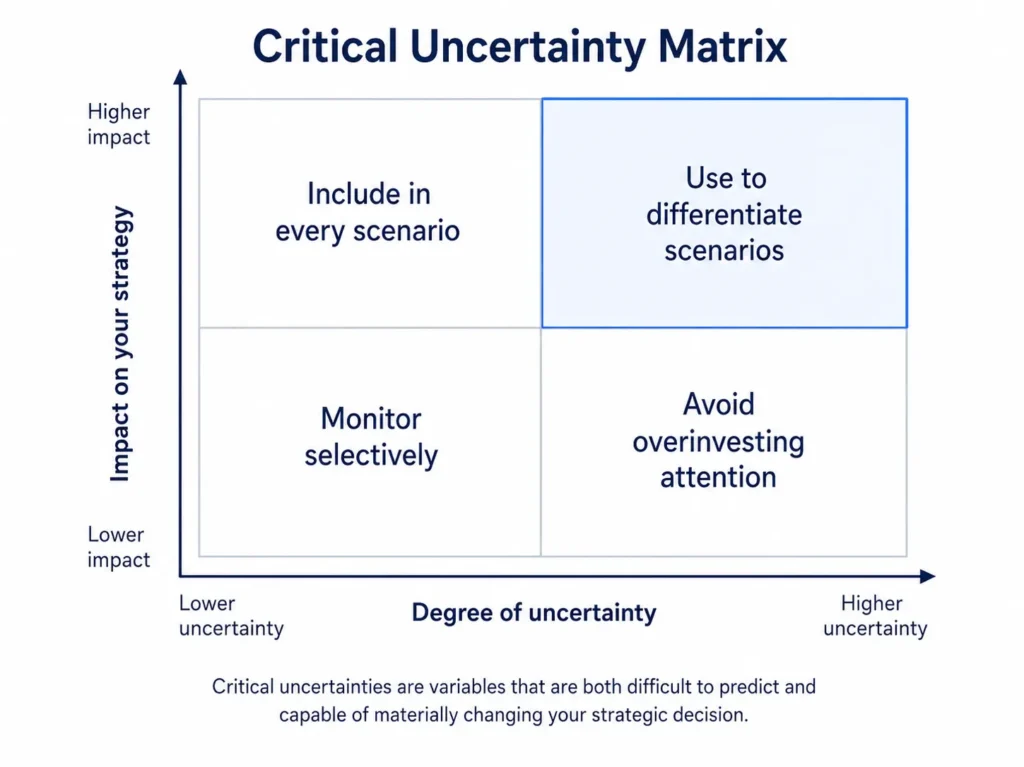
Figure 3. The most useful scenario drivers are both difficult to predict and capable of materially changing your strategic decision. More predictable, high-impact trends should still be incorporated into the scenarios, while low-impact variables generally require less management attention.
6. Build a manageable set of credible scenarios
Most projects use two to four scenarios.
Each scenario describes a distinct environment and may include:
- Customer behavior
- Competitor behavior
- Channel structure
- Technology adoption
- Regulation
- Industry economics
- Sources of competitive advantage
- Required capabilities
- A causal narrative or timeline
- Strategic implications
We test each scenario for plausibility, relevance, and internal consistency.
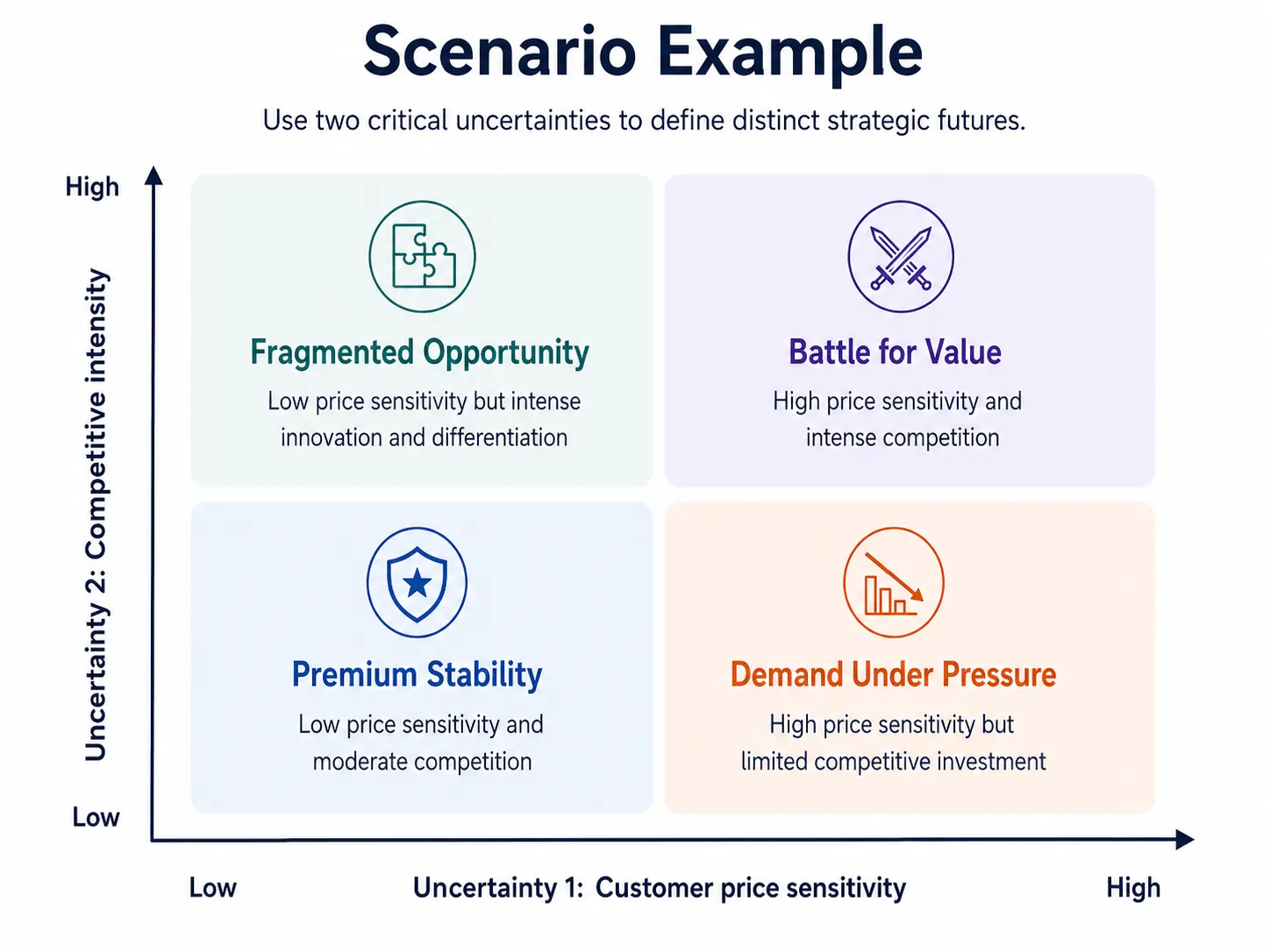
Figure 4. Combining two critical uncertainties can create four meaningfully different business environments. The purpose is not to choose the scenario you prefer. It is to understand how your strategy performs and what your company should do under each set of conditions.
7. Assess the impact on your business
For every scenario, we evaluate what changes for your company.
Depending on the decision, this may include:
- Revenue and margin implications
- Market attractiveness
- Competitive position
- Customer value propositions
- Route-to-market requirements
- Investment exposure
- Capability gaps
- Operational risks
- Cash-flow requirements
- Strategic partnerships
- M&A implications
8. Test your strategic options
We assess how your current strategy and alternative choices perform across the scenarios.
Your leadership team can then distinguish among:
- Robust or no-regret moves
- Scenario-specific actions
- Staged commitments
- Experiments and pilots
- Options to preserve
- Investments to accelerate
- Commitments to delay
- Risks that require mitigation
9. Define early-warning indicators and decision triggers
Finally, we work backward from each scenario to identify what would need to happen before it became reality.
For every important indicator, we can define:
- What should be monitored
- Why it matters
- The information source
- The monitoring frequency
- The responsible owner
- The threshold that requires attention
- The decision that should be reviewed
- The management response that should be considered
This turns scenario planning from a one-time workshop into an ongoing management capability.
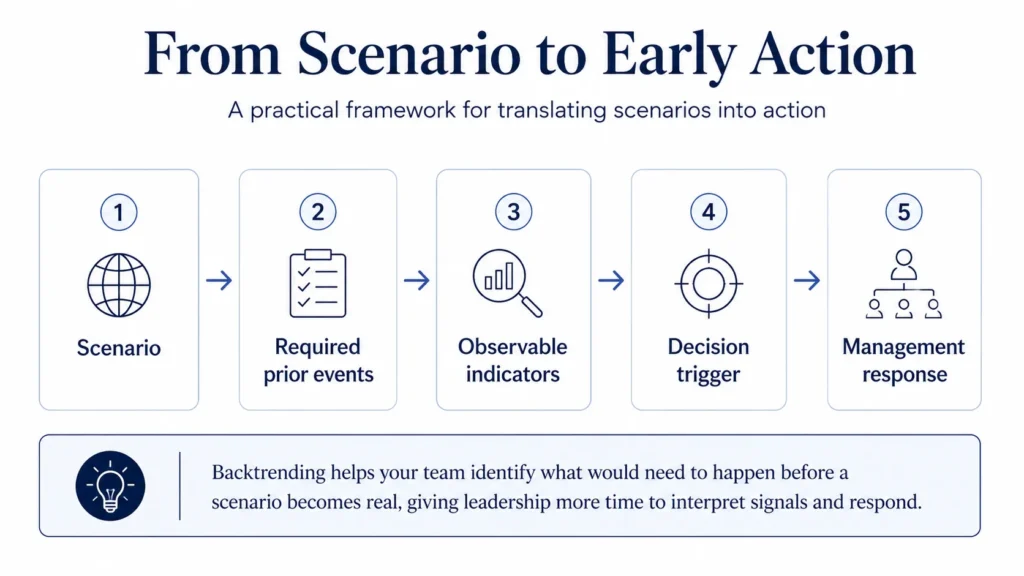
Figure 5. Backtrending helps your team identify what would need to happen before a scenario becomes real. Linking observable signals to predefined triggers, owners, and responses gives leadership more time to interpret change and act.

What You Receive from a Scenario Consulting Engagement
The exact deliverables depend on your decision and scope. A typical engagement may include:
- Executive kickoff and decision-framing workshop
- Stakeholder interviews
- Strategic-assumption map
- External trends and forces analysis
- Predetermined-trends assessment
- Critical-uncertainty matrix
- Two to four detailed scenario narratives
- Evidence and rationale supporting each scenario
- Scenario timelines or causal pathways
- Business-impact assessment
- Financial or operational sensitivity analysis where relevant
- Strategic-options matrix
- Identification of robust and no-regret moves
- Contingent actions for specific scenarios
- Capability and investment priorities
- Risks, vulnerabilities, and mitigation measures
- Early-warning indicator dashboard
- Decision triggers and governance responsibilities
- Executive alignment workshop
- Final strategic recommendations
- Implementation and monitoring roadmap
You receive more than a scenario presentation. You receive a structured basis for deciding what your company should do now, what it should prepare, and what it should monitor before committing further resources.
How Our Consulting Makes the Scenarios Credible
A scenario should challenge your thinking without becoming speculation.
To improve credibility, we test each scenario against five standards.
Plausibility
Could the scenario reasonably occur, even if it is not the most likely future?
Relevance
Would it materially affect your strategy, investment choices, business model, or capabilities?
Internal consistency
Do the assumptions and developments within the scenario make sense together?
Distinctiveness
Is the scenario meaningfully different from the others, or is it simply a different growth rate within the same environment?
Decision value
Does it reveal a risk, opportunity, trade-off, or strategic option that changes what management should consider doing?
We also make the distinction between evidence and judgment clear. Where public information is incomplete, we identify the assumptions being made and recommend the signals your team should monitor to validate or challenge them.
Scenario Consulting Across Industries
The uncertainties that matter most depend on your industry.
A pharmaceutical company may need to explore regulatory change, market access, reimbursement, technological innovation, and competitor pipelines.
An industrial company may be more concerned with input costs, supply-chain disruption, capacity investment, substitution, channel evolution, and customer concentration.
A consumer-goods company may need to consider changes in purchasing power, price sensitivity, retailer behavior, channel fragmentation, and competitor investment.
Midas Consulting adapts the scenario-planning process to the strategic, commercial, regulatory, and operational realities of your sector.
Our experience includes projects involving:
We do not treat every scenario assignment as the same exercise. We adjust the research, uncertainties, participants, evidence sources, and strategic implications to the realities of your industry.
Selected Companies We Have Worked With Scenario Consulting
Midas Consulting and members of our senior team have advised multinational, regional, and specialized companies across consumer, industrial, healthcare, technology, energy, and B2B markets.







The companies shown represent selected organizations for which Midas Consulting or members of its senior team have provided consulting services. The nature and scope of each engagement vary, and the inclusion of a logo does not necessarily indicate a scenario-planning assignment.
From Scenarios to Strategic Intelligence
Scenario planning helps you define the futures your company should be prepared to face. Strategic intelligence helps you determine which of those futures may be emerging.
That connection is essential.
Without an ongoing monitoring process, scenarios can become static workshop documents. By linking them to strategic intelligence, your company can track relevant changes in customers, competitors, regulation, technology, channels, and market economics.
Midas Consulting helps leadership teams connect:
- Scenarios with observable market developments
- Weak signals with strategic implications
- Indicators with decision thresholds
- Thresholds with management responsibilities
- Intelligence with timely executive action
Explore our Strategic Intelligence Applied: Insights for Executives and Organizations hub to learn how Midas combines competitive intelligence, early-warning systems, strategic analysis, and executive decision-making.
Case Study: Helping an Energy Company Prepare for an Uncertain Technological Future
The situation
A renewable-energy company needed to define its development strategy while facing substantial uncertainty about the direction and timing of emerging technologies.
The leadership team understood that different technological pathways could alter market economics, investment priorities, partnership requirements, and the capabilities needed to compete.
A conventional forecast could estimate individual variables, but it could not adequately address the possibility that the industry structure itself might change.
The challenge
The company needed to answer three strategic questions:
- Which technological developments could most strongly affect its future position?
- Which investments would remain attractive across several plausible futures?
- Which market signals would indicate that one technological pathway was becoming more likely?
Our approach
Midas Consulting worked with the company’s leadership team and relevant industry specialists to:
- Clarify the strategic decisions the scenarios needed to support
- Analyze technological, market, competitive, and regulatory developments
- Distinguish predetermined trends from critical uncertainties
- Develop a limited set of credible technological scenarios
- Assess the implications of each scenario for the company’s strategy
- Identify strategic moves that remained attractive across several futures
- Define scenario-specific options and contingencies
- Design an early-warning system with observable indicators and decision triggers
The outcome
The engagement gave management:
- A shared view of the most important technological uncertainties
- A portfolio of strategies tested against different possible futures
- Greater clarity about which investments could be made immediately
- A clearer understanding of which options should remain flexible
- An early-warning framework for monitoring technological and competitive signals
- A stronger basis for adapting the strategy as new evidence emerged
The value did not come from predicting which technology would win. It came from helping the company make more resilient decisions before the uncertainty was resolved.
Client identity and commercially sensitive details have been withheld to protect confidentiality.
Why Leadership Teams Choose Midas for Scenario Consulting
Senior-level involvement
Your project is led by experienced consultants who understand the strategic and organizational complexity of C-level decisions.
A decision-first methodology
We do not begin by asking your team to imagine the future. We begin with the decision you need to make and build the scenarios around it.
Independent analysis and collaborative development
We bring an objective external perspective while involving your executives in the discussions that shape the final strategy.
Experience in volatile and complex markets
Our work across Latin America and other international markets gives us practical experience with regulatory change, macroeconomic volatility, fragmented information, changing channels, and unconventional competitive behavior.
Integration with strategic intelligence
We connect scenarios to indicators, sources, thresholds, and management actions so your team can continue using the work after the engagement ends.
Strategy rather than storytelling
The final output is not a collection of imaginative narratives. It is a set of practical strategic choices, contingencies, and monitoring priorities.
Cross-functional alignment
Scenario planning helps commercial, financial, operational, regulatory, technological, and corporate teams evaluate uncertainty through a common framework.
Confidentiality
We treat your strategic assumptions, vulnerabilities, investment choices, and competitive information as confidential. The scope, participants, interview process, documentation, and information-sharing protocols can be adapted to your internal requirements.
Scenario Consulting by Midas Consulting
Midas Consulting is a strategy and market-intelligence consulting firm that helps executives make high-stakes growth and competitive decisions.
Our scenario work draws on the firm’s experience in:
- Corporate and competitive strategy
- Strategic intelligence
- Early-warning systems
- Business wargaming
- Competitor-response analysis
- Market entry
- Go-to-market strategy
- M&A
- Distribution strategy
- Industry and market analysis
Our senior team combines consulting experience, executive facilitation, applied research, and academic work in strategy and competitive intelligence.
The engagement is adapted to your organization’s decision, rather than delivered through a standardized workshop package.
Frequently Asked Questions About Scenario Consulting
What is scenario consulting?
Scenario consulting is a structured process that helps your leadership team prepare for several plausible future business environments.
The work typically includes identifying critical uncertainties, constructing credible scenarios, evaluating their impact on your company, testing strategic options, and defining early-warning indicators and decision triggers.
Is scenario planning the same as forecasting?
No. Forecasting usually estimates how one or more variables may develop within an expected business environment. Scenario planning examines how the environment itself could change.
The two approaches are complementary. Forecasts can quantify the business implications of a scenario, while scenarios can reveal which forecasts your team should run.
How many scenarios should we develop?
Most companies need between two and four scenarios.
Too few scenarios may not challenge the current strategy sufficiently. Too many can overwhelm executives and make the implications difficult to use.
The right number depends on the decision, the degree of uncertainty, and how different the plausible futures are.
How far into the future should the scenarios look?
The horizon should match the decision.
A technology, infrastructure, or capability decision may require a five- to ten-year horizon. A market-entry, channel, or competitive decision may require a shorter period.
We define the horizon at the beginning of the engagement so the scenarios remain strategically relevant.
How long does a scenario consulting project take?
A focused engagement may take several weeks, while a broader multi-market or highly technical assignment may require several months.
The timeline depends on the scope, number of markets, research requirements, stakeholder interviews, quantitative analysis, and number of workshops.
We define the schedule, activities, responsibilities, and deliverables before the project begins.
Who should participate in a scenario consulting project?
The core team normally includes the executives responsible for the decision and representatives from the functions most affected by it.
Depending on the topic, this may include strategy, finance, commercial, marketing, operations, supply chain, regulatory, technology, legal, market access, or business-development leaders.
We keep participation focused enough to support productive discussion while ensuring that critical perspectives are represented.
In your scenario consulting engagements, do you conduct research, or is the process based only on workshops?
We combine workshops with research.
Depending on the engagement, the evidence base may include internal documents, executive interviews, secondary research, expert interviews, customer or channel perspectives, competitor intelligence, regulatory analysis, and quantitative modeling.
Workshops help interpret the evidence and translate it into strategic decisions. They do not replace the evidence.
Can you quantify the financial impact of each scenario?
Yes, when sufficient data is available.
We can work with your financial and operational teams to estimate implications for revenue, margins, cash flow, capacity, investment exposure, market share, working capital, or risk-adjusted returns.
The purpose is not to create false precision. It is to understand how the economics of your strategic choices may change under different conditions.
What do you mean by a robust strategy?
A robust strategy performs reasonably well across several plausible scenarios.
It may not deliver the highest theoretical return in every future, but it provides an attractive balance of growth potential, downside protection, adaptability, feasibility, and strategic control.
What happens after the scenarios are completed?
We help you convert them into an action and monitoring system.
This may include:
- Immediate strategic priorities
- Scenario-specific contingencies
- Staged investments
- Capabilities to build
- Options to preserve
- Early-warning indicators
- Decision thresholds
- Named owners
- Executive-review routines
Can scenario planning help with a specific investment or market-entry decision?
Yes. Scenario planning is particularly useful when the decision is material, the external environment could evolve in different directions, and your company still has the ability to adapt its commitment.
It can support decisions involving market entry, product launches, acquisitions, technology investments, capacity, regulation, channel strategy, partnerships, and long-term portfolio choices.
Can you combine scenario planning with a business wargame?
Yes. Scenario planning examines how the broader environment could evolve. A business wargame examines how competitors and other stakeholders might actively respond within that environment.
Combining the two can help your team test both structural uncertainty and competitive reaction.
How do you protect confidential information?
We define appropriate confidentiality arrangements before the engagement begins.
These may include nondisclosure agreements, restricted document access, anonymized interviews, controlled workshop participation, and clear rules concerning the handling of strategic and competitive information.
How do we know whether scenario planning is the right tool?
We begin by understanding the decision, planning horizon, degree of uncertainty, and strategic flexibility available to your company.
If your need can be addressed more effectively through forecasting, market analysis, competitor assessment, a strategy workshop, or another focused approach, we will recommend that instead.
How to Start a Scenario Consulting Engagement
1. Tell us about the decision
In an initial confidential conversation, you explain the strategic decision, the uncertainties surrounding it, the teams involved, and the timing you are working toward.
2. Receive a tailored proposal
We define the project scope, research requirements, methodology, workshops, responsibilities, deliverables, timing, and professional fees.
3. Build and test the scenarios
We work with your team to analyze the environment, construct credible scenarios, evaluate the implications, and test your strategic choices.
4. Agree on actions and monitoring
Your leadership team leaves with clear priorities, contingent moves, early-warning indicators, and a practical governance process.
You do not need to predict the future before making a decision. You need a strategy that remains sound when the future does not follow the plan.
Further Reading on Scenario Planning and Strategic Intelligence
- Midas Consulting. Scenario Planning for Strategy: How to Prepare for Futures You Cannot Predict
- Midas Consulting. Strategic Intelligence Applied: Insights for Executives and Organizations
- Schoemaker, P. J. H. “Scenario Planning: A Tool for Strategic Thinking.” Sloan Management Review.
- Wack, P. “Scenarios: Uncharted Waters Ahead.” Harvard Business Review.
- Wack, P. “Scenarios: Shooting the Rapids.” Harvard Business Review.
Related Midas Consulting Services
Scenario consulting is often most valuable when integrated with other strategic capabilities.
- Strategic Intelligence. Monitor the indicators, market developments, and weak signals that may reveal which scenario is emerging.
- Strategy Consulting. Translate the scenario implications into strategic priorities, choices, resource allocation, and an implementation roadmap.
- Business Wargaming. Test how competitors, customers, distributors, regulators, and other stakeholders may respond to your strategy under different scenarios.
- Market Entry Consulting. Evaluate how different political, economic, regulatory, channel, and competitive futures could change the attractiveness of a new market.
- Go-to-Market Consulting. Convert strategic choices into channel, customer, commercial, capability, and execution plans.
- M&A Consulting. Test acquisition assumptions and determine how different market futures could affect strategic fit, valuation, synergies, and integration priorities.
About the Author: Midas Consulting
Midas Consulting is a strategy and market intelligence consulting firm that helps executives make high-stakes decisions when markets, competitors, technologies, regulations, or customer behavior are difficult to predict.
Our scenario consulting work draws on more than two decades of advisory experience as well as our capabilities in corporate and competitive strategy, strategic intelligence, business wargaming, early-warning systems, market entry, go-to-market strategy, M&A, and market analysis. This broader perspective allows us to connect alternative futures with the decisions your leadership team needs to make today.
Our senior team combines consulting experience, executive facilitation, applied research, and academic work in strategy and competitive intelligence. The perspectives presented on this page reflect that experience as well as established scenario-planning principles and lessons from working with companies facing uncertainty across Latin America and international markets.
We treat scenarios as a decision-making tool rather than a prediction exercise: the objective is to help your organization identify robust strategic choices, preserve flexibility where it matters, and recognize the signals that could indicate when your strategy needs to change.
Last reviewed: August 2026