

Expand and Succeed with a Tailored Go-To-Market Consulting in Argentina
Growing in Argentina requires more than a strong product or a regional playbook. It requires a go-to-market strategy that can operate in a market shaped by volatility, pricing pressure, shifting regulations, channel constraints, and changing customer priorities.
For C-level teams, the key question is not only “Is there demand?” The real question is: Can we reach the right customers, defend our value proposition, manage channel economics, and adapt execution as conditions change?
At Midas Consulting, we help companies design and refine GTM strategies for Argentina by clarifying priority segments, competitive positioning, route to market, distributor or partner requirements, sales messages, pricing implications, and execution metrics.
Our focus is practical: helping leadership teams move from market opportunity to commercial execution.
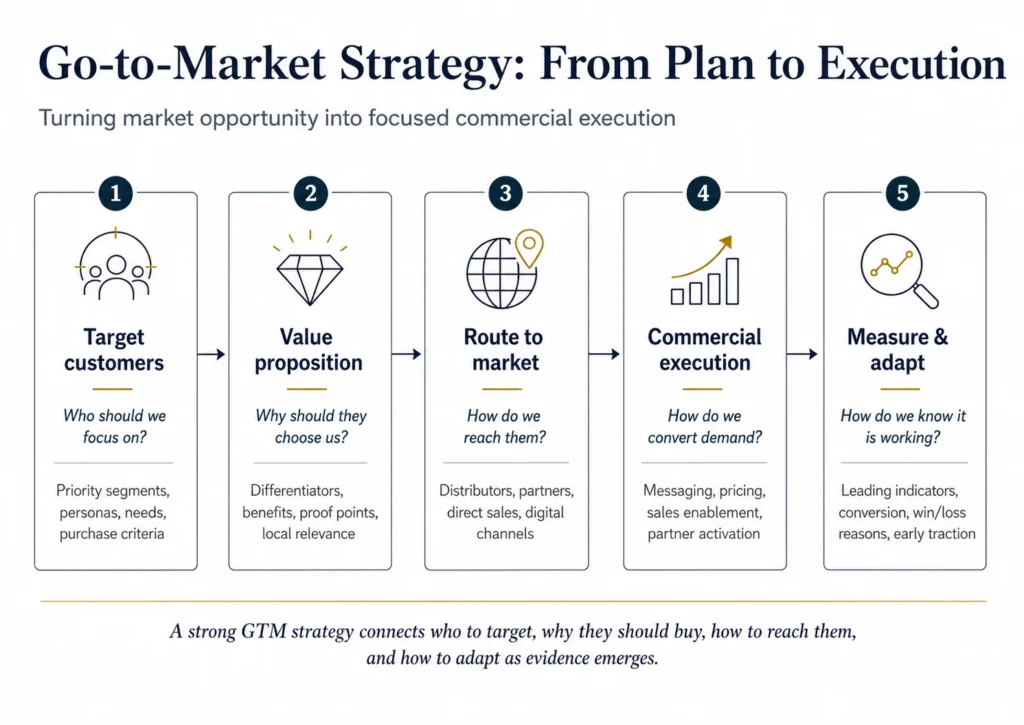
Figure 1. Midas Go-to-Market Strategy Process: A strong GTM strategy connects who to target, why they should buy, how to reach them, and how to adapt as market evidence emerges.

Key Aspects of a Strong Go-To-Market Strategy in Argentina:
| Key Component | Description |
|---|---|
| Market Analysis | Comprehensive analysis of industry trends, local demand, and competitive landscape |
| Value Proposition Development | Crafting a compelling message that differentiates your offering for Argentine customers |
| Sales & Distribution Strategy | Identifying the most effective channels, partners, and market entry tactics |
| Competitive Benchmarking | Assessing key players, pricing strategies, and industry positioning in Argentina |
| Marketing & Demand Generation | Developing targeted campaigns that resonate with Argentina’s diverse customer segments |
| Go-to-Market Optimization | Enhancing strategies to improve efficiency, market penetration, and revenue growth |
| Product Launch Execution | Ensuring a data-driven approach to introducing new products successfully |
What Makes Go-to-Market Strategy in Argentina Different?
Argentina can offer attractive growth opportunities, but it also requires a GTM model that is resilient, flexible, and grounded in local evidence.
| Argentina GTM issue | Why it matters | Executive implication |
| Economic volatility | Inflation, FX pressure, and cost changes can quickly weaken a static commercial plan. | GTM plans need shorter review cycles, pricing flexibility, and clear trigger points for adjustment. |
| Channel economics | Distributor margins, payment terms, logistics costs, and service expectations can determine whether growth is profitable. | Channel choice should be evaluated not only by reach, but by economics and execution capability. |
| Regulatory and import constraints | Import rules, taxes, and administrative requirements can affect product availability and route-to-market feasibility. | Companies may need to compare direct sales, distributors, local partners, or hybrid models. |
| Price-sensitive buying behavior | Customers may delay, switch, negotiate aggressively, or prioritize availability and financing. | The value proposition must give sales teams a credible way to defend value without relying only on discounts. |
| Informal or substitute competition | In some categories, counterfeit, refill, gray market, or low-cost alternatives can reshape the competitive game. | GTM strategy should map the full competitive set, not only formal direct competitors. |
Defending Value Without Defaulting to Discounts
In Argentina, weak GTM execution often appears as a pricing problem. But in many cases, the deeper issue is value communication.
Sales teams and distributors need to know:
- Which customer segments value the offer most.
- Which product or service attributes matter in the local buying process.
- Which objections prevent conversion.
- Which competitors or substitutes customers compare against.
- Which messages help defend price, margin, service, or reliability.
Midas helps companies translate market insight into a value proposition that can be used in real sales conversations, distributor discussions, and commercial materials.
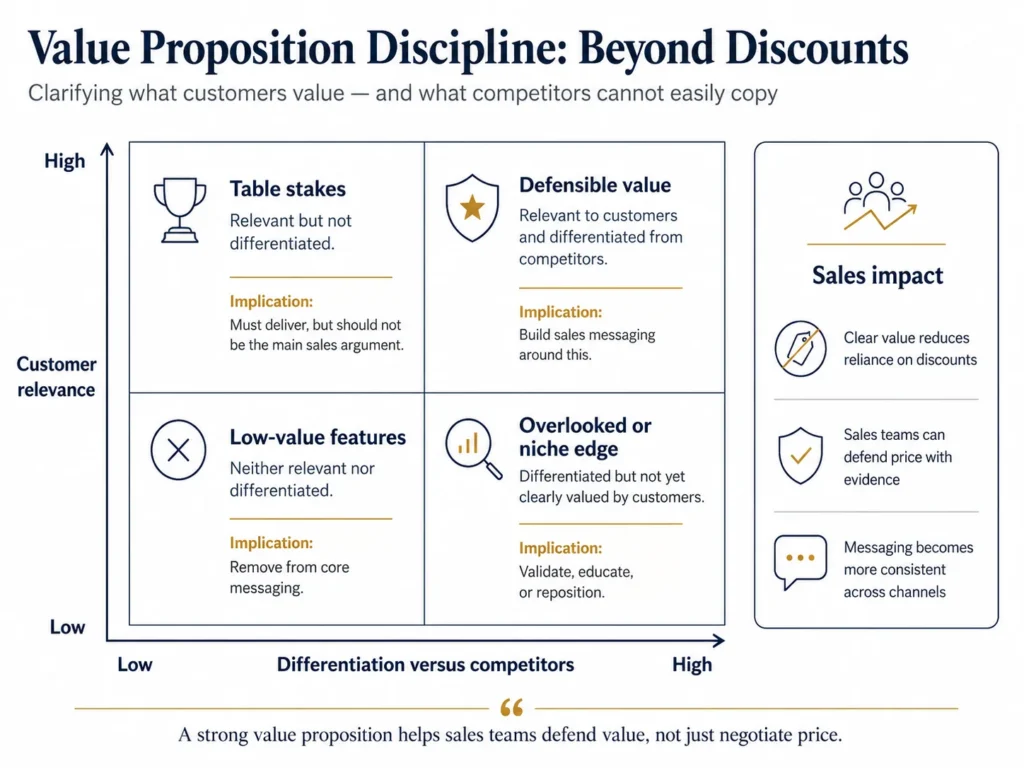
Figure 2. Value Proposition Discipline: A strong GTM strategy helps sales teams defend value, not just negotiate price.
Challenges in Developing a Successful Go-To-Market Strategy in Argentina
Argentina is at a strategic juncture and offers vast opportunities but also presents distinct challenges. Companies expanding or launching in the country often encounter:
- Overcoming Distribution and Logistics Barriers. Supply chain inefficiencies, high operational costs, and regional disparities impact market access and efficiency
- Navigating Economic Volatility. High inflation rate, fluctuating exchange rates, and frequent policy changes require businesses to remain agile and adaptable
- Understanding Regulatory Complexity. Constant shifts in import/export restrictions, tax policies, and labor laws demand careful planning and compliance expertise.
Read our guide to building and executing a go-to-market strategy in Latin America.

How Midas Helps You with Go-to-Market Consulting in Argentina
At Midas, we provide customized go-to-market consulting services specifically designed for multinational firms operating in Argentina. Our expertise includes:
- Local Market Analysis & Customer Insights. Our team of Argentine market experts analyzes economic trends, purchasing behaviors, and industry shifts to refine your strategy
- Competitive & Industry Benchmarking. We locally assess market leaders, pricing strategies, and competitive positioning to help you gain a strategic advantage
- Overall Go-to-Market Strategy Development. We identify optimal sales channels, refine pricing models, and establish key partnerships to maximize market penetration

Looking to refine your go-to-market strategy or optimize a product launch in Argentina?
Some of Our Go-to-Market Consulting in Argentina Customers:





How We Build the Evidence Base in Argentina
Depending on the challenge, our Argentina GTM work can combine:
- Interviews with client leadership, local sales teams, distributors, retailers, customers, and market experts.
- Market analysis to understand demand concentration, purchase criteria, adoption barriers, and regional differences.
- Competitor and substitute analysis, including pricing, positioning, distribution, incentives, and informal alternatives when relevant.
- Channel assessment to evaluate distributor capabilities, coverage, margins, service levels, and execution discipline.
- Executive workshops to align priorities, commercial messages, channel choices, pricing logic, and implementation milestones.
This helps leadership teams avoid generic recommendations and make GTM decisions based on Argentina’s actual market dynamics.
Strengths and Limitations of Our GTM Approach in Argentina
A structured GTM process helps companies reduce execution risk in Argentina by clarifying customers, channels, value proposition, distributor roles, and early performance indicators.
Its limitation is that Argentina changes quickly. A GTM strategy should not be treated as a fixed annual plan. Pricing assumptions, channel economics, customer behavior, and competitor moves should be reviewed regularly. The strongest GTM plans combine strategic clarity with disciplined adaptation.
Case Example, Unlocking Market Growth in Argentina’s Competitive Landscape
Background and challenges
A global laser cartridge manufacturer was struggling to expand its market share in Argentina. Competition was fierce, and two major threats were impacting growth: a strong presence of refill and counterfeit products, and a lack of reliable data on their market size. Additionally, understanding competitor distribution policies and incentives was crucial to crafting a strategy that could drive sales and improve positioning


Approach
To address these challenges, we conducted a comprehensive market analysis, combining secondary research with in-depth interviews. Our team gathered insights from distributors, competitors, and cartridge re-fillers to uncover key market trends, distribution strategies, and the true impact of counterfeit products. This intelligence allowed us to map the competitive landscape and develop a data-driven approach to optimizing distribution and sales
Results
We tailored our customer’s incentive strategy and a refined distribution approach. The company also successfully reduced the influence of re-fillers and optimized its supply chain. Within three years, it climbed the ranks to become the second-largest player in Argentina’s laser cartridge market

Frequently Asked Questions About Go-to-Market Consulting in Argentina
What does go-to-market consulting in Argentina include?
It includes market analysis, customer segmentation, value proposition design, channel and distributor assessment, competitor analysis, pricing implications, sales execution priorities, and launch or growth metrics.
Why is GTM strategy especially important in Argentina?
Because volatility, channel economics, regulatory changes, and pricing pressure can quickly weaken a generic commercial plan.
When should a company review its GTM strategy in Argentina?
When sales are below expectations, distributors are underperforming, price discounts are increasing, customers do not understand the differentiation, or market conditions have changed.
How does Midas adapt GTM strategy to Argentina?
We combine local market analysis, interviews, competitor insight, channel assessment, and executive alignment to build a GTM roadmap that can be implemented and adjusted as conditions evolve.
Is Your Argentina GTM Model Ready for Execution?
A strong opportunity can underperform if the route to market is unclear, distributors are misaligned, the sales message is generic, or the value proposition does not survive price pressure.
Midas helps executive teams clarify the GTM choices that matter most in Argentina: who to target, how to win, which channels to activate, how to defend value, and how to measure progress.
Let’s talk about your Argentina go-to-market challenge.
About the Author:
By Adrian Alvarez, PhD. Adrian Alvarez is Managing Partner at Midas Consulting, a Wharton Alumnus, MBA Professor at Universidad Argentina de la Empresa (UADE), and Competitive Intelligence Fellow. He specializes in competitive strategy, growth strategy, and strategic decision-making under uncertainty across Latin America.
He has developed go-to-market strategies supporting product launches, commercial acceleration, and regional expansion initiatives. Access his published strategic insights.
View professional profile on LinkedIn
External References
This page is informed by Midas Consulting’s project experience and by selected external sources on go-to-market strategy, customer segmentation, and Argentinean market context: