

M&A Consulting in Brazil: clarity, confidence, and results
Are you evaluating an acquisition, joint venture, licensing agreement, or strategic partnership in Brazil?
Brazil is one of Latin America’s largest and most attractive markets. But it is also one of the most complex. Scale, regional differences, tax complexity, regulatory exposure, channel power, labor issues, ownership dynamics, and strong local competitors can all shape whether a deal creates value.
A target that looks compelling at national level may perform very differently by region, customer segment, channel, or product category.
At Midas, we help you approach M&A in Brazil with a stronger fact base. We support your team in defining the acquisition thesis, mapping and screening targets, profiling priority companies, validating commercial risks, preparing discreet outreach, and supporting negotiations with better market intelligence.
The goal is simple: help you identify the right targets, surface deal-breakers earlier, and move forward with more confidence.

What makes M&A consulting in Brazil different
Brazil rewards scale, but scale can hide complexity.
A potential target may have strong revenues, recognizable brands, or attractive regional presence. But the value of the deal may depend on questions that require deeper validation:
- How sustainable is growth by region?
- How strong is the company’s channel position?
- How dependent is the business on a few customers, distributors, or executives?
- What tax, labor, environmental, regulatory, or compliance issues could affect the transaction?
- Which capabilities are truly transferable after closing?
- What will competitors do if the deal changes the market structure?
- What integration risks could reduce value after signing?
In Brazil, the best M&A decisions combine strategic clarity, local intelligence, and disciplined risk validation.
What makes M&A consulting in Brazil valuable before the deal becomes expensive
M&A decisions become harder to change once your organization is already emotionally, politically, or financially committed to a target.
That is why the early stages matter so much.
Before valuation, legal due diligence, tax structuring, or integration planning take over, you need to answer a more strategic question:
Does this target truly fit your acquisition thesis, and what could make the deal fail?
At Midas, we help you answer that question before the process becomes expensive. We work with your leadership team to clarify the reason to acquire, map the target universe, screen candidates, identify hidden risks, understand the other side’s priorities, and prepare for negotiations with a stronger fact base.
The goal is not to create a longer list of companies. The goal is to help you make a better acquisition decision.
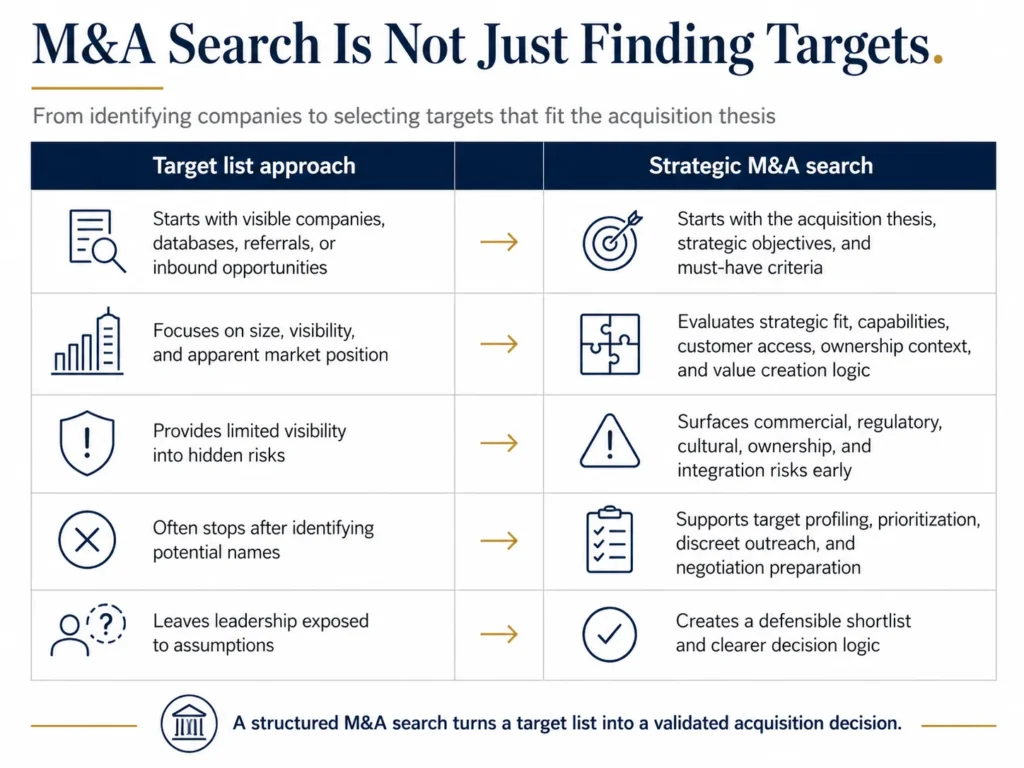
Figure 1. M&A Search Is Not Just Finding Targets: A structured M&A search turns a target list into a validated acquisition decision.
Why local intelligence matters in M&A consulting in Brazil
In Brazil, a target that looks attractive in a spreadsheet may carry risks that only become visible through local validation.
Public information can be incomplete. Private companies may be family-owned or low-profile. Real decision-making power may sit outside the formal org chart. Growth may depend on a few key accounts, personal relationships, temporary pricing conditions, or channel advantages that may not survive after closing.
That is why you need more than a database search.
You need to understand the business behind the numbers:
- Who really controls the decision?
- Why might the owner sell, partner, delay, or resist?
- How sustainable is the company’s growth?
- Are key customer relationships transferable?
- What regulatory, tax, labor, compliance, or reputation issues could affect the deal?
- What could change the valuation logic?
- What needs to be true after closing for the acquisition to create value?
These questions are not secondary. They can determine whether the deal strengthens your company or becomes an expensive distraction.
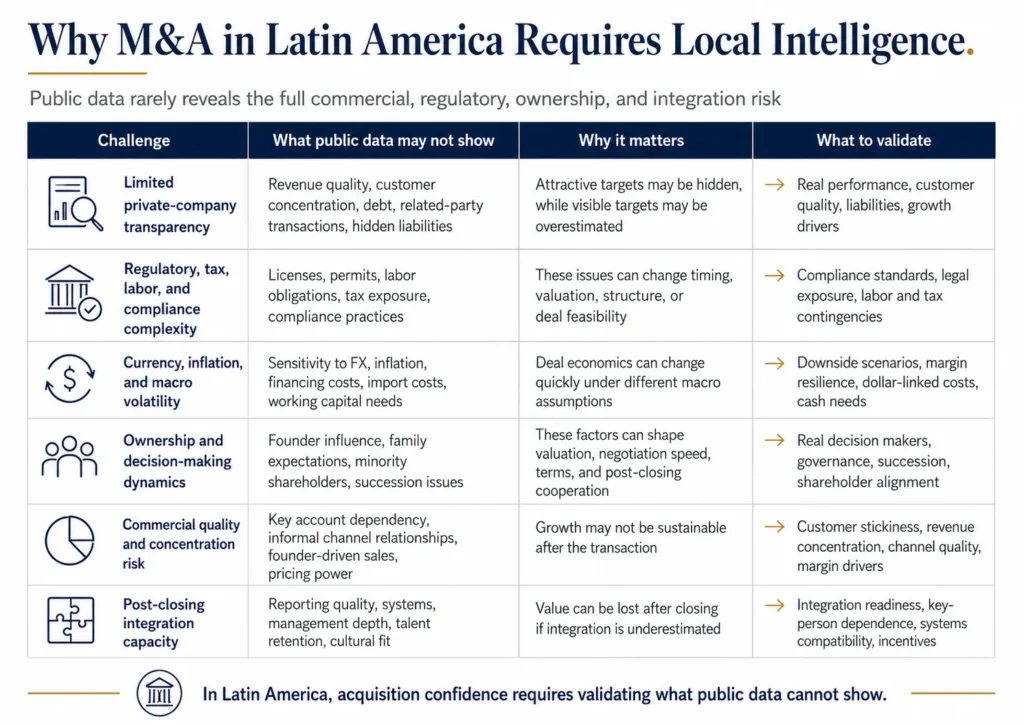
Figure 2. Why M&A in Brazil Requires Local Intelligence: Acquisition confidence requires validating what public data cannot show.
How Midas supports your M&A decision in Brazil
At Midas, we support the strategic work that investment bankers, lawyers, and accountants often do not cover.
We help you understand the market, the target, the counterpart, and the strategic logic of the deal.
Our role is especially valuable when you need to:
- Define the acquisition thesis
- Identify and screen potential targets
- Profile priority companies in depth
- Understand commercial, regulatory, ownership, and negotiation risks
- Compare acquisition with partnership, licensing, distribution, or direct entry
- Prepare discreet outreach
- Understand what may matter to the other side
- Support negotiations with better assumptions
- Frame strategic due diligence questions
- Connect the deal to post-closing value creation
You still need financial, legal, tax, and accounting advisors. But before those advisors can do their best work, your team needs strategic clarity: why acquire, which target fits, what risks matter, and how the deal will create value.
Access our detailed guide to creating a solid M&A search strategy in Latin America.

The Midas six-phase M&A search consulting process in Brazil
A strong M&A process should balance rigor, confidentiality, and momentum.
Our methodology usually includes six phases.
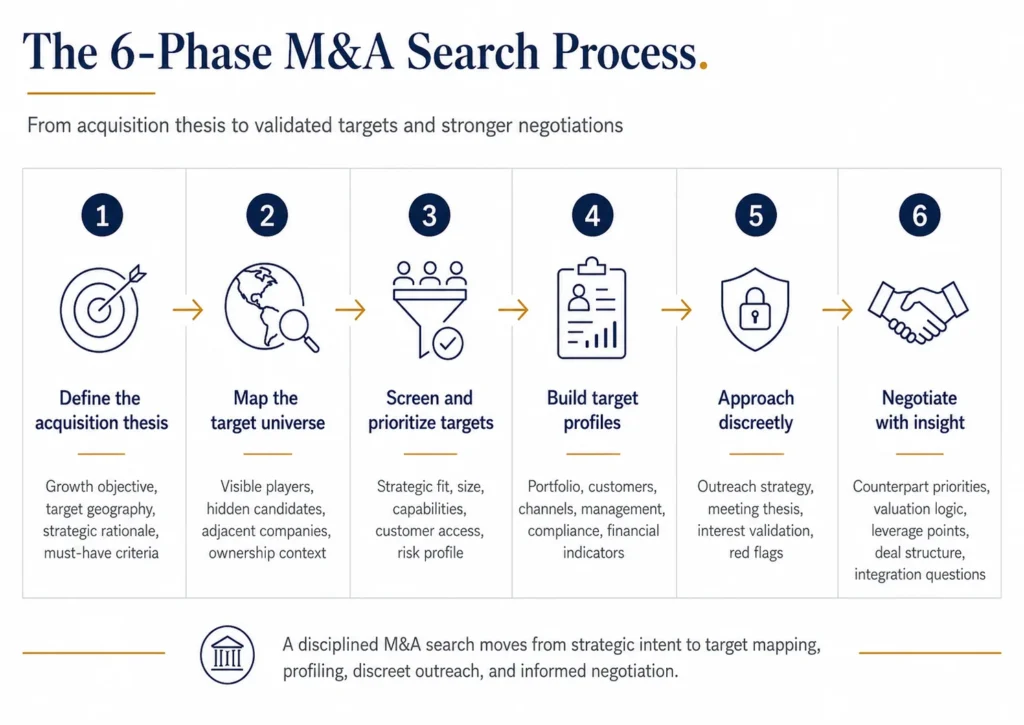
Figure 3. The Midas 6-Phase M&A Search Process: A disciplined M&A search moves from acquisition thesis to market mapping, target profiling, discreet outreach, negotiation insight, and integration readiness.
1. Define the acquisition thesis
We begin by clarifying the strategic reason to acquire.
Are you looking for market entry, geographic expansion, customer access, portfolio extension, technology, innovation capabilities, vertical integration, consolidation, or defensive positioning?
Then we define attractiveness criteria, must-haves, deal-breakers, and risk tolerance, so your team does not waste time chasing targets that are available but strategically weak.
2. Map and screen the market
We build the target universe and screen companies based on strategic fit, market position, size, portfolio, customer base, geographic reach, ownership structure, regulatory exposure, available intelligence, and deal feasibility.
The objective is to avoid two mistakes: spending too much time on obvious but weak names, and missing hidden but attractive candidates.
3. Develop in-depth target profiles
For priority candidates, we build profiles that answer what a database cannot.
A strong profile should cover business model, customers, channels, portfolio, ownership, management, capabilities, compliance exposure, growth potential, commercial risks, partnership history, likely transaction motivations, and possible deal-breakers.
The output is not just “who the company is.” It is why the target could fit, what could break the deal, and how you might approach it.
4. Prioritize and prepare the approach
We help you compare targets, identify likely concerns, assess negotiation levers, and prepare a discreet outreach strategy.
This includes defining a credible acquisition, partnership, licensing, joint venture, or strategic collaboration logic that makes sense for the other side, not only for your company.
5. Approach and negotiate with insight
Once the right candidates are identified, we support discreet outreach and meeting preparation.
During negotiations, our intelligence helps you understand what may matter to the counterpart: valuation expectations, succession issues, growth ambitions, governance concerns, timing, risk appetite, role of the founder, family dynamics, or preferred deal structures.
You negotiate better when you understand both the target’s reality and the other side’s priorities.
6. Prepare for value capture
Before the deal advances too far, we help identify the strategic, commercial, operational, cultural, and integration questions that need to be validated.
The goal is to avoid treating due diligence as a financial checklist. The real question is whether the deal can create the value that justified the acquisition thesis in the first place.
How Midas Consulting helps you evaluate M&A targets in Brazil
We help your team move beyond obvious names and public information.
Depending on the acquisition thesis, we can map the market universe, screen visible and less visible companies, profile priority targets, interview industry sources, validate customer and channel assumptions, identify potential deal-breakers, and prepare a negotiation brief.
For Brazil, this often means connecting national strategy with regional execution reality.
The result is a clearer view of which targets deserve attention, which risks must be validated, and how your company can approach the deal with stronger assumptions.
How we prioritize M&A targets in Brazil
Not every attractive company is a good acquisition target. And not every available company deserves your time.
That is why we prioritize targets using two lenses:
- Strategic fit: Does the target support the acquisition thesis?
- Deal feasibility: Is there a realistic path to conversation, negotiation, closing, and value creation?
This creates four practical categories:
Priority targets
These are the candidates with strong strategic fit and realistic deal potential. They deserve deeper profiling, discreet validation, and prepared outreach.
Strategic but difficult targets
These companies may be highly attractive, but hard to acquire. The right move may be to structure the approach differently, wait, build a relationship, explore a partnership, or monitor ownership changes.
Opportunistic options
These targets may be feasible but less strategic. They can be useful in specific circumstances, but they should not distract the leadership team from the core acquisition thesis.
Deprioritized targets
These companies may appear in the market universe, but they do not justify deeper work. The discipline to stop early is part of good M&A decision-making.
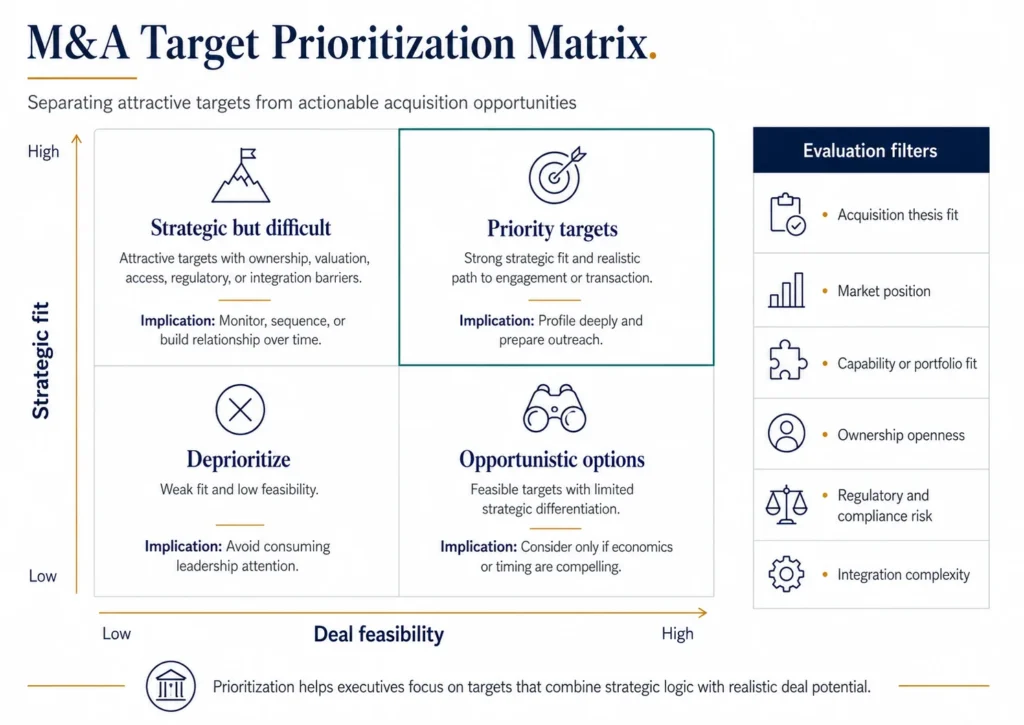
Figure 4. Midas’ M&A Target Prioritization Matrix: Prioritization helps executives focus on targets that combine strategic logic with realistic deal potential.
Why does this M&A consulting approach work particularly well in Brazil?
Because three challenges shape M&A in Brazil:
- Regulatory and tax complexity: Intricate labor laws, local taxes (ICMS, ISS, PIS/COFINS), and regulatory approvals can slow or reshape deals
- Regional diversity: What works in São Paulo may not succeed in the Northeast or South; integration strategies must adapt
- Competitive intensity: Local champions, global entrants, and a fast-growing startup ecosystem mean competition is fierce and fast-moving
Our approach ensures you see these issues early and plan accordingly.

What you get from our M&A consulting in Brazil
- Visibility into regulatory, tax, and market risks
- Tailored insights into regional opportunities and challenges
- Stronger negotiation position with local intelligence
- Integration strategies adapted to Brazil’s complexity
With over 25 years of experience and a client-rated NPS of 82.2% (2020-2025), we help you make smarter, safer, and more profitable M&A decisions in Brazil.

Ready to pursue opportunities with clarity and confidence?
Contact us to successfully acquire your ideal target company!
Some of our M&A consulting customers in Brazil:




What you should expect from our M&A consulting work in Brazil
A strong M&A consulting engagement should give your team more than a report.
It should help you make a clearer decision.
Typical outputs include:
- Acquisition thesis and target criteria
- Market universe and master target list
- Screening logic and scoring
- Shortlist of priority targets
- In-depth company profiles
- Commercial and strategic risk assessment
- Ownership and decision-maker insight
- Partner, JV, licensing, or acquisition-route alternatives
- Discreet approach strategy
- Negotiation brief
- Strategic due diligence questions
- Integration and value-capture hypotheses
- Clear next steps for leadership decision-making
The practical value is simple: your team should know which targets to prioritize, which risks to validate, how to approach the other side, and when to walk away.
Case example, entering Brazil’s healthcare sector
Background and challenges
An international healthcare group wanted to acquire a mid-sized Brazilian diagnostics company but lacked clarity on local dynamics and competitive risks


Approach
We conducted market due diligence, mapping competitors, patient flows, regulatory hurdles, and local reimbursement models. We also facilitated scenario planning to stress-test the investment under different policy and demand conditions
Results
The client adjusted its valuation, saving 20% on acquisition price
A new go-to-market strategy prioritized private insurance partnerships and tiered service models
Within the first year, the company expanded its footprint in São Paulo and Rio, achieving faster-than-expected revenue growth

Related Midas consulting services that can strengthen your M&A decision in Brazil
M&A decisions rarely sit in isolation. They often connect with market entry, go-to-market strategy, competitor behavior, partner alternatives, benchmarking, and post-deal execution.
Depending on your objective, Midas can combine M&A consulting with other services to give your team a stronger decision base.
Market Entry Consulting
Use this when acquisition is one possible route into a new country, segment, or region.
Market entry consulting helps you decide whether to enter, where to play, which route makes sense, and whether acquisition is better than building directly, partnering, licensing, or waiting.
Go-to-Market Consulting
Use this when the acquisition thesis depends on execution.
A deal may look attractive, but value is only created if the acquired business can be translated into customer targeting, channel design, pricing, sales priorities, distributor alignment, and commercial execution.
Distributor Search Consulting
Use this when your team needs to compare acquisition with distribution, partnership, licensing, or channel-based market entry.
Sometimes the best route is to acquire. Sometimes it is to partner first. The key is to evaluate the strategic trade-offs before you commit.
Competitor Analysis
Use this when target evaluation depends on understanding incumbent strength, local players, likely reactions, pricing behavior, channel power, and competitive threats.
Competitor analysis helps you understand whether the target is truly advantaged or simply appears attractive because the competitive reality is not fully visible.
Market Analysis
Use this when your acquisition decision depends on demand, customer segments, market size, barriers, growth potential, channels, and opportunity attractiveness.
This is especially useful when the acquisition is part of a broader growth or market entry strategy.
Benchmarking
Use this when your team needs to compare target capabilities, cost structures, commercial practices, operating models, service levels, or performance gaps against competitors or reference companies.
Benchmarking can help you understand whether the target has capabilities worth acquiring or gaps that could reduce value after closing.
Wargaming
Use this when the deal could trigger competitor reactions, customer concerns, channel conflict, regulatory attention, or post-deal countermoves.
A wargame helps your leadership team pressure-test how the market may react after you move.
Strategy Consulting
Use this when M&A raises broader questions about growth priorities, competitive positioning, resource allocation, operating model, or execution.
This is especially useful when your leadership team is still deciding whether to acquire, partner, build directly, delay, or avoid the opportunity.
Not sure which service should come first?
You do not need to know the answer before we talk.
In a short conversation, we can help you clarify whether your challenge requires M&A consulting, market entry analysis, partner search, strategic due diligence, competitor analysis, a wargame, or a broader strategy discussion.
If you are considering an acquisition, joint venture, licensing agreement, or strategic partnership, do not leave the target search to chance.
Frequently asked questions about M&A consulting in Brazil
What does M&A consulting include?
M&A consulting helps your leadership team make better acquisition, partnership, joint venture, licensing, or divestment decisions.
At Midas, the work can include defining the acquisition thesis, mapping the market, identifying potential targets, screening companies, building in-depth profiles, validating risks, preparing discreet outreach, supporting negotiations, and framing the strategic due diligence questions that should be answered before the deal advances too far.
The goal is not just to find companies. The goal is to help you decide which targets truly fit your strategy, which risks matter, and how the deal could create value after closing.
How is Midas different from an investment banker?
Investment bankers usually focus on running or supporting the transaction process. Lawyers focus on legal risks. Accountants focus on financial and tax diligence.
Midas focuses on the strategic and market side of the decision: which targets fit your acquisition thesis, how attractive the market really is, what hidden risks could change the deal logic, how the other side may think, and what needs to be true after closing for the acquisition to create value.
In many projects, we complement investment bankers, lawyers, accountants, and internal corporate development teams.
When should we involve Midas in an M&A process?
The earlier, the better.
Midas is especially useful before your team becomes committed to a specific target. That is when you still have room to clarify the acquisition thesis, compare routes to market, map the target universe, screen alternatives, identify hidden candidates, and surface deal-breakers before the process becomes expensive or politically difficult to stop.
You can also involve us when you already have a target in mind and need strategic due diligence, market validation, competitor insight, customer or channel intelligence, or negotiation preparation.
Can Midas help if we do not yet know which company to acquire?
Yes. That is often where we create the most value.
We can help you move from a broad strategic objective — for example, entering a market, acquiring capabilities, expanding a portfolio, accessing customers, or building local presence — to a clear acquisition thesis and target universe.
Then we screen the market to identify which companies deserve attention, which should be deprioritized, and which hidden or less visible candidates may be more attractive than the obvious names.
Can Midas help us compare acquisition with partnership, licensing, distribution, or joint venture?
Yes. In Brazil, acquisition is not always the best route.
Sometimes the right answer is to buy. Sometimes it is better to partner, license, form a joint venture, appoint a distributor, or build directly. The right route depends on your strategic objective, urgency, investment appetite, control requirements, regulatory exposure, local capabilities, and risk tolerance.
Midas can help you compare these alternatives before your team commits to one path too early.
Why does M&A in Brazil require local intelligence?
In Brazil, public information often does not tell the whole story.
Many attractive targets are private, family-owned, low-profile, or difficult to evaluate from desktop research alone. Ownership dynamics, informal decision-makers, customer concentration, channel dependence, regulatory exposure, labor issues, reputation risk, and management quality can all influence whether a deal creates value.
Local intelligence helps you understand the business behind the numbers.
What does an in-depth target profile include?
A strong target profile should help your team understand not only who the company is, but whether it truly fits your acquisition thesis.
Depending on the project, a Midas target profile may include market position, business model, portfolio, key brands, customers, channels, ownership, management, capabilities, growth drivers, pricing logic, compliance exposure, commercial risks, partnership history, likely motivations, possible deal-breakers, and approach considerations.
The output should help your team decide whether to prioritize, monitor, approach, partner with, or deprioritize the company.
How do you prioritize acquisition targets?
We usually prioritize targets through two main lenses: strategic fit and deal feasibility.
Strategic fit asks whether the target supports the reason you want to acquire. Deal feasibility asks whether there is a realistic path to conversation, negotiation, closing, and value creation.
That helps separate priority targets from companies that are attractive but hard to acquire, feasible but not strategic enough, or simply not worth pursuing.
Can Midas support discreet outreach?
Yes. Confidentiality is often critical in M&A, especially when the market is small, the target is sensitive, or the buyer wants to avoid reputational risk.
Midas can help prepare the outreach logic, define the reason to speak, anticipate counterpart concerns, and support discreet conversations. The objective is to create a credible first conversation without exposing your company unnecessarily.
What is strategic due diligence?
Strategic due diligence looks beyond the financials to test whether the acquisition thesis is valid.
It asks questions such as: Is the market attractive? Is growth sustainable? Are customer relationships transferable? How strong is the target’s competitive position? What risks could change the valuation logic? What will competitors do? Can the buyer actually capture the expected value after closing?
This does not replace legal, tax, accounting, or financial diligence. It complements them by focusing on whether the deal makes strategic and commercial sense.
Can Midas help during negotiations?
Yes. We can support negotiations by helping your team understand the target’s reality and the other side’s likely priorities.
That may include ownership motivations, succession issues, governance concerns, growth ambitions, valuation expectations, preferred deal structures, timing, risks, and possible objections.
You negotiate better when you understand not only what you want, but also what may matter to the counterpart.
What should we expect at the end of an M&A consulting engagement?
Typical outputs may include an acquisition thesis, target criteria, market universe, screening matrix, shortlist, in-depth target profiles, commercial risk assessment, ownership and decision-maker insight, strategic due diligence questions, approach strategy, negotiation brief, and value-capture hypotheses.
The practical outcome should be clear: your leadership team should know which targets to prioritize, which risks to validate, how to approach the other side, and what must be true for the deal to create value.
How long does an M&A target search usually take?
It depends on the market, the sector, the level of opacity, and the depth of validation required.
A focused target scan can be relatively fast. A more robust process that includes market mapping, screening, in-depth profiling, interviews, discreet validation, and negotiation preparation takes longer.
The key is to design the process around the decision you need to make. You do not always need the deepest possible study. You need the right level of confidence for the next decision.
Who should participate from our side?
The best team depends on the decision, but M&A work usually benefits from a small senior group that includes strategy, corporate development, business leadership, finance, legal, and the relevant regional or country leaders.
For Brazil, local input is especially important. The people closest to customers, channels, regulation, and execution often see risks that do not appear in a high-level model.
Is M&A consulting only useful for large acquisitions?
No. M&A consulting is useful whenever the decision is strategically important and the cost of being wrong is high.
That can include acquisitions, minority investments, joint ventures, licensing deals, distributor replacements, commercial partnerships, capability acquisitions, or divestments.
The question is not only deal size. The question is whether the decision could materially affect growth, market position, risk, or execution.
What is the first step if we want to explore an acquisition?
The first step is to clarify the acquisition thesis.
Before looking for names, you need to answer: Why acquire? What capability, market, customer access, portfolio position, or competitive advantage are you trying to obtain? What must be true for the deal to create value? What would be a deal-breaker?
Once that is clear, the target search becomes much more focused and much more useful.
About the author
By Adrian Alvarez, PhD. Adrian Alvarez is Managing Partner at Midas Consulting, a Wharton Alumnus, MBA Professor at Universidad Argentina de la Empresa (UADE), and Competitive Intelligence Fellow. He specializes in competitive strategy, growth strategy, M&A search, target screening, market entry, strategic due diligence, and decision-making under uncertainty across Latin America.
Adrian has contributed to M&A initiatives involving competitive assessment, market evaluation, target screening, partner identification, strategic due diligence, negotiation support, and post-deal value creation.
His role in M&A projects is to help leadership teams translate incomplete information into better strategic choices: which targets fit, which risks matter, how to approach the other side, what assumptions must be validated, and when it may be better not to move forward. Access his published strategic insights.
View professional profile on LinkedIn
Selected External References
This guide is informed by Midas Consulting’s M&A search and strategic due diligence work in Brazil and by respected sources on acquisition strategy, due diligence, negotiation, culture, and integration.