

In fast-changing markets, leaders rarely suffer from a lack of ideas. They suffer from a lack of alignment on which ideas matter most, which trade-offs are worth making, and how to turn strategic intent into execution. This is where strategy workshops can create real value.
A strategy workshop is not a brainstorming session. At Midas Consulting, we define a strategy workshop as a structured executive working session that helps leadership teams convert market evidence, internal perspectives, and strategic options into clear priorities, decisions, and an implementation roadmap.
This distinction matters for C-level executives because the challenge is not simply to discuss strategy. It is to make better strategic choices, align the people who must execute them, and create the discipline to follow through. Harvard Business Review’s research on why strategy execution unravels shows that execution often breaks down when companies struggle to coordinate across teams and adapt to changing conditions.
In a typical strategy workshop, we help executive teams move from discussion to decision. Outputs may include strategic priorities, explicit trade-offs, initiative roadmaps, accountable owners, decision rights, success metrics, and a 30/60/90-day action plan.
The quality of a strategy workshop depends heavily on the quality of the fact base behind it. Depending on the challenge, workshop preparation may draw on market analysis to understand demand and customer dynamics, competitor analysis to clarify rival behavior and likely moves, benchmarking to compare practices and capabilities, value proposition design to sharpen the customer promise, or win-loss analysis to understand why buyers choose, reject, or delay decisions.
As one client put it in an after workshop review:
“We already had ideas, but Midas helped us test them and align the team.” Strategy Manager, FMCG, 2025.
What Makes Strategy Workshops Different
Many strategy processes fail because analysis, debate, decision-making, and implementation ownership are separated. A workshop-based approach brings those elements together in the same executive process.
What makes a strategy workshop different is that it is designed around decisions, not presentations. Unlike routine internal meetings, a well-designed workshop creates the space, structure, and challenge required to test assumptions, compare options, and make choices.
At Midas, we use the term strategic alignment to mean more than agreement in the room. Strategic alignment means that leaders share a common understanding of priorities, trade-offs, roles, and success measures. Without that level of alignment, teams may agree with the strategy in principle but interpret it differently when execution begins.
We also define facilitation as more than moderating a meeting. In our work, facilitation means designing and guiding a strategic conversation so that leaders can challenge assumptions, surface disagreement, compare options, and make decisions without letting hierarchy, politics, or internal bias dominate the outcome.
This is why structured workshops are especially useful when companies need to make strategic choices under uncertainty. Wharton Executive Education’s article on strategic decision-making highlights the importance of recognizing decision biases when leaders make long-term choices.
This is especially important because strategy execution depends not only on the quality of the plan, but also on coordination across teams, clear decision roles, and the ability to adapt as conditions change. Harvard Business Review’s article on why strategy execution unravels explains how coordination and adaptation challenges can undermine implementation.
- Focused facilitation: We guide the process so your team can focus on strategic decisions, not meeting logistics.
- Practical outputs: Every session is designed to produce concrete management outputs, such as priorities, trade-offs, owners, metrics, and a roadmap.
- Team ownership: Because your people help build the strategy, they are more likely to understand it, defend it, and implement it.
One participant said it best in a post-workshop review:
“It was a disruptive activity that allowed us to think outside the box. We changed our mindset and dared to try new things.”
Revenue Manager, B2B Services, 2024
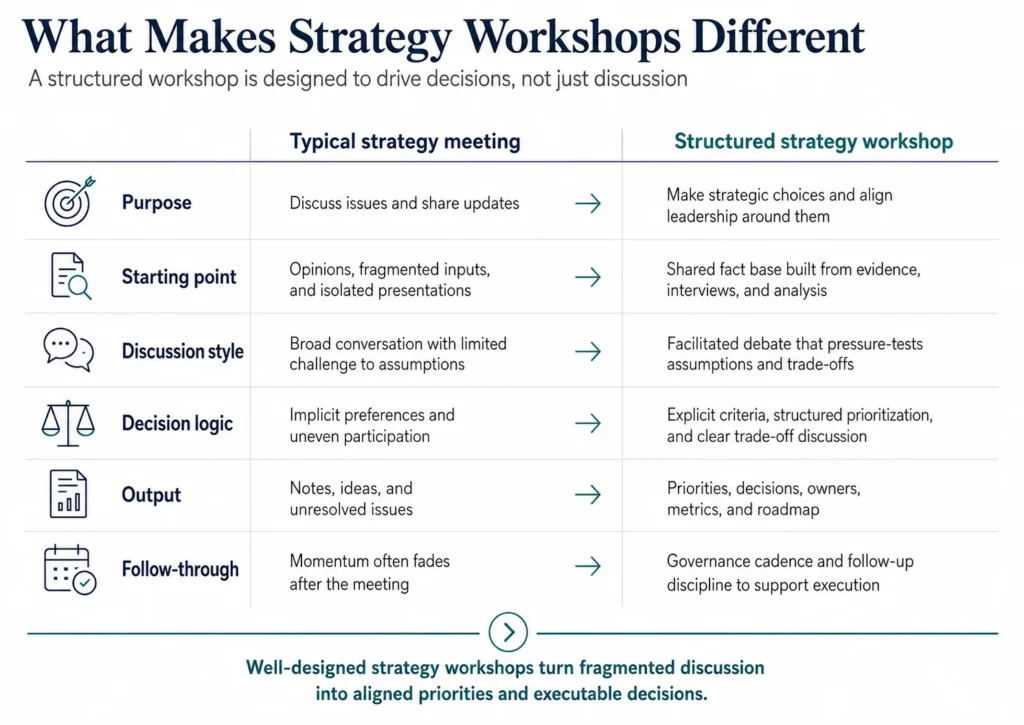
Figure 1. What makes Midas’ strategy workshops different: This framework shows how a structured workshop moves beyond discussion by using evidence, facilitation, explicit decision criteria, and follow-through mechanisms to turn executive alignment into actionable strategy.
The Benefits of a Workshop-Based Approach
A strategy workshop creates value when it helps leadership teams do three things faster and better: align on the real strategic issue, make explicit choices, and translate those choices into action.
In our experience leading more than 70 strategy workshops across Latin America, the strongest benefit is not the meeting itself. It is the discipline the workshop creates before, during, and after the session.
1. Align leaders around the same strategic challenge
Many teams start with different interpretations of the problem. A structured workshop creates a shared fact base, surfaces disagreements, and helps leaders align on what really needs to be decided.
2. Turn discussion into strategic choices
Good workshops are designed around decisions, not presentations. They help teams compare options, challenge assumptions, define trade-offs, and decide where to focus leadership attention and resources.
3. Convert priorities into execution
A workshop should not end with general agreement. It should end with clear priorities, initiatives, owners, timelines, metrics, and governance routines. In this context, action planning means defining who will do what, by when, and how progress will be reviewed.
This implementation focus is aligned with MIT Sloan Management Review’s perspective on closing the gap between strategy and execution, which frames strategy as a process that must connect choices, action, and revision.
From consulting practice to academic contribution
Our approach to strategy workshops has also become part of Adrian Alvarez’s academic and executive-education work.
In 2026, the Faculty of Economic Sciences at the Universidad de Buenos Aires (UBA) published his article Strategy Workshops: From Vision to Action. The article develops a practical idea that also sits at the center of our work at Midas: the real test of a strategy workshop is not how stimulating the conversation feels, but whether it helps an organization move from strategic intent to coordinated execution.
The framework emphasizes several elements we have repeatedly found critical in executive workshops: involving the right people in shaping the strategy, creating alignment across functions, making priorities and trade-offs explicit, and converting strategic choices into initiatives with owners, metrics, milestones, and follow-through.
For you as a leader, that distinction matters. A successful workshop should not end with a collection of ideas. It should leave your team with a clearer understanding of what matters, what you have decided, what you will not pursue, who owns each priority, and what happens next.
Typical Strategy Workshop Deliverables
Strong workshops produce tangible management outputs, not just discussion notes.
| Workshop output | Why it matters for executives |
|---|---|
| 3–5 strategic priorities | Forces focus and prevents initiative overload |
| Explicit trade-offs | Clarifies what the organization will and will not pursue |
| Initiative roadmap | Converts strategic choices into concrete workstreams |
| Accountable owners | Reduces ambiguity after the workshop |
| Success metrics | Defines how progress will be evaluated |
| Governance cadence | Ensures follow-through after the session |
Table 1. Table showing typical Midas’ strategy workshop deliverables, including strategic priorities, trade-offs, initiatives, owners, metrics, roadmap, and governance cadence
As a Go-to-Market Manager at an FMCG company shared in a post-workshop debriefing in 2023:
“We left with a clear, organized strategy. The experience and structure were excellent.”
Challenges Strategy Workshops Solve
Executives often come to us when the issue is not a lack of strategy, but a lack of shared interpretation, ownership, and follow-through. At Midas, we define the execution gap as the distance between what leadership agrees should happen and what the organization actually prioritizes, resources, tracks, and implements.
That gap usually appears in practical ways: too many initiatives competing for attention, functions moving in different directions, unclear decision rights, untested assumptions, or weak follow-through after the meeting.
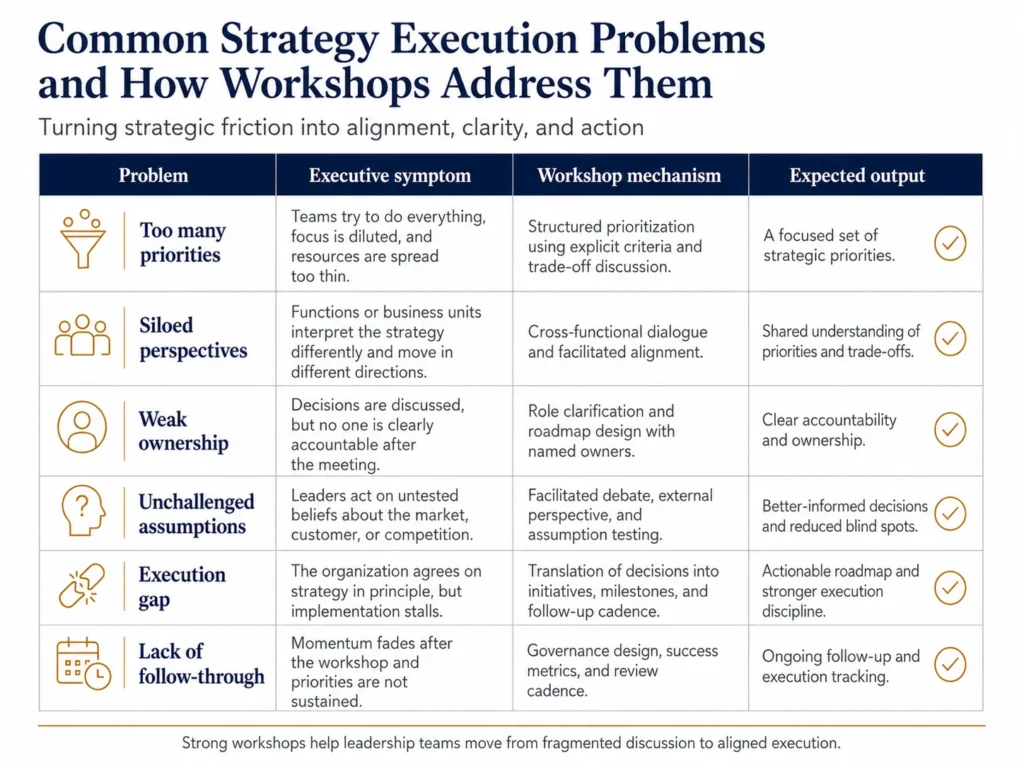
Figure 2. Common Strategy Execution Problems and How Midas’ Workshops Address Them: Strong workshops help leadership teams move from fragmented discussion to aligned execution.
This matters because implementation depends not only on the quality of the strategy, but also on whether managers share a common understanding of what the strategy requires. The Academy of Management article Managing Strategic Consensus: The Foundation of Effective Implementation emphasizes the role of shared understanding and commitment in effective implementation.
Our workshops overcome these hurdles by combining external facilitation with your internal expertise. Depending on the strategic challenge, a workshop can also be combined with other Midas methodologies. Companies facing competitor uncertainty may benefit from competitive wargaming. Teams planning under uncertainty may benefit from scenario consulting. Companies preparing a launch or commercial acceleration may benefit from go-to-market consulting.
One participant summarized it perfectly in a post-workshop review:
“The guidance and challenges during the session led us to the best outcome. We developed strategies we could implement immediately.”
Category Manager, B2B, 2024
How Our Process Works
Our workshops are built around three principles: fact-based preparation, structured executive debate, and implementation discipline. Each engagement is tailored to the client’s context, but the process usually includes four stages:
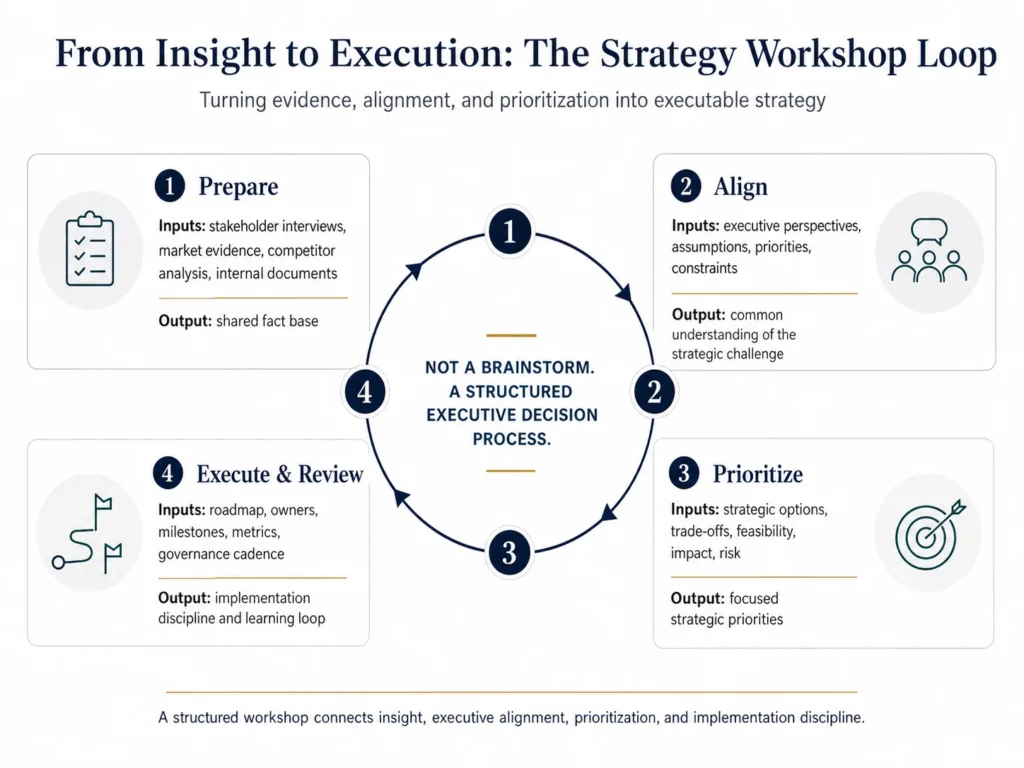
Figure 3. Midas’ Process From Insight to Execution: A strategy workshop connects evidence, executive alignment, prioritization, and implementation discipline so leadership teams can move from discussion to action.
1. Preparation
We begin with stakeholder interviews, market evidence, competitor analysis, customer insights, and internal documents. The goal is to build a shared fact base before the workshop begins, so the workshop starts from evidence rather than opinion.
For example, a workshop focused on growth priorities may require market analysis. A workshop focused on competitive response may require competitor analysis. A workshop focused on commercial conversion may require win-loss analysis. The preparation phase should be designed around the decision the leadership team needs to make.
The quality of that evidence can change the strategic conversation. In the Midas Import Competition Monitor 2026, we analyzed 151 business decisions made in response to trade opening in Argentina and found very different responses to similar competitive pressure. Forbes Argentina used our research to examine how companies are investing, reconfiguring production, regionalizing, importing, reducing capacity, or exiting. This type of evidence helps ensure that a strategy workshop starts from real market behavior rather than internal assumptions alone.
Our preparation can draw on Midas’s Applied Strategic Intelligence Hub, which brings together strategic frameworks, applied research, and real-world lessons for executives. This helps us design workshop exercises that challenge assumptions, pressure-test strategic options, and connect the discussion to practical executive decisions.
2. Workshop design
We design the agenda around the strategic decisions the leadership team needs to make. This may include exercises to test assumptions, prioritize opportunities, compare scenarios, or simulate competitor responses.
The workshop design changes depending on the strategic challenge. A market expansion workshop may connect with market entry c|onsulting. A commercial acceleration workshop may connect with go-to-market consulting. A workshop designed to test competitive reactions may connect with wargame consulting or scenario consulting.
3. Prioritization and decision-making
During the workshop, we help the team compare options using explicit criteria such as strategic impact, feasibility, resource intensity, time to impact, risk, and organizational readiness. At Midas, we define strategic decision-making as the process of choosing where to focus resources, which trade-offs to accept, and how to act under uncertainty.
How We Prioritize Strategic Options:
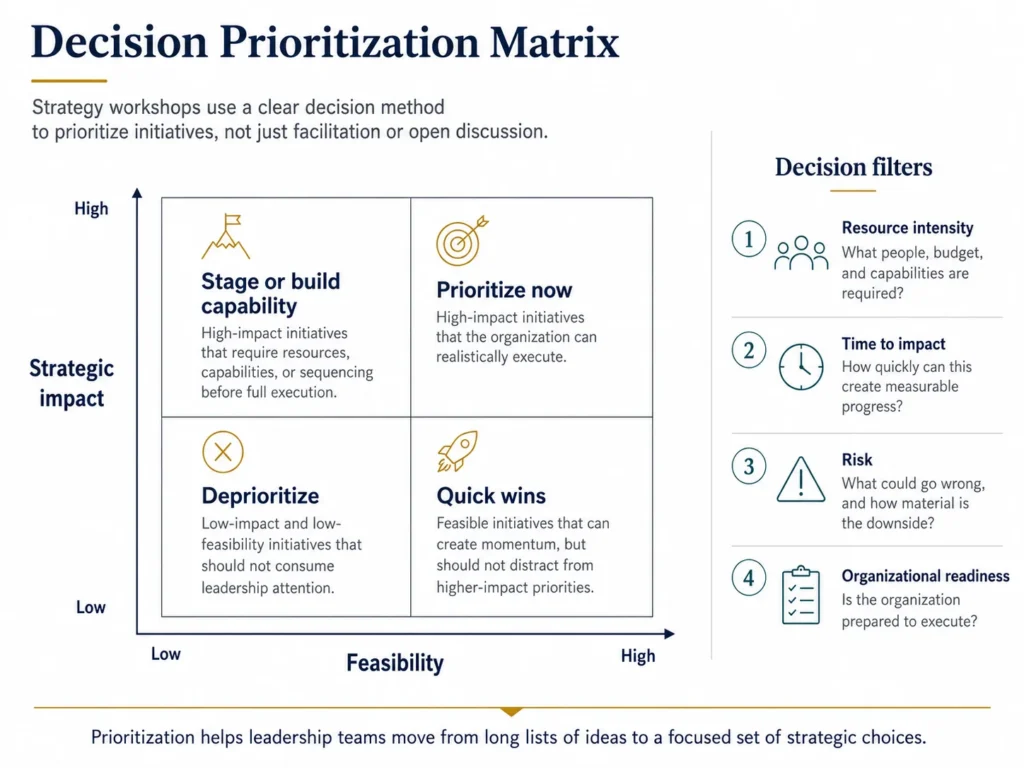
Figure 4. Midas’ Decision Prioritization Matrix: Prioritization helps leadership teams move from long lists of ideas to a focused set of strategic choices
Clear decision roles and decision processes are critical to execution. Harvard Business Review discusses this in Who Has the D? How Clear Decision Roles Enhance Organizational Performance.
4. Implementation roadmap
The workshop ends with priorities, owners, milestones, metrics, and a follow-up cadence so that execution can begin immediately after leadership validation. For companies that need to connect strategy with commercial implementation, this approach can be complemented with Midas’s go-to-market consulting services.
As a Marketing Manager of a B2B company told us during a post-workshop debriefing in 2024:
“The organization, information management, and pre-reading materials were excellent and key to the success of the workshop.”
Strengths and Limitations of Strategy Workshops
Strategy workshops are powerful when they are used for the right problem: aligning leaders, making choices, and turning strategy into action. They are less useful when the team lacks decision authority, when critical evidence is missing, or when participants are not willing to make trade-offs.
Strengths
- High engagement: Leaders participate in shaping the strategy, which increases understanding, ownership, and commitment.
- Faster alignment: A structured workshop compresses analysis, debate, and prioritization into a focused executive process.
- Clearer choices: The process makes trade-offs explicit, helping teams decide what to pursue and what not to pursue.
- Practical outputs: The session produces priorities, owners, metrics, and next steps that can be translated into execution.
Limitations
- Preparation is essential: A workshop without a strong fact base can become opinion-driven.
- Decision authority matters: If the right leaders are not in the room, the workshop may generate ideas but not decisions.
- Follow-through is required: Even the best workshop needs governance, metrics, and leadership discipline after the session.
- Trade-offs can be uncomfortable: Strong workshops often challenge entrenched views, which requires openness and leadership courage.
When a Strategy Workshop Is the Right Tool and When It Is Not
A strategy workshop is especially useful when leadership needs to make choices, align functions, challenge assumptions, or convert analysis into an implementation roadmap.
It is not the right tool when the leadership team lacks decision authority, when critical market evidence is missing, or when participants are unwilling to make trade-offs. In those cases, the first step may be market research, competitive intelligence, scenario analysis, or leadership alignment before the workshop.
When the missing input is external evidence, the first step may be a focused market analysis, competitor analysis, or benchmarking effort before bringing the leadership team into a workshop.
For market-expansion decisions, see our market entry consulting work. For commercial execution decisions, see our go-to-market consulting services. For broader strategic direction, see our strategy consulting services.
Real-World Examples
B2B industrial company, defending against a global competitor
A B2B industrial company was facing pressure from a global competitor. Midas designed a workshop to align the leadership team around likely competitor moves, internal vulnerabilities, and defensive priorities. The output was a coordinated action plan with country-level priorities, owners, and next steps.
Food company, entering a government market
A food company aiming to sell into the public sector faced fragmented regulations, complex pricing dynamics, and a highly specific bidding environment. Midas designed a go-to-market strategy during a workshop that clarified pricing, competitive dynamics, and bidding processes. For companies facing similar commercial execution challenges, Midas also provides go-to-market consulting.
Healthcare company, building a five-year roadmap in Brazil
A medical equipment manufacturer needed a five-year roadmap for Brazil. Midas combined market research with a tailored strategy workshop to help the team identify growth priorities, reduce blind spots, and align around a practical implementation plan. For healthcare and pharmaceutical organizations, Midas also provides specialized consulting for the pharmaceutical and healthcare industry.
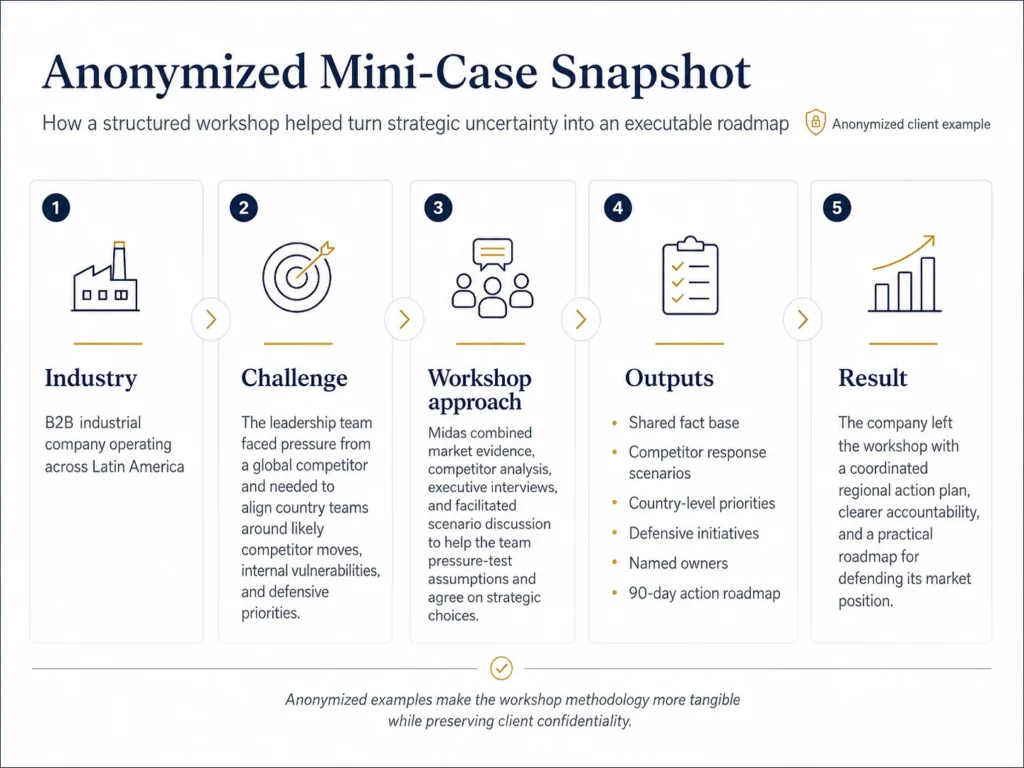
Figure 5. Anonymized Mini-Case Snapshot: An anonymized example makes the workshop methodology more tangible while preserving client confidentiality.
These examples reflect how Midas combines market insight, facilitation, and strategy consulting to help clients move from analysis to action.
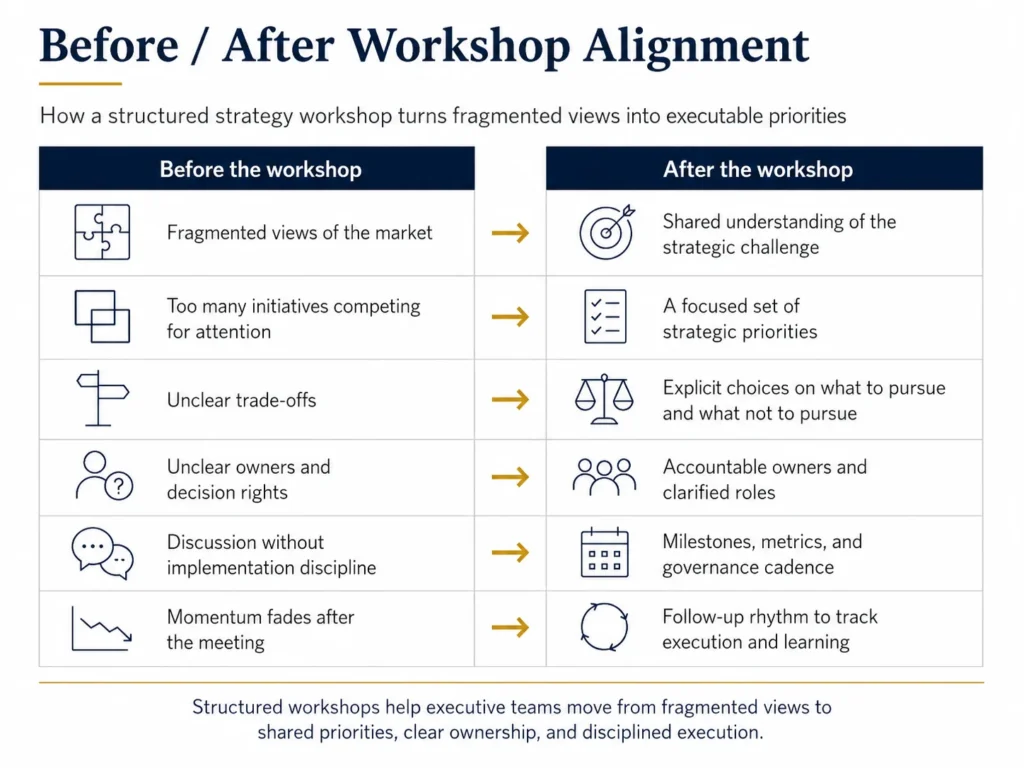
Figure 6. Before / After Workshop Alignment: Structured workshops help executive teams move from fragmented views to shared priorities, clear ownership, and disciplined execution.
One participant said in a post-workshop talk in 2023:
“We weren’t left working alone at any point. That was the critical factor for success.”
Senior Brand Manager, Pharma.
Why Strategy Workshops Work
- Proven methodology: We have refined our workshop model through 70+ projects in B2B, pharmaceutical, IT, and B2C industries. The foundation of our workshop exercises is built on Midas’s applied research in strategic intelligence, competitive simulation, business wargaming, regional strategy, and execution excellence, available in our Applied Strategic Intelligence Hub.
- Deep experience: Our team has led strategy across Latin America for more than 25 years, helping companies make decisions in complex, uncertain, and competitive environments.
- Tailored facilitation: We do not impose templates. We co-create strategies that fit the client’s business reality, competitive context, and implementation capacity.
- Execution orientation: The workshop is designed to end with priorities, owners, metrics, and next steps, so the team can move from discussion to disciplined action.
As one Business Unit Manager put it in a post-workshop talk:
“I think Midas was the first to implement workshops in the region, and they are the most experienced.”
Frequently Asked Questions About Strategy Workshops
Who should participate in a strategy workshop?
The right participants depend on the decision to be made. In most cases, the workshop should include the executive sponsor, business leaders, and the functions required for implementation, such as marketing, sales, finance, operations, or country leadership.
How much preparation is required?
Preparation is critical. A strong workshop usually requires stakeholder input, market evidence, competitor analysis, customer insight, and a clear definition of the strategic decisions to be addressed.
What should a strategy workshop produce?
A strategy workshop should produce clear priorities, explicit trade-offs, accountable owners, success metrics, and a practical implementation roadmap.
How do you avoid a workshop becoming just another meeting?
The key is structured facilitation, a clear decision agenda, fact-based preparation, and follow-up governance. The workshop should be designed around decisions, not presentations.
Can strategy workshops be combined with other methodologies?
Yes. Strategy workshops can be combined with market analysis, competitor analysis, benchmarking, win-loss analysis, competitive wargaming, scenario planning, go-to-market consulting, or market entry consulting, depending on the strategic challenge.
Conclusion: Are You Ready to Rethink Strategy?
If your leadership team needs to make a strategic choice, align functions, challenge assumptions, or turn analysis into an implementation roadmap, a strategy workshop can create the structure, challenge, and commitment required to move from discussion to action.
Our approach does not just produce insights. It produces alignment, ownership, and a concrete roadmap. Most importantly, it helps your people understand the strategy well enough to implement change with confidence.
Because in today’s world, being clear is not enough. You need to be clear, aligned, and ready to act.
About the Author:
By Adrian Alvarez, PhD. Adrian Alvarez is Managing Partner at Midas Consulting, a Wharton Alumnus, MBA Professor at Universidad Argentina de la Empresa (UADE), and Competitive Intelligence Fellow. He specializes in competitive strategy, growth strategy, and strategic decision-making under uncertainty across Latin America.
He has led dozens of executive strategy workshops for leadership teams across Latin America. You can explore his applied research and executive frameworks in Midas Consulting’s Applied Strategic Intelligence Hub.
View professional profile on LinkedIn
Selected External References
This article is informed by Midas Consulting’s experience facilitating executive strategy workshops across Latin America and by respected sources on strategy execution, decision-making, strategic alignment, and organizational follow-through.
- Harvard Business Review: Why Strategy Execution Unravels — and What to Do About It
- MIT Sloan Management Review: Closing the Gap Between Strategy and Execution
- Wharton Executive Education: Making Strategic Decisions: Do You Have What It Takes?
- Academy of Management Executive: Managing Strategic Consensus — The Foundation of Effective Implementation
- Universidad de Buenos Aires, Faculty of Economic Sciences, Adrian Alvarez: Strategy Workshops: From Vision to Action
Related Midas Resources for Strategy Workshops
Strategy workshops often sit at the intersection of strategic analysis, executive alignment, decision-making, and implementation. These Midas resources can help executives connect workshop design with the evidence and follow-up actions required to turn discussion into results:
- Strategy Consulting: When leadership teams need to make broader choices about growth, positioning, resource allocation, priorities, and execution.
- Go-to-Market Consulting: When the workshop needs to translate strategy into customer targeting, value proposition, pricing, channels, sales priorities, and commercial execution.
- Market Entry Consulting: When the leadership team needs to decide which markets, countries, or segments to prioritize and how to enter them.
- Wargame Consulting: When a workshop needs to pressure-test a strategy against competitor reactions, countermoves, and market escalation risks.
- Scenario Consulting: When uncertainty is high and leadership teams need to explore alternative futures before committing to a strategic path.
- Applied Strategic Intelligence: When executives need a stronger fact base to interpret market signals, competitor behavior, customer needs, and strategic uncertainty.
For executives who want to explore the analytical foundations behind strategy workshops, these Midas articles provide additional context:
- Market Analysis: When workshop preparation depends on understanding demand, customer needs, market structure, barriers, and opportunity attractiveness.
- Competitor Analysis: When the workshop needs a stronger view of competitor behavior, positioning, capabilities, likely moves, and strategic vulnerabilities.
- Benchmarking: When leadership teams need to compare practices, capabilities, performance, or strategic choices before prioritizing improvement actions.
- Value Proposition Design: When the workshop focuses on clarifying why customers should choose the offer and how to make that value more credible and differentiated.
- Win-Loss Analysis: When buyer feedback is needed to understand why customers choose, reject, switch from, or stay with specific offers.
Together, these resources show how strategy workshops fit into a broader strategy process: build the fact base, align the leadership team, make explicit choices, assign ownership, and translate decisions into execution.
Ready to Turn Strategy Into Action?
Understanding how strategy workshops work is one thing. Designing and facilitating them so they produce real decisions is another.
At Midas Consulting, we work with leadership teams before, during, and after the workshop: preparing the fact base, designing the decision agenda, facilitating the discussion, and translating outputs into a practical roadmap.
With more than 70 strategy workshops behind us, we have refined an approach that helps companies move from fragmented discussion to shared priorities, clear ownership, and disciplined execution.
A Few of Our Customers:

Benefits that You Can Expect from Our Strategy Workshops Consulting:
Craft a Winning Strategy
Get Team Buy-In
Implement with Confidence
Explore your market and competitive landscape to find new opportunities
Involve your team from the beginning for smoother implementation and better alignment
Leave the workshop with a tested, actionable roadmap to achieve your goals
Related Midas Resources
If you are exploring strategy workshops, these related Midas resources may also be useful:
- Strategic consulting services
- Competitive wargaming
- Scenario consulting
- Go-to-market consulting
- Market entry consulting
- Applied Strategic Intelligence Hub
- Midas Consulting team
Ready to Accelerate Your Strategy Journey?
Book a call
Join a workshop
Implement with confidence
We’ll design a custom roadmap
We’ll guide your team through the process
Achieve your goals with a fully vetted strategy
Let’s develop a winning strategy together!