
Pharmaceutical, biologic, healthcare, medical device consulting to grow.
A clinically valuable product does not automatically become a successful healthcare business.
Your specialty pharmaceutical or biologic may address an important unmet need but struggle because eligible patients are difficult to identify, physicians lack experience with the treatment, diagnostic pathways are fragmented, reimbursement is uncertain, or access differs across institutions.
Your medical device may perform well but face long hospital evaluations, procurement barriers, training requirements, capital-budget constraints, or resistance from clinicians who are comfortable with the current standard of care.
Your healthcare consumable may appear straightforward but depend on tender cycles, institutional protocols, distributor coverage, inventory reliability, and repeat use by healthcare professionals.
Midas Consulting helps pharmaceutical, biologic, medical-device, and healthcare-consumable companies understand this complete market-access and commercial system.
For more than 25 years, we have helped companies evaluate markets, prioritize opportunities, understand stakeholders, identify partners, benchmark competitors, design go-to-market strategies, and expand across Latin America and selected international markets.
Our work can support companies operating in:
- Specialty pharmaceuticals
- Biologics and biosimilars
- Rare and complex diseases
- Hospital products
- Prescription medicines
- Medical devices
- Diagnostic products
- Surgical and procedural products
- Healthcare consumables
- Drug-delivery systems
- Patient-support technologies
- Related healthcare markets
We help you answer questions such as:
- Which countries, therapeutic areas, indications, patient groups, institutions, and channels should you prioritize?
- How many patients may be eligible, diagnosed, treated, and commercially accessible?
- Where does the patient pathway break down?
- Which physicians, specialists, hospitals, laboratories, payers, procurement organizations, and patient groups influence adoption?
- What evidence will clinicians, institutions, payers, and purchasers require?
- How does the standard of care differ across countries and institutions?
- What barriers could delay diagnosis, prescription, approval, purchasing, treatment initiation, or continued use?
- Should your company establish a direct presence, appoint a distributor, license the product, partner with a local pharmaceutical company, or pursue an acquisition?
- Which distributors or commercialization partners can manage regulatory, medical, institutional, logistics, and market-access requirements?
- How should you position your product against the current standard of care, alternative technologies, and emerging competitors?
- How should pricing, reimbursement, tendering, and access conditions affect your market priorities?
- How can you support healthcare professionals and institutions without overstating the available evidence?
- Which competitors are likely to enter, expand indications, change prices, form partnerships, or strengthen access?
- What must happen during the first months of a launch to create sustainable adoption?
You receive more than a healthcare market report.
You receive a clearer understanding of the patients, pathways, stakeholders, evidence, access requirements, partners, and commercial actions that determine whether your product can create meaningful and sustainable growth.
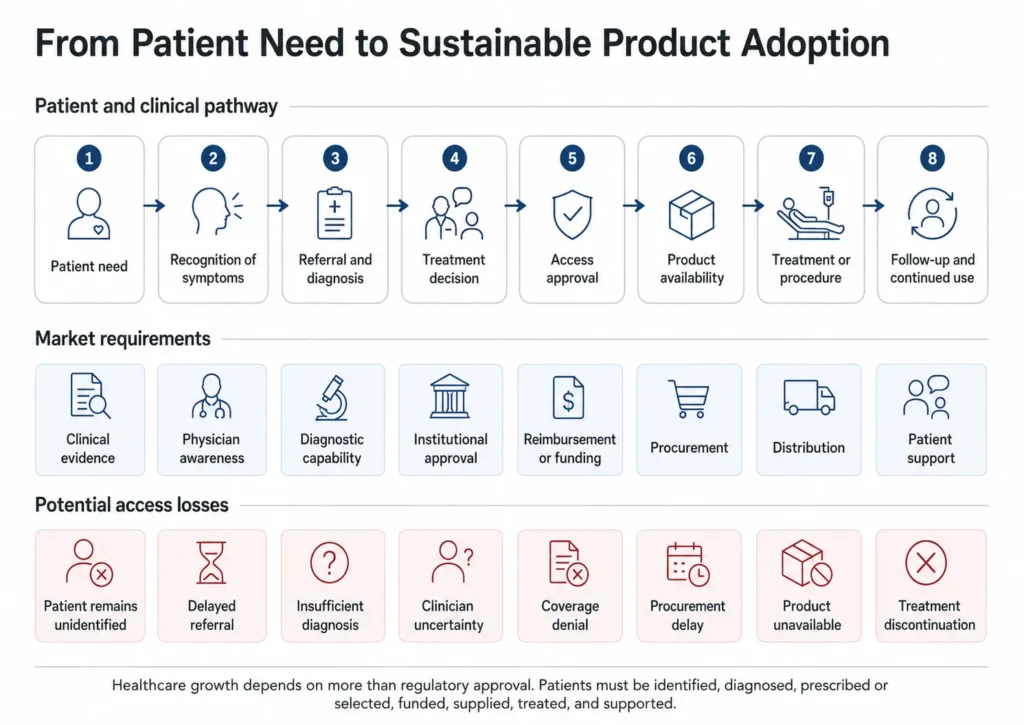
Figure 1: Healthcare growth depends on more than regulatory approval. Patients must be identified, diagnosed, prescribed or selected, funded, supplied, treated, and supported.
Begin with the Patient Pathway
Healthcare markets are often described through broad categories:
- Oncology
- Immunology
- Rare diseases
- Cardiology
- Neurology
- Gastroenterology
- Diagnostics
- Surgical devices
- Hospital consumables
Those categories are useful, but they do not reveal the commercially accessible opportunity.
Two products serving the same therapeutic area may face very different realities depending on:
- Disease prevalence
- Patient severity
- Diagnostic criteria
- Biomarker availability
- Referral patterns
- Treatment setting
- Physician specialization
- Competing standards of care
- Funding
- Institutional capacity
- Geographic access
- Treatment persistence
The theoretical number of patients is only the beginning.
A useful market assessment should distinguish among:
- People who may have the condition. The epidemiological population.
- Patients who enter the healthcare system. Those who seek care or are identified through screening.
- Patients who receive an accurate diagnosis. Those who complete the necessary clinical, laboratory, imaging, or genetic process.
- Patients who are eligible for the product. Those who meet the clinical, regulatory, and treatment criteria.
- Patients who receive access approval. Those whose insurer, health system, institution, or payer authorizes treatment.
- Patients who begin treatment. Those for whom the product is prescribed, purchased, supplied, and initiated.
- Patients who continue treatment. Those who remain on therapy or continue using the device as clinically appropriate.
We help you identify where patients are lost along this pathway and which barriers your company can legitimately help address.
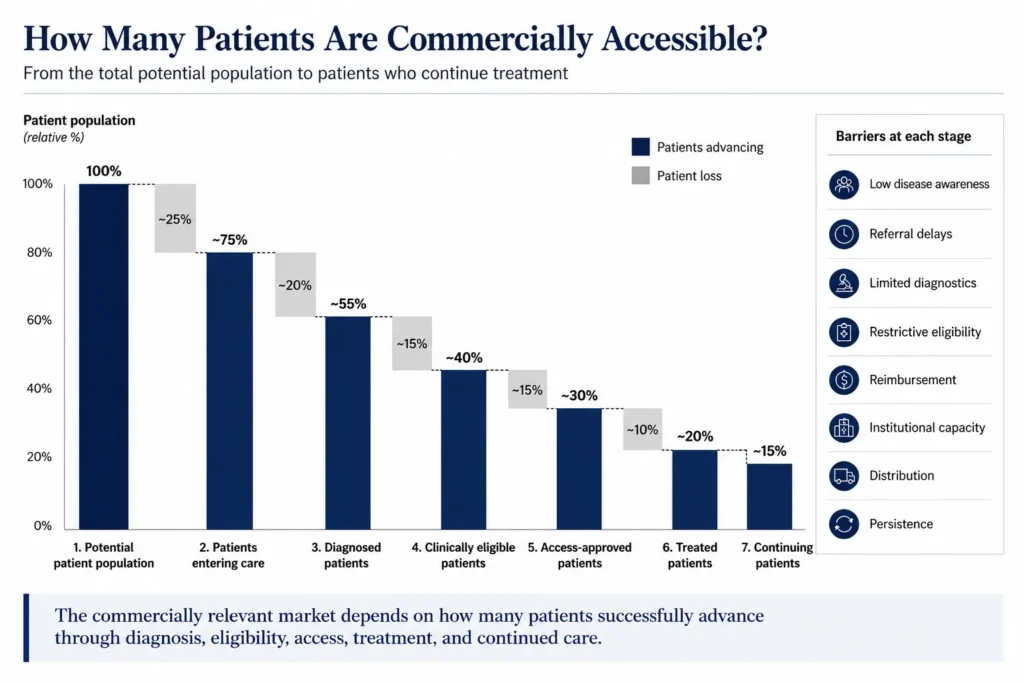
Figure 2: The commercially relevant market depends on how many patients successfully advance through diagnosis, eligibility, access, treatment, and continued care.
Specialty Pharmaceuticals Require More Than a Prevalence Estimate
For specialty and biologic products, demand may depend on a small number of highly specific variables.
These may include:
- Disease subtype
- Severity
- Biomarker status
- Treatment line
- Prior treatment failure
- Comorbidities
- Contraindications
- Physician experience
- Diagnostic access
- Treatment-center capacity
- Reimbursement restrictions
- Patient affordability
- Administration requirements
A prevalence estimate may overstate the opportunity when:
- Many patients remain undiagnosed
- Diagnostic criteria are inconsistently applied
- Testing is unavailable outside major cities
- Referral pathways are weak
- Treatment requires a specialist center
- Reimbursement is narrow
- Competing treatments are deeply established
- Physicians reserve the product for late treatment lines
- Administration creates logistical barriers
We build specialty-pharmaceutical market models that make these assumptions visible.
An illustrative model may use:
Relevant population × prevalence × diagnosis rate × clinical eligibility × access rate × treatment initiation × persistence
Each component should be adapted to the disease, product, country, and treatment setting.
When exact evidence is unavailable, we present scenarios or ranges rather than a single unsupported figure.
Epidemiological Potential Is Not the Same as Treated Demand
A market can appear large based on prevalence while the accessible opportunity remains limited by diagnosis, referral, eligibility, reimbursement, institutional capacity, or treatment persistence.
We help you identify which barriers materially affect the opportunity.
The Standard of Care Defines the Real Competitive Market
A healthcare product does not compete only against products with the same mechanism, material, or regulatory classification.
It may compete against:
- Another pharmaceutical
- A biologic
- A biosimilar
- Surgery
- A medical device
- Watchful waiting
- Symptom management
- An older generic therapy
- A hospital protocol
- A diagnostic alternative
- No treatment
- Delayed treatment
The relevant question is:
What does the physician, institution, payer, or patient do today?
We examine:
- Current treatment algorithms
- Treatment sequencing
- Clinical guidelines
- Physician habits
- Institutional protocols
- Patient characteristics
- Reasons for switching
- Reasons for remaining with the current approach
- Unmet needs
- Safety concerns
- Administration burden
- Monitoring
- Total treatment cost
This broader definition helps reveal competitors that a product-level market map may miss.
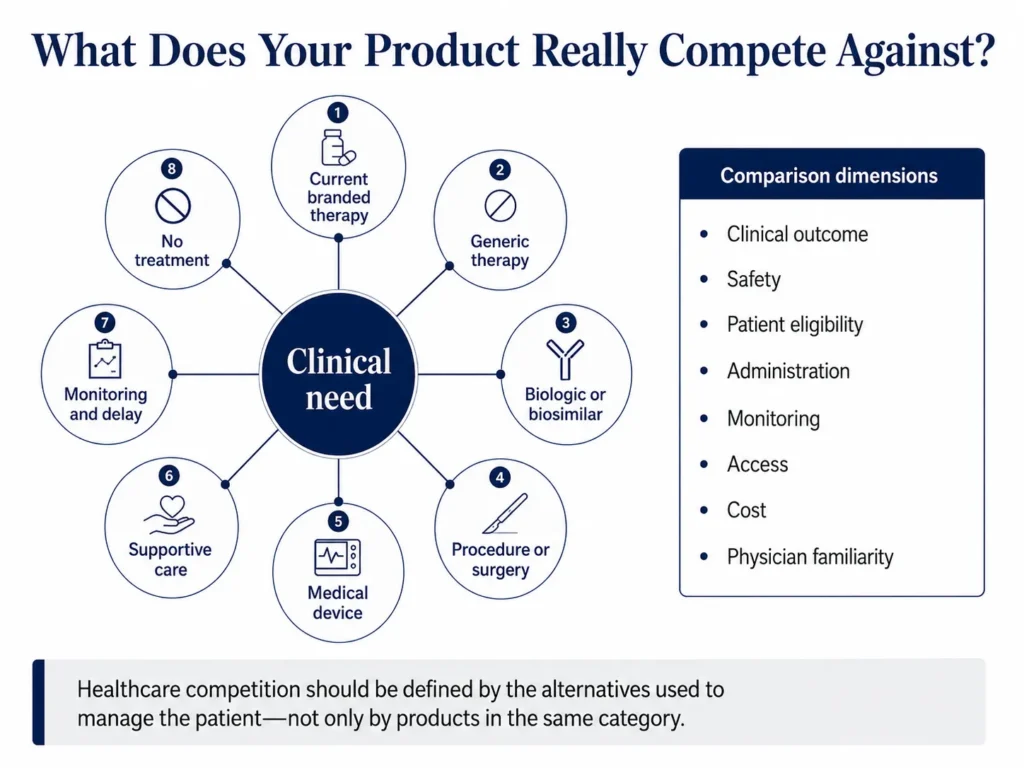
Figure 3: Healthcare competition should be defined by the alternatives used to manage the patient—not only by products in the same category.
Healthcare Decisions Are Made by a Network, Not One Buyer
Different stakeholders may influence whether a product is used, funded, purchased, and continued.
Depending on the market, the decision network may include:
- Specialists
- Primary-care physicians
- Surgeons
- Nurses
- Pharmacists
- Diagnostic laboratories
- Hospital committees
- Pharmacy and therapeutics committees
- Procurement
- Hospital management
- Insurers
- Public payers
- Health technology assessment bodies
- Regulators
- Distributors
- Specialty pharmacies
- Patient associations
- Patients and caregivers
Each stakeholder evaluates a different part of the decision.
Clinicians may ask:
- Which patients benefit?
- How strong is the evidence?
- How does the product compare with the standard of care?
- What safety and monitoring requirements apply?
- How difficult is administration?
Institutions may ask:
- Does the product fit the treatment protocol?
- What infrastructure or training is required?
- How will it affect patient flow?
- Can it be stocked and managed safely?
- What budget impact will it create?
Payers may ask:
- What clinical and economic value does it provide?
- Which patients should receive it?
- What restrictions are appropriate?
- How uncertain is the evidence?
- How will utilization be controlled?
Procurement may ask:
- What is the price?
- Is it included in a tender or purchasing agreement?
- Are alternatives available?
- Can the supplier guarantee availability?
- What commercial conditions apply?
Patients and caregivers may ask:
- Can I access the treatment?
- How is it administered?
- What support is available?
- How will it affect my daily life?
- Can I continue treatment?
We help you map:
- Who identifies the patient
- Who recommends the product
- Who prescribes or selects it
- Who approves access
- Who purchases it
- Who administers or uses it
- Who monitors outcomes
- Who can delay or block adoption
- Which evidence each stakeholder requires
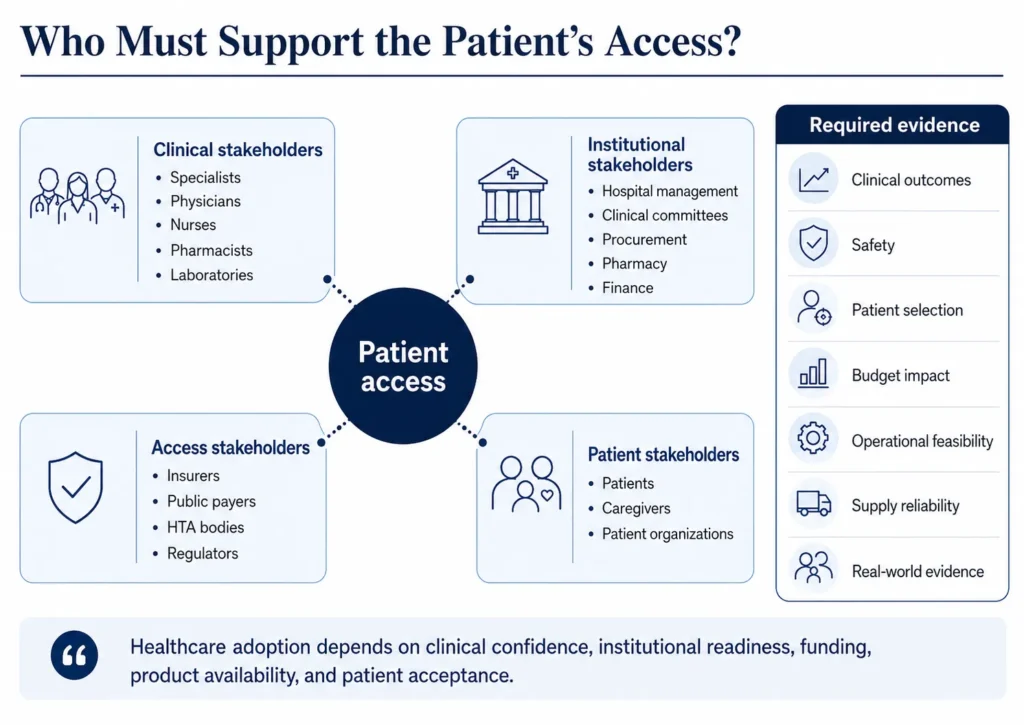
Figure 4: Healthcare adoption depends on clinical confidence, institutional readiness, funding, product availability, and patient acceptance.
Regulatory Approval Is Necessary, but It Is Not Market Access
A product may receive regulatory approval and still face substantial commercial barriers.
Market access may depend on:
- Formulary inclusion
- Reimbursement
- Coverage criteria
- Health technology assessment
- Institutional approval
- Hospital protocols
- Tender inclusion
- Budget allocation
- Coding
- Diagnosis-related funding
- Patient affordability
- Distribution
- Importation
- Cold chain
- Administration capacity
These conditions differ substantially across countries and institutions.
A product may be reimbursed nationally but remain difficult to access because local institutions lack budget or operational capacity.
A device may have authorization for sale but require hospital evaluation, capital approval, training, consumables planning, and service coverage.
A consumable may be technically approved but purchased almost entirely through tenders controlled by price, volume, and delivery requirements.
We help you understand the complete path from authorization to actual use.
This may include:
- Access pathways
- Reimbursement mechanisms
- Institutional decision criteria
- Payer requirements
- Tender structures
- Procurement cycles
- Distribution
- Patient co-payment or affordability
- Local operational barriers
- Evidence gaps
- Market-access sequencing
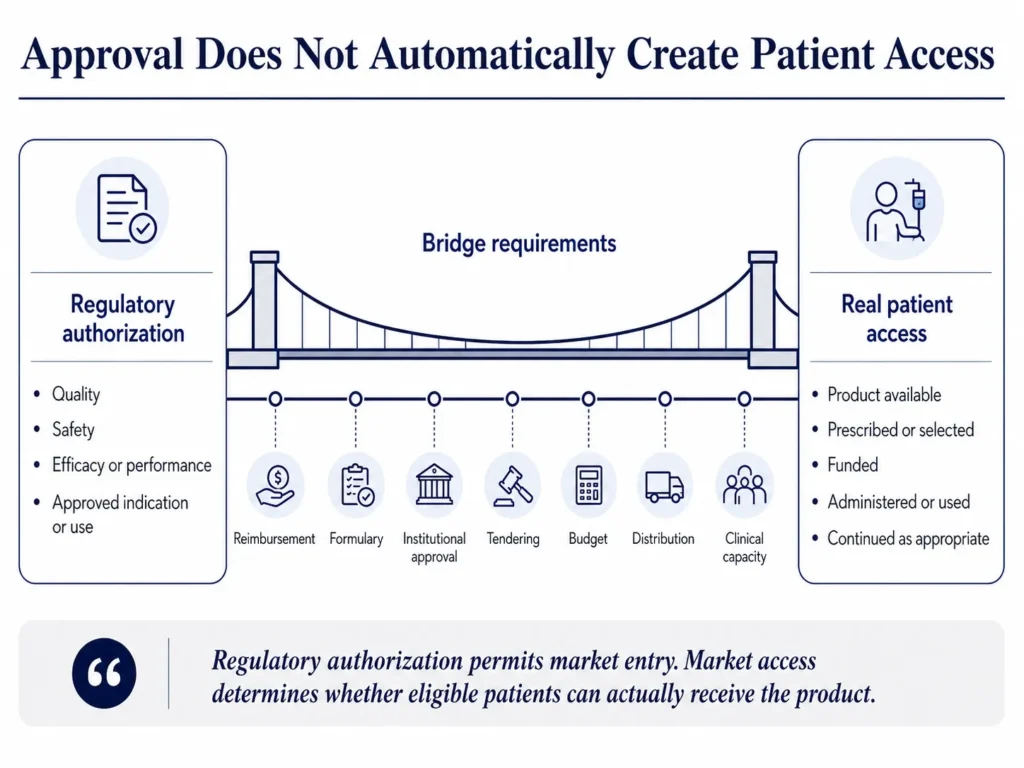
Figure 5: Regulatory authorization permits market entry. Market access determines whether eligible patients can actually receive the product.
Medical Devices Must Fit the Clinical Workflow
A medical device may perform well technically but fail commercially if it does not fit the hospital’s workflow.
Adoption may require changes to:
- Clinical procedures
- Staff responsibilities
- Sterilization
- Patient preparation
- Operating-room time
- Storage
- Documentation
- Maintenance
- Data systems
- Billing
- Training
Healthcare professionals may resist a device when it:
- Requires unfamiliar techniques
- Extends procedure time
- Creates additional preparation
- Lacks credible references
- Increases perceived clinical risk
- Is difficult to clean or maintain
- Requires unavailable accessories
- Has unreliable technical support
- Creates uncertainty about reimbursement
We help device companies evaluate:
- Clinical need
- Current procedure
- User requirements
- Workflow fit
- Training needs
- Evidence
- Capital or operating budget
- Consumables
- Maintenance
- Service
- Patient throughput
- Total procedure economics
A strong device value proposition connects:
Device capability, Clinical or workflow outcome, and Institutional and patient value
For example:
- Faster and more consistent procedure (reduced procedure time and greater predictability, more efficient use of clinical capacity)
- Improved monitoring accuracy (earlier recognition of patient deterioration, better clinical decision-making and lower avoidable risk)
Clinical Performance Is Only Part of Device Value
Hospitals may also evaluate procedure time, training, maintenance, consumables, service, workflow disruption, capacity, and total cost per patient.
Capital Equipment and Consumables Have Different Growth Economics
Healthcare products can generate demand through different business models.
Capital equipment
Examples may include:
- Diagnostic systems
- Imaging equipment
- Surgical equipment
- Laboratory platforms
- Monitoring systems
- Treatment devices
Demand may depend on:
- Installed base
- Equipment age
- Capacity
- Replacement cycles
- New hospitals
- New clinical programs
- Capital budgets
- Technology upgrades
- Service availability
Consumables linked to equipment
Examples may include:
- Cartridges
- Test kits
- Reagents
- Sensors
- Electrodes
- Catheters
- Surgical consumables
- Disposable components
Demand may depend on:
- Installed equipment
- Patient or procedure volumes
- Utilization
- Protocols
- Consumption per procedure
- Compatible alternatives
- Contract terms
Standalone healthcare consumables
Demand may depend on:
- Patient volumes
- Hospital activity
- Procedure rates
- Infection-control requirements
- Treatment protocols
- Tender cycles
- Replacement or use frequency
We help companies model both the initial placement and the recurring revenue opportunity.
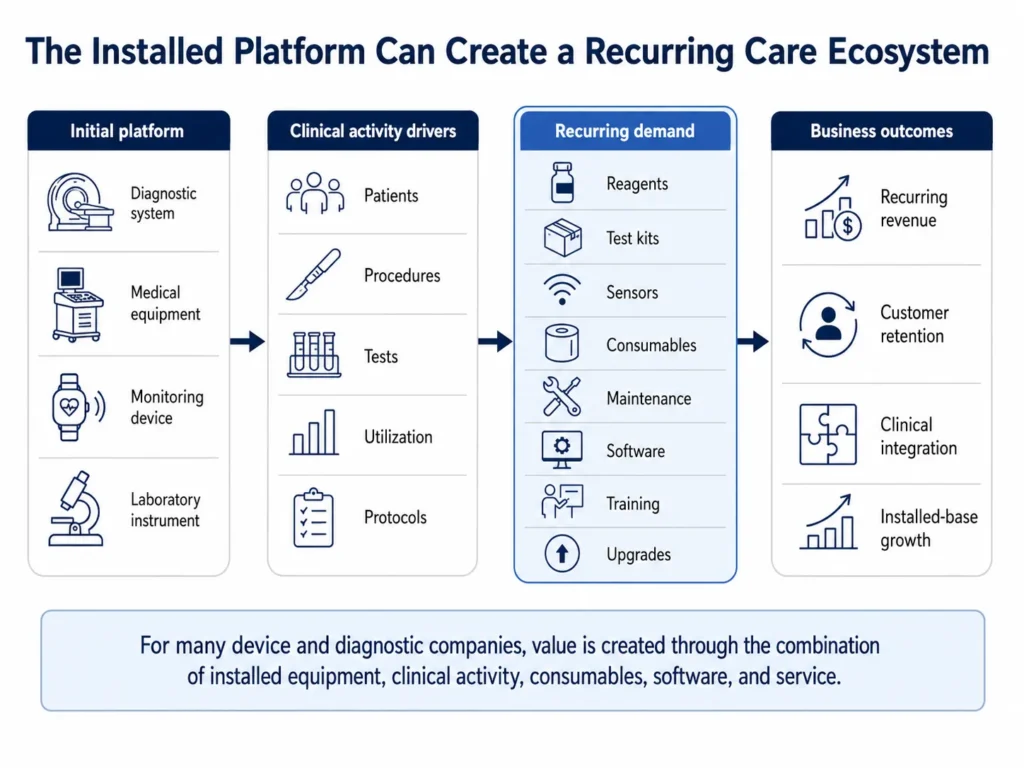
Figure 6: For many device and diagnostic companies, value is created through the combination of installed equipment, clinical activity, consumables, software, and service.
How We Estimate Pharmaceutical and Healthcare Demand
A useful market estimate should explain how demand is generated.
Depending on the product, the model may use:
Specialty pharmaceutical demand
Relevant population × prevalence × diagnosis × eligibility × access × treatment initiation × persistence
Hospital-product demand
Relevant institutions × patient or procedure volume × product use per case × purchasing accessibility
Diagnostic demand
Eligible population or clinical events × testing rate × platform penetration × tests per patient
Device demand
Relevant facilities or clinicians × equipment need × replacement or expansion rate
Device-consumable demand
Installed systems × utilization × consumables per procedure
Healthcare-consumable demand
Relevant procedures or patient days × consumption per procedure or day
Further adjustments
We then adjust for:
- Clinical protocols
- Physician practice
- Institutional capacity
- Access restrictions
- Tender cycles
- Current contracts
- Product substitution
- Informal or unrecorded purchasing
- Distributor coverage
- Commercial accessibility
When evidence is incomplete, we explain the assumptions and provide ranges or scenarios.
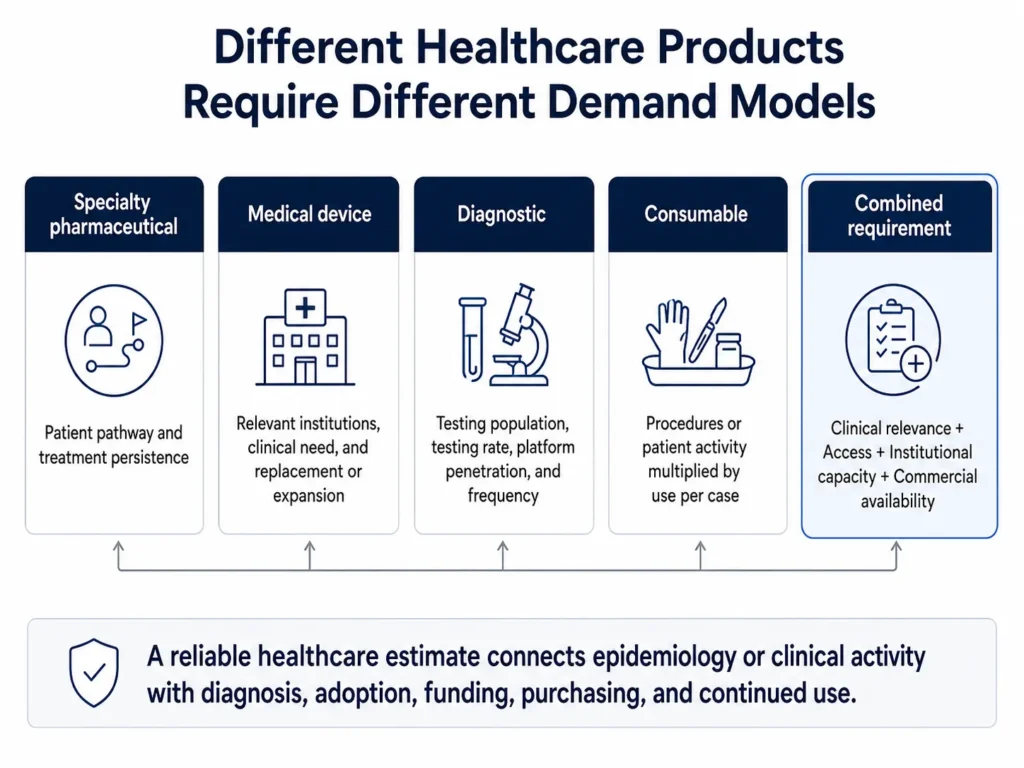
Figure 7: A reliable healthcare estimate connects epidemiology or clinical activity with diagnosis, adoption, funding, purchasing, and continued use.
Prioritize Institutions and Centers, Not Only Countries
A national market may appear attractive while access remains concentrated in a relatively small number of institutions.
Relevant centers may differ in:
- Patient volume
- Specialist concentration
- Diagnostic capability
- Treatment infrastructure
- Formulary status
- Purchasing model
- Research activity
- Referral influence
- Budget
- Access restrictions
- Openness to new products
A leading reference hospital can provide credibility but may be difficult to access.
A smaller center may offer a stronger initial opportunity when:
- The unmet need is clear
- Decision-makers are accessible
- The institution can complete the required evaluation
- Funding is available
- The product can generate measurable value
- The center can influence regional adoption
We help you prioritize institutions, treatment centers, laboratories, or professional groups using criteria such as:
- Relevant patient or procedure volume
- Clinical influence
- Diagnostic capacity
- Institutional readiness
- Access status
- Current standard of care
- Competitor position
- Decision access
- Reference value
- Probability of adoption
- Commercial potential
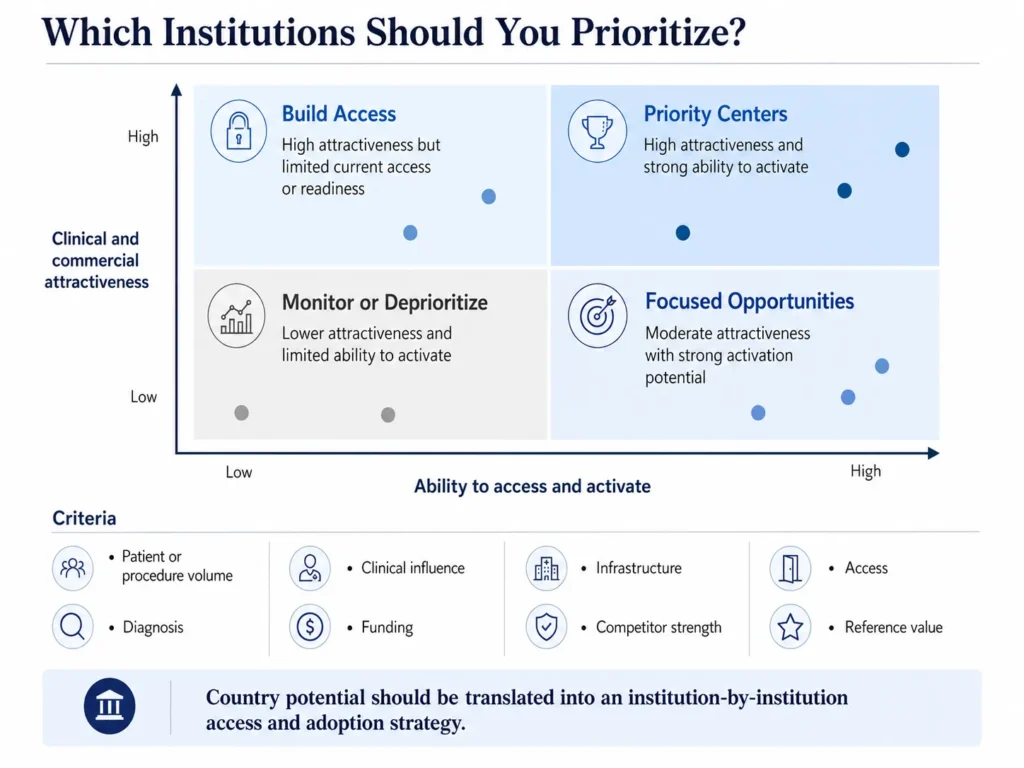
Figure 8: Country potential should be translated into an institution-by-institution access and adoption strategy.
Distribution in Specialty Healthcare Is a Strategic Capability
Pharmaceutical and healthcare distributors may need to provide more than importation and delivery.
Relevant capabilities may include:
- Product registration support
- Importation
- Cold chain
- Controlled products
- Specialty logistics
- Hospital access
- Tender participation
- Institutional sales
- Payer relationships
- Medical support
- Pharmacovigilance
- Complaint handling
- Traceability
- Inventory management
- Patient-support coordination
- Technical service
- Device installation
- Spare parts
- Training
The right partner profile depends on the product.
A specialty biologic may require:
- Cold chain
- Named-patient or exceptional-access experience
- Hospital relationships
- Reimbursement support
- Medical and regulatory capabilities
A device may require:
- Clinical sales
- Demonstration
- Installation
- Training
- Maintenance
- Spare parts
- Tender management
A consumable may require:
- Broad hospital coverage
- Tender capabilities
- Inventory
- Reliable delivery
- Price discipline
We evaluate potential distributors and commercialization partners across:
Market access
- Therapeutic-area experience
- Institutions
- Specialists
- Payers
- Tenders
- Geographic reach
Medical and regulatory capability
- Scientific understanding
- Medical affairs
- Regulatory support
- Pharmacovigilance
- Quality
- Compliance
Commercial capability
- Hospital sales
- Key accounts
- Tendering
- Reimbursement support
- Forecasting
- Launch execution
Operational capability
- Importation
- Cold chain
- Warehousing
- Traceability
- Inventory
- Delivery
- Technical service
Strategic commitment
- Portfolio fit
- Conflicts
- Management attention
- Investment willingness
- Launch resources
- Long-term alignment
Our work can include:
- Ideal-partner profile
- Market mapping
- Candidate identification
- Capability validation
- Initial approach
- Interest assessment
- Comparative evaluation
- Meeting coordination
- Negotiation preparation
- Governance and performance indicators
The objective is not simply to find a licensed distributor.
It is to identify a partner capable of navigating the clinical, access, institutional, regulatory, logistical, and commercial requirements of your product.
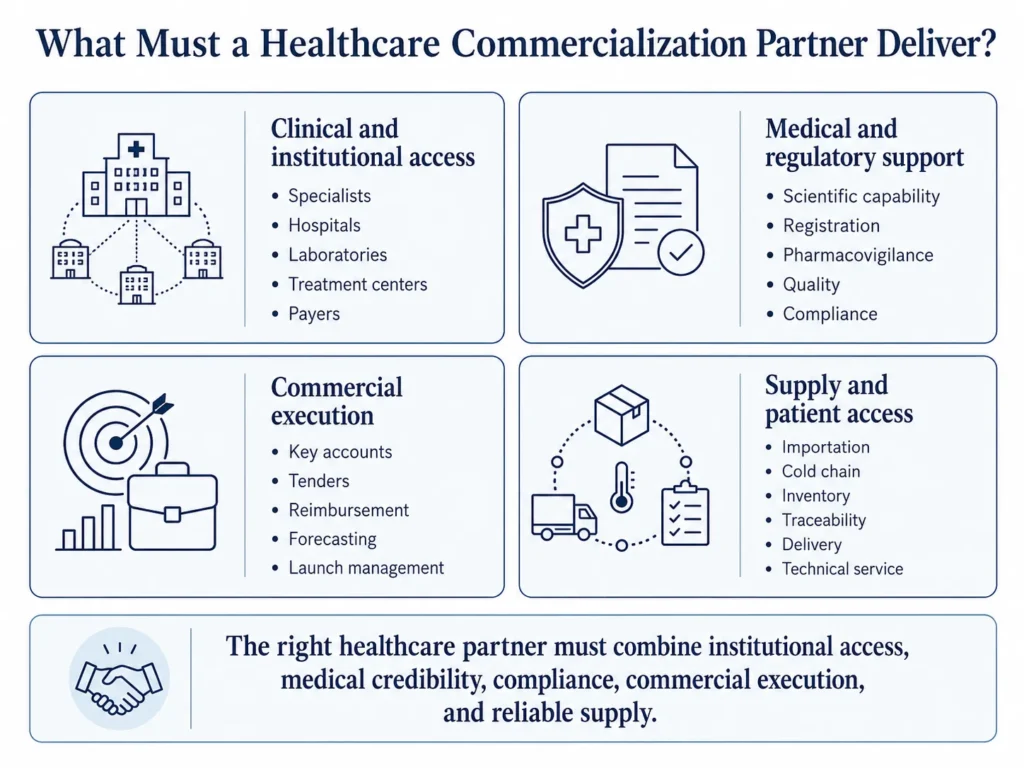
Figure 9: The right healthcare partner must combine institutional access, medical credibility, compliance, commercial execution, and reliable supply.
Go-to-Market Strategy for Specialty Pharmaceuticals
A specialty-pharmaceutical go-to-market strategy should connect:
- Patient pathway
- Diagnosis
- Therapeutic area
- Indication
- Prescribers
- Treatment centers
- Medical evidence
- Market access
- Reimbursement
- Distribution
- Patient support
- Launch execution
Depending on the product, the strategy may define:
- Priority countries
- Eligible patient segments
- Diagnostic pathway
- Priority specialists
- Reference institutions
- Medical-education needs
- Evidence gaps
- Reimbursement pathway
- Access sequencing
- Distributor or licensing model
- Supply requirements
- Patient-support needs
- Launch milestones
- Adoption and persistence indicators
Your final roadmap may include:
- Patient and treatment-pathway map
- Market-size scenarios
- Prescriber and center segmentation
- Access and reimbursement analysis
- Competitor profiles
- Value proposition by stakeholder
- Distributor or licensee strategy
- Medical and commercial coordination
- Launch sequence
- Early-adoption plan
- Patient-support implications
- Performance indicators
- Implementation governance
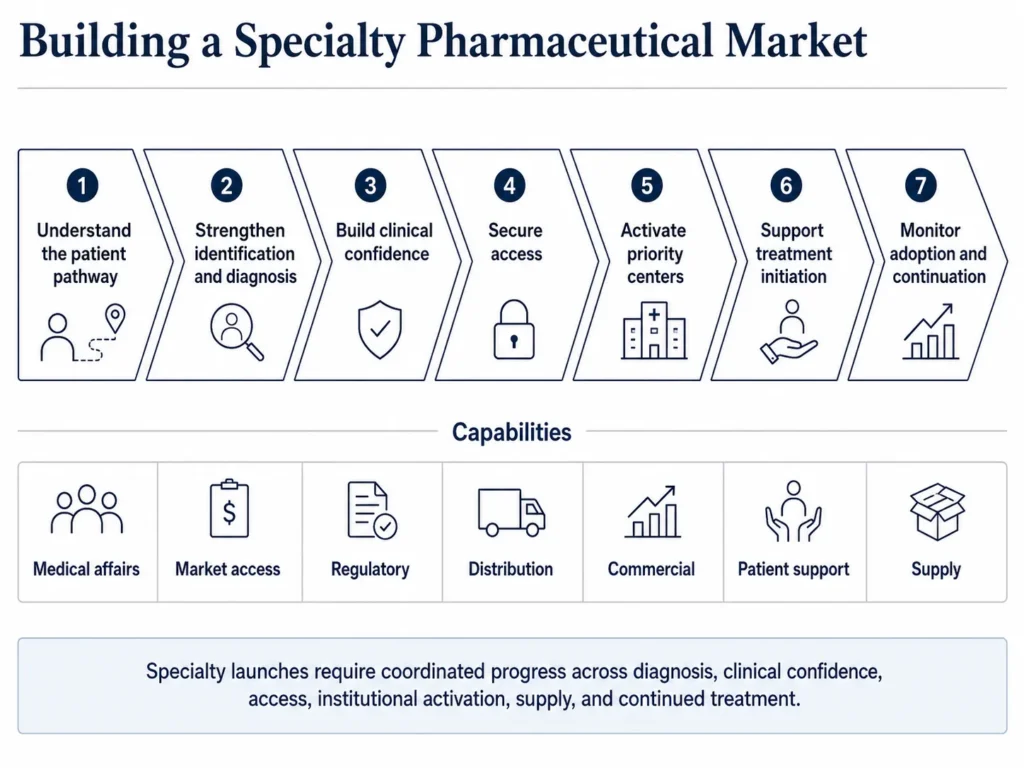
Figure 10: Specialty launches require coordinated progress across diagnosis, clinical confidence, access, institutional activation, supply, and continued treatment.
Go-to-Market Strategy for Devices and Consumables
Medical-device and consumable strategies often require different choices.
A device go-to-market model may need to define:
- Clinical users
- Hospital segments
- Demonstrations
- Evaluations
- Capital or operating budgets
- Tendering
- Training
- Installation
- Service
- Consumables
- Replacement
- Clinical references
A consumable strategy may need to define:
- Procedure volumes
- Institutional protocols
- Purchasing cycles
- Standardization
- Tender participation
- Distributor inventory
- Product availability
- Cost per procedure
- Professional preference
- Repeat use
The final roadmap may include:
- Priority institutions
- User and buying-center map
- Clinical and operational value proposition
- Trial or evaluation process
- Tender and procurement strategy
- Direct and distributor roles
- Service and training model
- Consumable attach strategy
- Pricing
- Inventory
- Account-development plans
- Adoption indicators
Market Entry in Latin American Healthcare Markets
Latin America should not be treated as one unified healthcare market.
Countries may differ in:
- Regulatory pathways
- Public and private coverage
- Reimbursement
- Health technology assessment
- Hospital concentration
- Procurement
- Tenders
- Out-of-pocket spending
- Distributor requirements
- Importation
- Cold chain
- Medical practice
- Diagnostic availability
- Institutional capacity
- Patient pathways
- Litigation and exceptional access
A product that succeeds through direct commercialization in one country may require a distributor, local pharmaceutical partner, licensee, or institutional model elsewhere.
We help you compare countries according to:
- Patient or procedure opportunity
- Clinical unmet need
- Regulatory path
- Access and reimbursement
- Institutional readiness
- Competitive intensity
- Partner availability
- Supply complexity
- Investment
- Ability to win
Potential entry models include:
- Direct commercialization
- Specialty distributor
- Local licensee
- Co-promotion
- Pharmaceutical partnership
- Device distributor
- Institutional partner
- Named-patient access
- Local affiliate
- Joint venture
- Acquisition
The right model should balance:
- Control
- Speed
- Medical capability
- Access
- Regulatory execution
- Commercial reach
- Supply
- Compliance
- Investment
- Long-term value
Benchmarking the Companies That Achieve Stronger Access and Adoption
Competitor market share does not explain why a healthcare company performs better.
Its advantage may come from:
- Stronger patient identification
- More effective medical education
- Better diagnostic support
- Greater physician confidence
- Earlier institutional access
- Stronger payer evidence
- Better tender capabilities
- More reliable supply
- Better patient support
- Stronger distributor management
- More focused centers and accounts
- Faster indication expansion
- Superior device service
- Better consumable availability
Depending on the decision, we may benchmark:
Market and patient focus
- Countries
- Indications
- Patient segments
- Treatment lines
- Priority centers
Medical and evidence strategy
- Medical affairs
- Scientific communication
- Evidence generation
- Investigator relationships
- Real-world evidence
- Diagnostic support
Market access
- Reimbursement
- Formulary
- Payer strategy
- Institutional access
- Tender capabilities
- Patient affordability
Commercial execution
- Account segmentation
- Field-force roles
- Key-account management
- Distributor governance
- Launch sequencing
- Performance indicators
Devices and services
- Demonstrations
- Training
- Installation
- Maintenance
- Spare parts
- Consumable attachment
- Clinical support
We normalize differences in indication, product maturity, market access, treatment setting, and commercial model before drawing conclusions.
The objective is not to copy a competitor.
It is to understand which capabilities explain the performance gap and what your organization should improve, adapt, or deliberately approach differently.
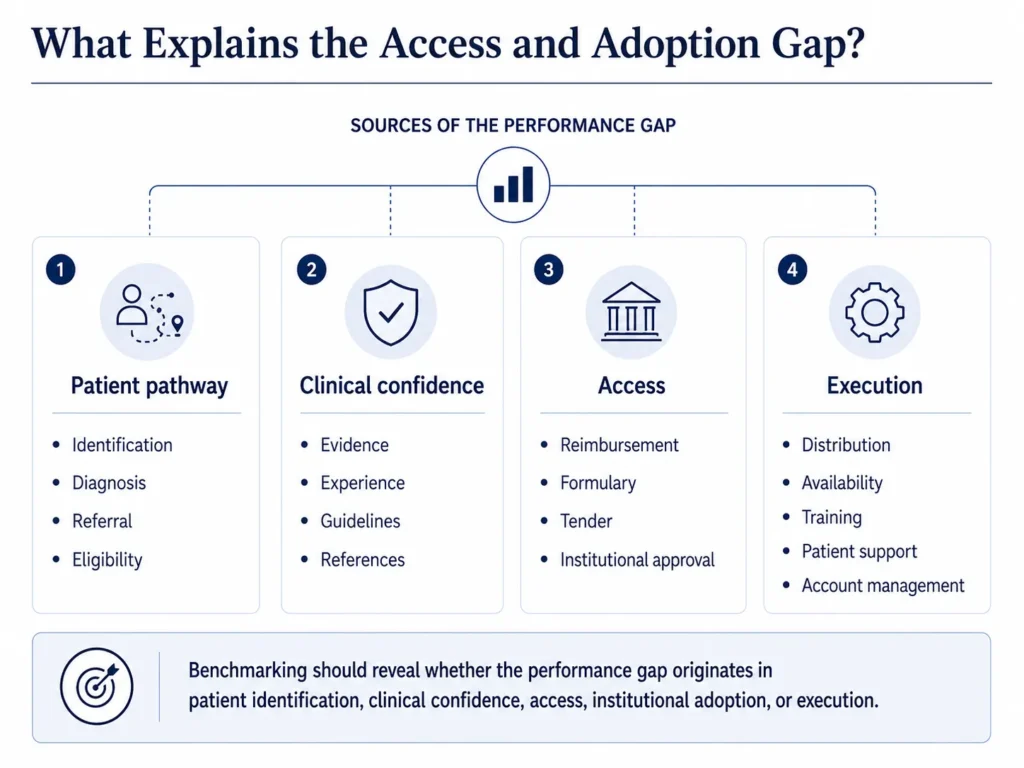
Figure 11: Benchmarking should reveal whether the performance gap originates in patient identification, clinical confidence, access, institutional adoption, or execution.
Pricing and Value Must Reflect the Healthcare Decision
Healthcare pricing cannot be separated from:
- Clinical outcomes
- Patient eligibility
- Treatment duration
- Administration
- Monitoring
- Avoided procedures
- Hospital utilization
- Complications
- Budget impact
- Procurement
- Competitive alternatives
- Access restrictions
For pharmaceuticals and biologics, relevant questions may include:
- Which patient outcomes create meaningful value?
- What is the impact on other healthcare resources?
- How will treatment duration affect cost?
- Which restrictions are likely?
- How will biosimilars or future competitors affect price?
For devices, relevant questions may include:
- Does the product reduce procedure time?
- Does it avoid complications?
- Does it improve clinical capacity?
- What consumables, maintenance, and training are required?
- Is the budget capital or operating?
For consumables, relevant questions may include:
- What is the cost per procedure?
- Does the product reduce waste, infection, failure, or rework?
- How sensitive is the tender to price?
- Can a technical advantage be protected in the specification?
We help you identify:
- Relevant value drivers
- Customer and payer perspectives
- Total treatment or procedure economics
- Price-volume trade-offs
- Tender implications
- Partner margins
- Cost to serve
- Price governance
- Access risks
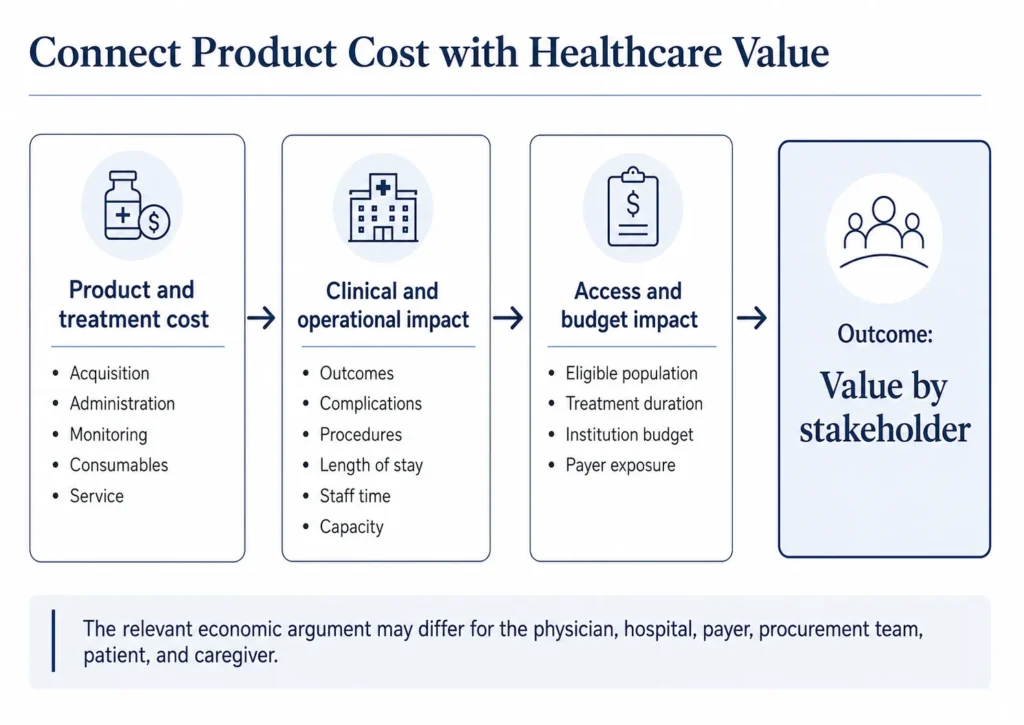
Figure 12: The relevant economic argument may differ for the physician, hospital, payer, procurement team, patient, and caregiver.
Launch Success Depends on the First Adoption System
Healthcare launches can underperform when companies focus on national sales targets without establishing the conditions for local adoption.
The early launch period may require:
- Priority-center activation
- Internal stakeholder alignment
- Medical education
- Diagnostic readiness
- Access approval
- Institutional protocols
- Product availability
- Patient-support processes
- Field-team coordination
- Competitive monitoring
We help you define:
- Which centers should adopt first
- Which clinicians can provide credible experience
- Which access barriers must be resolved before promotion
- What evidence is required
- How medical, access, regulatory, commercial, supply, and distributor teams should coordinate
- Which indicators reveal progress
- Which early problems require management attention
Early indicators may include:
- Patients identified
- Diagnostic tests completed
- Priority clinicians engaged
- Centers approved
- Access requests
- Treatment initiations
- Device evaluations
- Tender inclusion
- Product availability
- Continued use
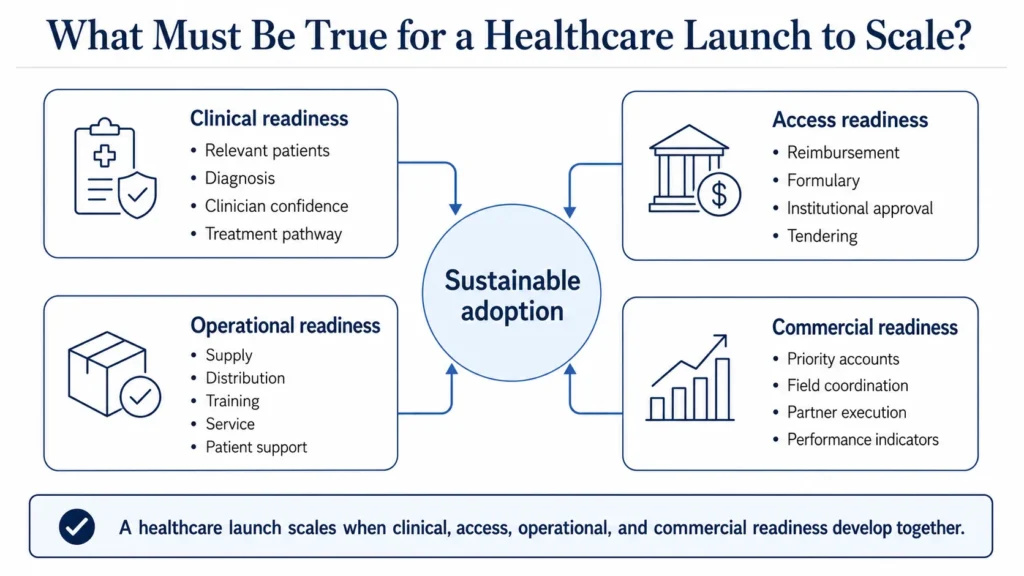
Figure 13: A healthcare launch scales when clinical, access, operational, and commercial readiness develop together.
Innovation Must Improve the Patient or Care Pathway
Healthcare innovation can attract attention while adding complexity without sufficient value.
A new product or feature may require:
- Different diagnosis
- New physician behavior
- New administration
- Training
- Monitoring
- Hospital investment
- Additional reimbursement
- Patient education
- Data integration
We help you determine:
- What unmet need the innovation addresses
- Which patients benefit
- How meaningful the improvement is
- What changes in the care pathway
- Who bears the adoption cost
- Which evidence is needed
- Whether institutions can implement it
- Whether payers will recognize the value
- What could prevent scale
- How competitors may respond
The objective is not to label the product innovative.
It is to establish whether the innovation improves outcomes, care delivery, patient experience, or healthcare economics sufficiently to justify change.
Scenario Planning for Healthcare Access and Competition
Healthcare strategies may depend on uncertain developments such as:
- Regulatory reform
- Public-health budgets
- Insurance coverage
- Health technology assessment
- Biosimilar entry
- New clinical evidence
- Diagnostic technology
- Hospital consolidation
- Tender reform
- Digital health
- Local manufacturing
- Competitor licensing
- Price regulation
An illustrative scenario exercise could use:
Critical uncertainty 1: Healthcare funding and access expansion
Restricted ↔ Expansive
Critical uncertainty 2: Speed of clinical and competitive change
Gradual ↔ Rapid
This could produce four environments:
- Expanding Access. Funding improves while clinical change remains gradual, increasing patient access to established and differentiated products.
- Innovation-Led Transformation. Access expands while new biologics, diagnostics, devices, evidence, and treatment pathways accelerate.
- Selective Funding. Budgets remain constrained, increasing prioritization, negotiation, tender pressure, and evidence requirements.
- Disruption Under Constraint. Funding remains limited while new competitors, biosimilars, technologies, and evidence rapidly reshape the standard of care.
For each scenario, we identify:
- Patient implications
- Market-access consequences
- Product vulnerabilities
- Competitive threats
- Partner requirements
- Pricing pressure
- No-regret actions
- Strategic options
- Early-warning indicators
- Decision triggers
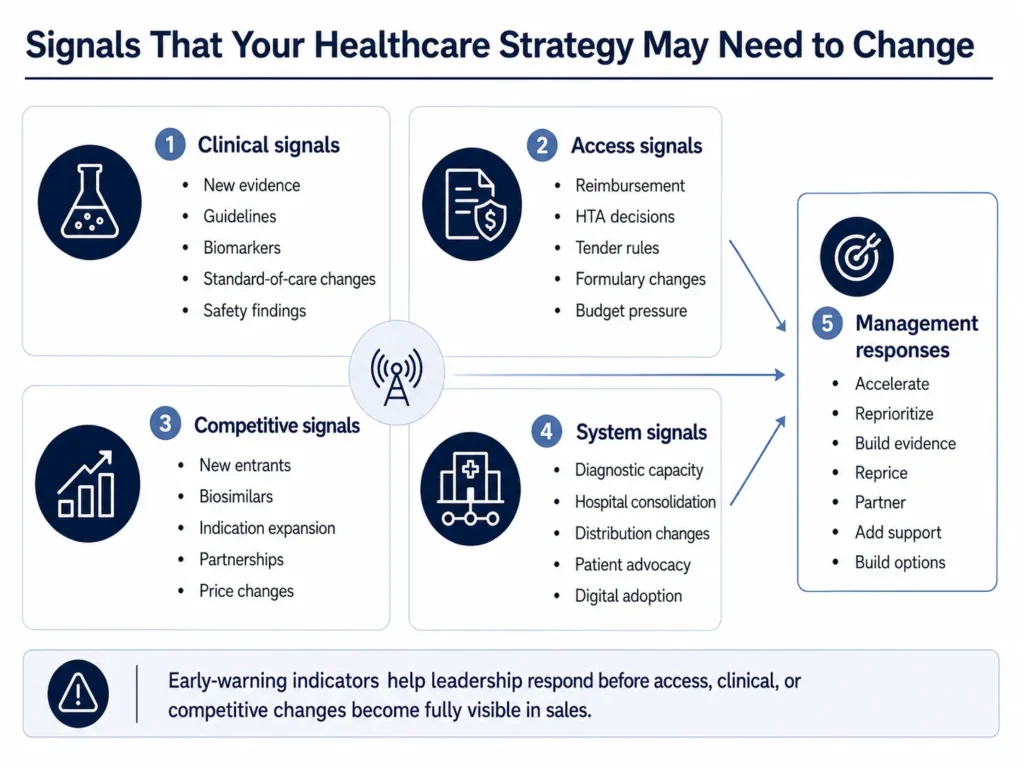
Figure 14: Early-warning indicators help leadership respond before access, clinical, or competitive changes become fully visible in sales.
Business Wargames for Pharmaceutical and Healthcare Strategy
Your strategy can trigger responses from:
- Established pharmaceutical companies
- Emerging biotechnology companies
- Biosimilar manufacturers
- Device competitors
- Distributors
- Hospitals
- Payers
- Local partners
- Generic manufacturers
A market entry, indication expansion, pricing decision, distributor appointment, access strategy, or acquisition may cause competitors to:
- Adjust price
- Expand patient-support programs
- Accelerate medical education
- Form local partnerships
- Strengthen payer evidence
- Lock in distributors
- Increase tender participation
- Introduce a biosimilar or alternative device
- Challenge your evidence
- Expand indications
- Acquire a local company
A business wargame helps your team explore these reactions before implementation.
Participants may represent:
- Your company
- Global pharmaceutical competitors
- Biotech challengers
- Biosimilar companies
- Device competitors
- Payers
- Hospitals
- Distributors
- Patient stakeholders
The exercise helps reveal:
- Unsupported assumptions
- Likely competitor moves
- Access vulnerabilities
- Pricing pressure
- Partner reactions
- Institutional barriers
- Alternative strategies
- Early-warning signals
- Prepared responses
M&A, Licensing, and Pharmaceutical Partnerships
Healthcare companies may use acquisitions, licenses, and partnerships to obtain:
- Products
- Indications
- Technology
- Regulatory approvals
- Local infrastructure
- Medical capabilities
- Market access
- Distribution
- Hospital relationships
- Manufacturing
- Patient populations
- Diagnostic platforms
These opportunities may also conceal risks:
- Limited patent or exclusivity life
- Weak evidence
- Narrow reimbursement
- Regulatory uncertainty
- Safety exposure
- Manufacturing dependence
- Supply risk
- Product concentration
- Distributor dependence
- Weak treatment persistence
- Unrealistic patient estimates
- Unfunded access assumptions
- Poor commercial execution
We help companies with:
- Licensing and acquisition strategy
- Product and partner-profile definition
- Opportunity identification
- Market and competitor intelligence
- Patient and treatment-pathway analysis
- Commercial due diligence
- Market-access assessment
- Distributor and licensee evaluation
- Strategic-fit analysis
- Owner or licensor interest
- Approach strategy
- Negotiation preparation
- Post-deal market priorities
Financial, legal, tax, regulatory, clinical, intellectual-property, quality, manufacturing, pharmacovigilance, cybersecurity, and technical due diligence should be completed by appropriately qualified specialists.
Our role is to strengthen the strategic and commercial understanding of the opportunity.
How We Build Reliable Pharmaceutical and Healthcare Intelligence
Healthcare markets generate substantial published information.
However, public data often does not reveal:
- Undiagnosed patients
- Referral patterns
- Physician preferences
- Institutional protocols
- Formulary restrictions
- Tender conditions
- Real access delays
- Distributor performance
- Patient persistence
- Competitor launch plans
- Actual commercial conditions
Depending on the decision, we may combine:
- Epidemiology
- Clinical pathways
- Regulatory information
- Treatment guidelines
- Product and pipeline analysis
- Hospital and institutional data
- Procurement and tender information
- Physician interviews
- Payer and access perspectives
- Distributor and partner interviews
- Device-user interviews
- Former industry executives
- Patient-pathway research
- Competitive intelligence
- Midas’s accumulated project experience
We triangulate important conclusions whenever feasible.
We distinguish among:
- Verified facts
- Supported estimates
- Stakeholder perceptions
- Analytical inferences
- Management hypotheses
- Unresolved information gaps
When evidence does not support a precise figure, we provide ranges or scenarios and explain the assumptions.
Healthcare Intelligence Requires Strong Ethical Boundaries
We use lawful and ethical research methods.
We do not request confidential patient information, identifiable health records, trade secrets, unpublished clinical data, or information sources are not authorized to provide.
Research should respect:
- Patient privacy
- Informed participation
- Institutional policies
- Applicable data-protection requirements
- Pharmaceutical and device compliance standards
- The distinction between research and promotion
Your product plans, target indications, pricing, partnerships, regulatory strategies, and market priorities are treated as confidential.
A Pharmaceutical and Healthcare Consulting Approach Built Around Access and Adoption
Our work is designed around the healthcare decision your team needs to make rather than a fixed sector template.
Depending on your objectives, the engagement may include five connected perspectives.
1. Understand the patient and care pathway
We identify relevant patients, diagnosis, referral, treatment, procedures, institutions, and access barriers.
2. Prioritize the market
We compare countries, indications, patient groups, specialists, institutions, procedures, and channels.
3. Build the stakeholder value case
We connect clinical, operational, economic, access, and patient value with the needs of each decision-maker.
4. Design the market-access and commercialization model
We define regulatory sequencing, evidence needs, access, partners, distribution, institutional strategy, pricing, and support.
5. Mobilize launch and growth
We translate the strategy into priority centers, actions, ownership, milestones, indicators, and decision triggers.
Your deliverables may include:
- Patient-pathway assessment
- Epidemiological and commercially accessible market model
- Standard-of-care analysis
- Treatment-center segmentation
- Physician and stakeholder research
- Market-access assessment
- Reimbursement and procurement analysis
- Competitor profiles
- Product and stakeholder value propositions
- Distributor, licensee, or partner long list
- Partner shortlist and assessments
- Go-to-market strategy
- Market-entry recommendation
- Launch-readiness plan
- Medical-device installed-base model
- Consumable demand model
- Scenario framework
- Wargame conclusions
- Licensing or acquisition target profiles
- Implementation roadmap
- Executive workshop
- Supporting evidence and databases
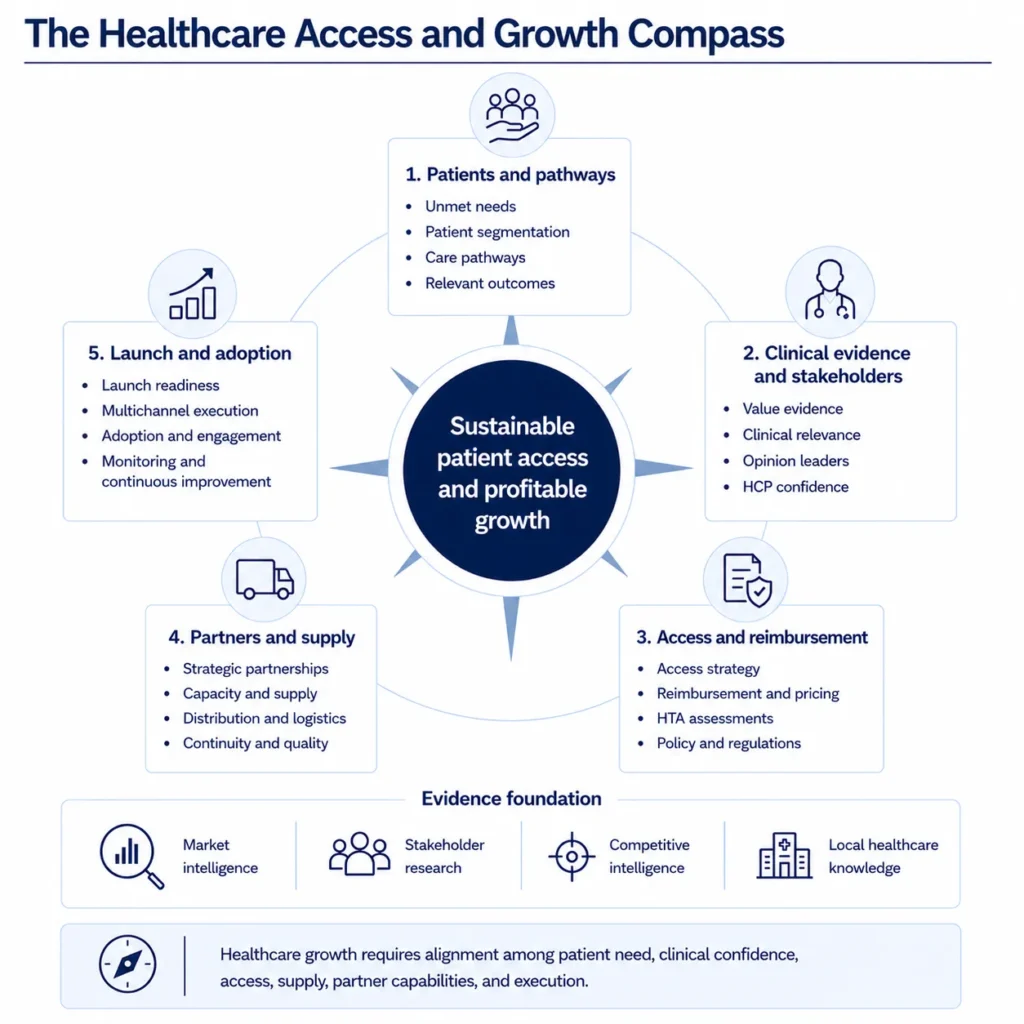
Figure 15: Healthcare growth requires alignment among patient need, clinical confidence, access, supply, partner capabilities, and execution.
Executive Workshops for Healthcare Decisions
Pharmaceutical and healthcare strategy frequently requires alignment among:
- General management
- Medical affairs
- Market access
- Regulatory affairs
- Commercial
- Marketing
- Patient services
- Supply chain
- Finance
- Legal and compliance
- Country teams
- Distributor management
- Device-service teams
Different functions may see different priorities.
Medical affairs may focus on evidence and clinical practice.
Market access may see reimbursement barriers.
Commercial teams may focus on prescribers and accounts.
Supply chain may highlight cold-chain, inventory, or importation risk.
Finance may question pricing, access assumptions, and investment.
We design workshops that help your team:
- Build a shared view of the patient pathway
- Separate epidemiological potential from accessible demand
- Prioritize countries, institutions, and patient groups
- Clarify stakeholder value propositions
- Resolve access and commercialization trade-offs
- Compare partners and entry models
- Anticipate competitor responses
- Assign ownership
- Define milestones and indicators
- Translate strategy into coordinated action
The workshop is designed around your decision and supporting evidence—not around a generic agenda.
Why Pharmaceutical and Healthcare Companies Work with Midas Consulting
More than 25 years of experience
Since 2000, Midas Consulting has supported companies in pharmaceuticals, healthcare, medical products, technology, consumer markets, and other complex industries.
Focus on specialty and complex healthcare products
Our approach is particularly relevant when growth depends on:
- Patient identification
- Specialist prescribers
- Diagnosis
- Institutional adoption
- Reimbursement
- Medical evidence
- Specialty distribution
- Complex launches
Pharmaceutical, biologic, device, and consumable coverage
Our methodology can be adapted to:
- Specialty pharmaceuticals
- Biologics
- Biosimilars
- Rare-disease products
- Hospital medicines
- Medical devices
- Diagnostics
- Surgical products
- Consumables
- Drug-delivery and monitoring technologies
A patient-pathway perspective
We do not treat healthcare demand as a single epidemiological number.
We examine diagnosis, referral, clinical eligibility, physician practice, access, institutional capability, product availability, treatment initiation, and continued use.
Latin American market knowledge
We work across Spanish- and Portuguese-speaking Latin America, as well as Spain, Portugal, and selected international markets.
We understand that regulation, funding, reimbursement, hospital purchasing, distribution, treatment access, and medical practice differ across countries.
Primary market intelligence
When public information is insufficient, we develop evidence through physicians, institutions, distributors, market-access stakeholders, device users, former executives, and other informed participants.
Senior involvement
Senior consultants remain involved in defining the question, designing the research, interpreting the evidence, and discussing recommendations with management.
Strategic and commercial focus
We connect patient need and clinical value with market access, distribution, partnerships, pricing, launch, and competitive strategy.
Collaboration with your team
We combine your clinical, medical, regulatory, and product knowledge with an independent market perspective that can challenge assumptions and reveal strategic blind spots.
Transparent limitations
Healthcare data, access conditions, treatment pathways, and competitor information may be incomplete or change over time.
We make assumptions, uncertainty, evidence dates, and information gaps visible.
Selected Pharmaceutical and Healthcare Experience
We have supported pharmaceutical, biologic, medical-device, diagnostic, and healthcare-product companies across different therapeutic areas, countries, channels, and strategic decisions. Each logo represents a separate client relationship; project scope, timing, and services differed.




What Clients Say About Working with Midas
“Midas delivered practical, high-impact ideas that helped us focus our commercial strategy in a complex healthcare market.”
Business Unit Leader
Pharmaceutical Company
Client identity withheld due to confidentiality
“Midas combined detailed market analysis with a clear understanding of the stakeholders who influence access and adoption.”
Market Access Executive
Specialty Pharmaceutical Company
Client identity withheld due to confidentiality
“The team helped us identify and evaluate potential partners with the capabilities required to support our growth.”
International Business Leader
Pharmaceutical or Medical Device Company
Client identity withheld due to confidentiality
“Midas worked effectively across our internal teams and translated complex findings into practical priorities.”
Global Product Manager
Healthcare Company
Client identity withheld due to confidentiality
Strategic Intelligence for Pharmaceutical and Healthcare Leadership
Healthcare companies have access to epidemiology, clinical studies, sales information, regulatory decisions, and competitor pipelines.
But those data do not automatically explain:
- Which patients remain unidentified
- Why physicians do not adopt
- Which institutions control access
- How payers may respond
- Whether a distributor can execute
- Which competitor move matters
- What could change the standard of care
- Which signal requires management action
Strategic intelligence connects:
- Patient pathways
- Clinical evidence
- Market access
- Institutions
- Competitors
- Partners
- Regulation
- Scenario analysis
- Management choices
Midas Consulting’s applied strategic intelligence work brings together market analysis, competitive intelligence, benchmarking, market entry, partner search, scenario planning, business wargaming, early-warning systems, and strategic decision-making.
Frequently Asked Questions
What types of pharmaceutical and healthcare companies does Midas Consulting support?
We work primarily with companies developing or commercializing:
- Specialty pharmaceuticals
- Biologics
- Biosimilars
- Rare-disease products
- Hospital medicines
- Medical devices
- Diagnostics
- Surgical products
- Healthcare consumables
- Drug-delivery and patient-monitoring solutions
The methodology is adapted to the product, indication, patient pathway, geography, institution, channel, and strategic decision.
Is this service focused on specialty pharmaceuticals?
Specialty pharmaceuticals, biologics, and other complex products are an important focus because their success often depends on patient identification, specialists, diagnostics, reimbursement, treatment centers, medical evidence, and specialized distribution.
We also support broader pharmaceutical, device, diagnostic, and consumable categories.
Do you work with hospitals and healthcare providers?
The primary clients for this page are pharmaceutical, biologic, medical-device, diagnostic, and healthcare-product companies.
We may interview or analyze hospitals, physicians, laboratories, payers, procurement organizations, and other healthcare providers because they influence product access and adoption.
Can you estimate the number of eligible patients?
Yes, when sufficient evidence is available.
Depending on the product, we may combine:
- Population
- Prevalence or incidence
- Diagnosis
- Disease subtype
- Severity
- Biomarkers
- Clinical eligibility
- Treatment line
- Access
- Treatment initiation
- Persistence
We explain the assumptions and use ranges or scenarios when the evidence does not support one exact figure.
Can you map the patient pathway?
Yes. We can examine:
- Symptom recognition
- Initial consultation
- Referral
- Diagnosis
- Testing
- Specialist access
- Treatment decision
- Reimbursement
- Product supply
- Treatment initiation
- Continued use
The objective is to identify where patients are lost and which barriers materially affect access.
Can you research physicians and other healthcare stakeholders?
Yes. Depending on the project, we may interview:
- Specialists
- Primary-care physicians
- Surgeons
- Nurses
- Pharmacists
- Laboratory professionals
- Hospital managers
- Procurement
- Payers
- Distributors
- Device users
- Former industry executives
Research design should respect relevant ethical, privacy, institutional, and compliance requirements.
Can you help us understand the standard of care?
Yes. We can analyze treatment pathways, guidelines, physician practice, alternative therapies, procedures, devices, monitoring, supportive care, and reasons for switching or remaining with the current approach.
Clinical conclusions should be reviewed with appropriately qualified medical professionals.
Can you evaluate reimbursement and market access?
We can analyze the strategic and commercial implications of reimbursement, formulary access, health technology assessment, hospital approvals, tenders, coverage criteria, and patient affordability.
We do not replace specialized legal, regulatory, health-economic, reimbursement, or pricing counsel where formal professional conclusions are required.
Can you help us find a pharmaceutical distributor or commercialization partner?
Yes. We can define the ideal partner profile, identify candidates, assess therapeutic-area experience, institutional access, medical and regulatory capabilities, supply infrastructure, interest, conflicts, and strategic commitment.
Can you evaluate potential licensees?
Yes. We can assess:
- Therapeutic-area experience
- Medical capabilities
- Market access
- Regulatory execution
- Commercial coverage
- Distribution
- Supply
- Launch resources
- Portfolio conflicts
- Management commitment
Can you evaluate our current distributor?
Yes. We can assess:
- Institutional access
- Specialist coverage
- Market access
- Tenders
- Forecasting
- Inventory
- Cold chain
- Medical capabilities
- Compliance
- Launch execution
- Reporting
- Strategic alignment
Can you support a medical-device launch?
Yes. We can examine clinical workflow, users, institutions, training, evaluations, tendering, pricing, consumables, service, maintenance, distribution, references, and adoption indicators.
Can you estimate the installed base for a medical device?
Yes, when sufficient evidence is available.
The analysis may include:
- Installed equipment
- Brand and model
- Age
- Utilization
- Replacement cycle
- Relevant institutions
- Procedures
- Consumables
- Maintenance
- Competitive replacement risk
Can you estimate demand for healthcare consumables with your pharmaceutical and healthcare consulting?
Yes. Depending on the product, we may use procedure volumes, patient days, treatment protocols, use per procedure, institutional capacity, procurement cycles, installed equipment, and product availability.
Can you help us prepare a go-to-market strategy?
Yes. We can develop strategies covering:
- Patient and clinical pathways
- Target institutions
- Prescribers and users
- Value proposition
- Market access
- Distribution
- Partners
- Pricing
- Launch sequence
- Patient support
- Adoption metrics
Can you support market entry?
Yes. We can compare countries, estimate patient or procedure opportunities, analyze regulation and access, identify priority centers, evaluate competitors and partners, recommend an entry model, and create a launch roadmap.
Can you benchmark competitors in your pharmaceutical and healthcare consulting?
Yes. We may compare patient focus, indications, medical affairs, market access, distribution, pricing, tenders, institutional execution, device service, patient support, and other relevant capabilities.
Can you benchmark pharmaceutical prices?
We can analyze public and market-access information where available and develop market intelligence on commercial conditions where it can be gathered lawfully and ethically.
Healthcare prices may differ across list prices, tenders, negotiated agreements, coverage conditions, institutional purchasing, patient access, and confidential contracts. Limitations and confidence levels should therefore be made explicit.
Can you help us assess a licensing or acquisition opportunity?
Yes. We can support opportunity identification, patient and market analysis, competitive intelligence, partner assessment, commercial due diligence, access assessment, strategic fit, and negotiation preparation.
Clinical, regulatory, legal, financial, tax, quality, manufacturing, intellectual-property, safety, and technical due diligence should be performed by qualified specialists.
Do you provide medical, regulatory, or clinical advice within your pharmaceutical and healthcare consulting?
Our focus is market, competitive, commercial, growth, and strategic pharmaceutical and healthcare consulting.
We do not replace physicians, clinical-development experts, regulatory counsel, pharmacovigilance professionals, health economists, statisticians, quality specialists, or other licensed professionals.
We may work alongside those specialists when the strategic decision requires their input.
How long does a pharmaceutical or healthcare consulting project take?
A focused market, patient-pathway, competitor, institution, distributor, or partner assessment may require several weeks.
A multicountry go-to-market strategy, distributor or licensee search, detailed benchmarking program, scenario exercise, or licensing-related project may require several months.
The proposal defines the scope, methodology, milestones, deliverables, and expected timing.
What information will you need from us?
Useful inputs may include:
- Product profile
- Indication or use
- Clinical evidence
- Regulatory status
- Target patients
- Current markets
- Sales and access
- Pricing
- Distribution
- Partner network
- Competitive hypotheses
- Previous studies
- Launch plans
- Strategic priorities
- Decision timetable
We begin with the available information and identify the gaps that materially affect the decision.
How do you protect confidential and patient information?
We treat client information as confidential and can work under a nondisclosure agreement.
We do not need personally identifiable patient information for normal market and strategic pharmaceutical and healthcare consulting assignments.
Research and data collection should be designed to protect privacy and comply with applicable legal, ethical, institutional, and company requirements.
Do you guarantee regulatory, reimbursement, or commercial outcomes?
No responsible pharmaceutical and healthcare consulting firm should guarantee regulatory approval, reimbursement, tender success, patient access, sales, market share, licensing, or acquisition outcomes.
Results depend on:
- Clinical evidence
- Safety
- Regulation
- Reimbursement
- Institutional adoption
- Product supply
- Medical practice
- Pricing
- Partner execution
- Competitive response
- Healthcare funding
Our role is to improve the evidence, strategic choices, preparation, and execution behind your decision.
The Cost of Misreading a Healthcare Opportunity
Your company may:
- Confuse disease prevalence with accessible patient demand
- Underestimate diagnosis and referral barriers
- Focus on regulatory approval while neglecting reimbursement and institutional access
- Choose a distributor without sufficient medical or market-access capabilities
- Prioritize countries without identifying viable treatment centers
- Launch before clinical, access, supply, and commercial teams are ready
- Overestimate physician willingness to change the standard of care
- Underestimate device training and service requirements
- Price a product without understanding institutional or payer value
- Invest in patient support that does not address the real pathway barrier
- Treat a medical device, pharmaceutical, and consumable as if they had the same go-to-market model
- License a product with weak evidence or unrealistic access assumptions
- Acquire a company with an overstated patient or procedure opportunity
Better intelligence cannot remove clinical, regulatory, or reimbursement uncertainty.
It can help your team understand where patients are lost, who controls access, what evidence matters, which partners can execute, and where investment can create the greatest value.
Let’s Clarify Your Next Healthcare-Market Decision
You may be evaluating a country, indication, patient segment, product launch, distributor, licensee, access strategy, medical device, consumable, partnership, or acquisition.
We begin with your decision, not with a predetermined pharmaceutical and healthcare consulting package.
Tell us what is at stake
Share the product, patient group, indication, institution, partner, market, or investment choice your company is considering.
Define the evidence
Together, we determine which patient, clinical, access, institutional, competitor, pricing, distributor, and market questions must be answered.
Develop the strategy
We compare alternatives, make relevant assumptions visible, and recommend the strongest path supported by the evidence.
Prepare for execution
You receive clear priorities, actions, responsibilities, milestones, indicators, and decision triggers.
About Midas Consulting
Midas Consulting is a strategy and market intelligence consulting firm that helps companies grow, compete, enter markets, select partners, evaluate investments, and make stronger decisions across Latin America and selected international markets.
For more than 25 years, we have supported companies through market entry, go-to-market strategy, distributor and partner search, benchmarking, strategy consulting, scenario planning, business wargaming, and M&A-related decisions in the pharmaceutical and healthcare market.
Our work combines local market research, competitive intelligence, executive experience, and collaborative strategy development.