

Wargaming in Peru to strengthen your strategy and grow your market share
Are you trying to grow in Peru while facing strong competitors, price sensitivity, fragmented channels, or uncertainty about how the market will react?
Peru offers real opportunities, but execution can be challenging. Local and regional players may respond quickly. Informal competition can affect pricing. Channels may be fragmented. Customers can be highly value-conscious. And local teams may not always have enough time to step back and think strategically.
That is why a business wargame can be so useful.
At Midas, we design and facilitate wargames in Peru that help your team anticipate competitor reactions, uncover risks, and align around practical decisions before you move.
You do not need more guesswork. You need a structured way to test your strategy before the market does.
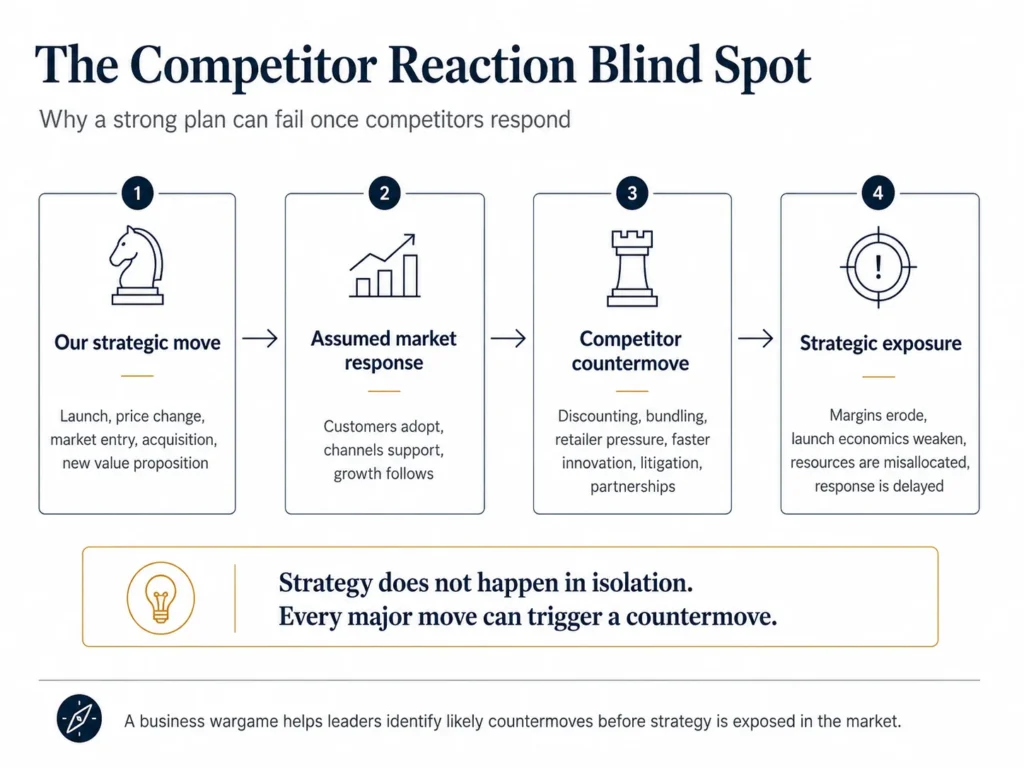
Figure 1. The Competitor Reaction Blind Spot: A business wargame helps leaders identify likely countermoves before strategy is exposed in the market.
What is wargaming in Peru?
A wargame is a strategic exercise where your team steps into the shoes of key market players, competitors, distributors, regulators, or even customers, to simulate how they might react to your moves or a given scenario. Then, you plan your own response
Don’t be blindsided by your competitors. Our guide shows how wargames can transform uncertainty into foresight and protect your strategy
It’s not a game for fun. It’s a serious, action-oriented tool for making better decisions as a team, with clarity, speed, and strategic depth.

When a business wargame is the right tool
A business wargame is most valuable when your decision depends on how other players may react.
Use it when you are preparing a product launch, defending market share, entering a new segment, changing pricing, redesigning your go-to-market model, responding to a disruptive competitor, or aligning regional and local teams around a high-stakes move.
The key question is not only: “Is our strategy attractive?”
The better question is: “What will competitors, customers, channels, regulators, or distributors do once we move, and are we ready for that?”
That is where a wargame creates value. It gives you a structured way to pressure-test your plan before the market does.
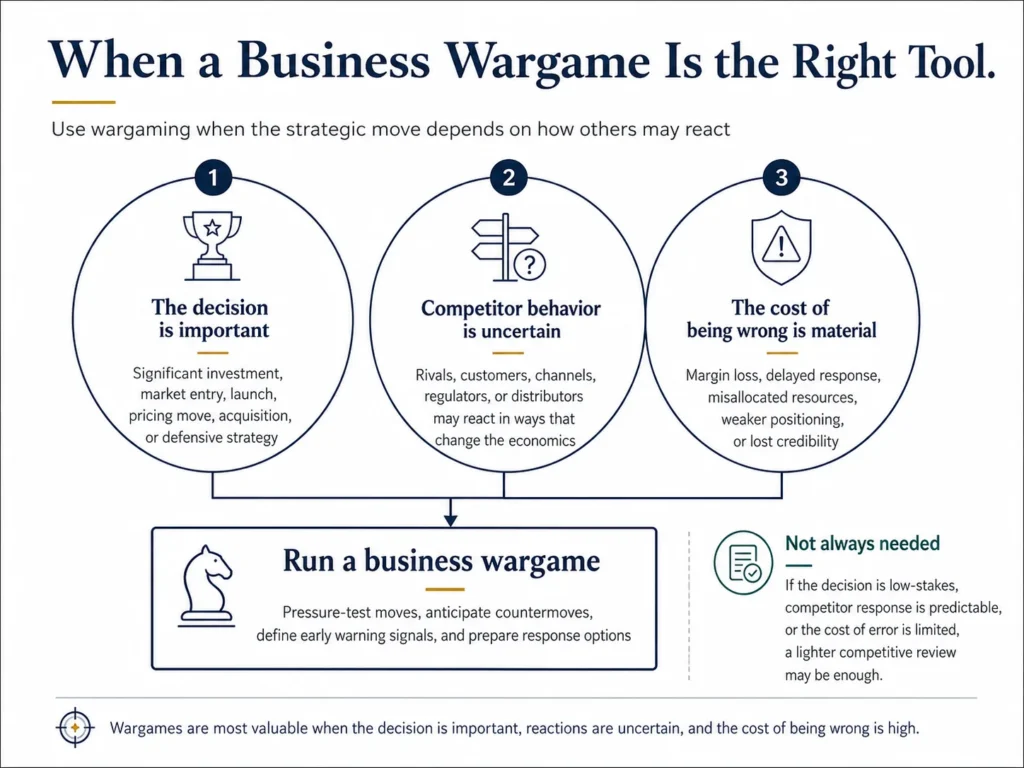
Figure 2. Decision framework: A wargame is the right tool when the decision is important, reactions are uncertain, and the cost of being wrong is high.
Why do wargaming in Peru?
Peru offers real potential, but it also brings unique challenges: high price sensitivity, strong local and regional players, informal competition, fragmented channels, and, often, local teams that don’t always have the space to think strategically.
Wargaming in Peru helps you:
- Map how key players might respond to your moves
- Spot risks before they hit your radar
- Align local and regional teams around a clear, shared plan
In sectors such as consumer goods, healthcare, financial services, industrial products, and technology, going to market unprepared can be expensive. A wargame helps your team plan ahead, prepare for market shifts, and avoid knee-jerk decisions.
It also creates the space for local and regional teams to think together. Instead of reacting to pressure once the strategy is already in motion, your team can identify likely risks, define countermoves, and agree on what to monitor before execution begins.
Every session is designed to be practical, focused, and action-oriented, so your team leaves with clearer decisions, not just interesting conversations.

How our wargaming process works in Peru
At Midas, we do not treat a wargame as a generic workshop. We treat it as a structured decision process designed to help your team make better strategic choices.
Our approach usually includes five steps:
1. Define the strategic decision
We clarify the move you need to test: a launch, pricing change, market entry, portfolio decision, channel strategy, competitor response, or growth plan.
2. Build the competitive fact base
We gather and synthesize the relevant market, customer, competitor, channel, regulatory, and financial information mostly from your own information, so the exercise is grounded in evidence, not opinions.
3. Define players and roles
We identify the actors whose reactions matter most: competitors, substitutes, customers, distributors, retailers, regulators, payers, or new entrants.
4. Simulate moves and countermoves
Your team steps into the shoes of those actors and explores how the market could respond. This is where hidden risks often emerge: price retaliation, channel conflict, faster innovation, copycat moves, regulatory delays, or unexpected partnerships.
5. Translate insights into action
The output is not a prediction. It is a practical playbook: strategic adjustments, risk mitigations, countermoves, early warning indicators, decision triggers, owners, and follow-up actions.
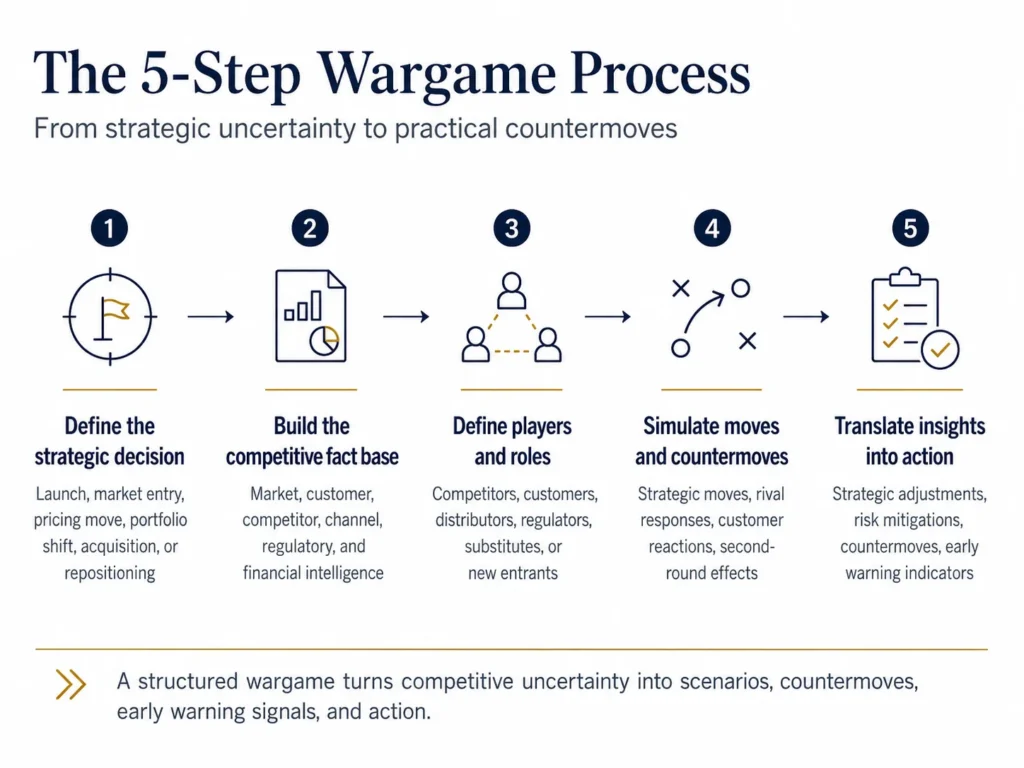
Figure 3. The Midas 5-Step Wargame Process: A structured wargame turns competitive uncertainty into scenarios, countermoves, early warning signals, and action

What do you gain from wargaming in Peru?
- Your team shifts from reacting to thinking strategically
- You make decisions with more insight, less guesswork
- You align key areas, across matrixed or regional structures
We’ve spent over 20 years refining a method that works, and it shows. Our 82.2% NPS (2020-2025) is a clear indicator of the strong relationships we’ve built with our clients

What you should expect after wargaming in Peru
A strong wargame should not end with an interesting discussion. It should help your team leave with decisions.
Typical outputs include:
- A clearer view of likely competitor reactions
- The main strategic blind spots in your current plan
- Priority risks by probability, impact, and urgency
- Practical countermoves your team can prepare before the market reacts
- Early warning indicators to monitor after launch or implementation
- Alignment between leadership, commercial, marketing, finance, operations, regulatory, and local teams
- A short action plan with owners, timing, and next steps
The goal is simple: you should be able to move forward with more confidence because your strategy has already been challenged from the outside in.
Some of our wargaming customers in Peru:



Why Midas for Wargaming in Peru
You need a partner who can make the session engaging, but also rigorous enough to influence real decisions.
Midas brings more than 20 years of experience facilitating strategic wargames and competitive simulations across Latin America. We have worked with leadership teams in industries such as pharmaceuticals and healthcare, consumer goods, automotive, industrial products, packaging, technology, agribusiness, and B2B services.
Our role is to help your team think like the market, not only like your company. We challenge assumptions, connect local insight with regional strategy, and turn the discussion into practical moves you can use.
Clients value the approach because it is structured, collaborative, and action-oriented. Our 82.2% NPS from 2020–2025 reflects the strength of those relationships and the value executives see in the work.
Case study: avoiding cannibalization while preparing for competitor response
Context
A global pharmaceutical company was preparing to launch a new treatment in Peru. The opportunity was attractive, but the category already included similar products in the company’s own portfolio. The team needed to grow without creating unnecessary cannibalization or leaving room for competitors to take advantage.
Approach
Midas facilitated a wargame in Peru with cross-functional teams. Participants simulated key competitor responses, explored internal portfolio implications, and developed tactical scenarios with sales and marketing leaders.
Results
- Blind spots were identified before launch
- The team built a go-to-market strategy that protected the existing portfolio
- Local priorities became clearer
- The launch moved forward with stronger alignment and ownership
The wargame helped the team see the launch from the market’s perspective and adjust before committing resources.
Frequently asked questions about business wargaming in Peru
Does a wargame predict exactly what competitors will do?
No. And it should not be sold that way. A wargame helps your team explore plausible reactions, test assumptions, and prepare stronger options. The value is not perfect prediction. The value is better preparedness.
How much preparation does a wargame require?
The preparation is critical. Before the live session, we clarify the decision, define the players, build the fact base, prepare playbooks, design the simulation rounds, and align expectations with your team. The better the preparation, the more realistic and useful the wargame.
Who should participate?
It depends on the decision. Most wargames include a mix of leadership, strategy, sales, marketing, finance, operations, product, regulatory, market access, supply chain, and local or regional teams. The group should be broad enough to capture reality, but focused enough to make decisions.
Can the session be run in English, Spanish, or Portuguese?
Yes. We regularly facilitate wargames in English, Spanish, and Portuguese. The right language is the one that allows your team to participate openly and think clearly.
What makes a wargame different from a strategy workshop?
A strategy workshop often focuses on what your company wants to do. A wargame forces the team to look at the decision from the outside in: what competitors, customers, distributors, regulators, or substitutes might do in response. That shift usually reveals blind spots that do not surface in a standard planning meeting.
About the author
By Adrian Alvarez, PhD. Adrian Alvarez is Managing Partner at Midas Consulting, a Wharton Alumnus, MBA Professor at Universidad Argentina de la Empresa (UADE), and Competitive Intelligence Fellow. He specializes in competitive strategy, business wargaming, competitor analysis, growth strategy, and strategic decision-making under uncertainty across Latin America.
Adrian has designed and facilitated dozens of business wargames and strategic simulations for executive teams in industries such as pharmaceuticals and healthcare, consumer goods, automotive, industrial products, packaging, technology, agribusiness, and B2B services.
His work helps leadership teams anticipate competitor reactions, pressure-test strategic assumptions, reveal blind spots, and prepare practical countermoves before committing significant resources. Access his published strategic insights.
View professional profile on LinkedIn
Selected External References
This article is informed by Midas Consulting’s experience facilitating business wargames across industries and by respected sources on competitor reactions, strategic decision-making, and competitive dynamics.
- Harvard Business Review: Predicting Your Competitor’s Reaction
- Futures: Combining Scenario Planning and Business Wargaming to Better Anticipate Future Competitive Dynamics
- Wharton Executive Education: Making Strategic Decisions: Do You Have What It Takes?
Midas Thought Leadership on Business Wargaming
Midas Consulting’s wargaming methodology is supported by a broader body of applied research, executive publications, and real-world experience in competitive simulation, competitor response analysis, and strategic decision-making under uncertainty.
For executives who want to go deeper, these Midas-related publications provide additional context on how business wargames help companies anticipate competitor reactions, pressure-test strategic assumptions, and prepare more resilient countermoves:
- Midas Applied Strategic Intelligence Hub. A curated collection of Midas frameworks, publications, and applied strategic intelligence resources for executives.
- Wargames: Pensar la Estrategia Sabiendo que el Competidor también Juega. An article published by the University of Buenos Aires that explains why strategies often fail when companies assume competitors will not react.
- Business Wargaming to Strengthen Corporate Strategy. A publication explaining how wargames can be used to evaluate competitor reactions, improve strategic decisions, and refine business strategy.
- Knowing the Enemy: Competitive Response Analysis. An executive article on competitor response analysis and how companies can better anticipate rival behavior.
Related Midas services that can strengthen your wargaming in Peru
A business wargame is powerful on its own. But in many cases, it becomes even more valuable when it is connected to the right fact base, strategic decision process, and execution plan.
Depending on the decision you need to make, Midas can combine your wargame with other consulting services so your team can move from uncertainty to insight, from insight to alignment, and from alignment to action.
- Competitor analysis: Use this before or during a wargame when your team needs a stronger fact base on competitor goals, strategies, assumptions, capabilities, constraints, pricing, channels, and likely responses. A wargame works better when you are not guessing how competitors think. Competitor analysis helps you understand the players before you simulate their moves.
- Market Analysis: Use this when your team needs to understand market size, demand, customer needs, barriers, channels, trends, and opportunity attractiveness before pressure-testing a strategy. This is especially useful when the wargame is tied to a new market, new segment, product launch, pricing move, or growth opportunity.
- Market Entry Consulting: Use this when your company is deciding whether, where, or how to enter a new market. A market entry project helps you evaluate the opportunity. A wargame helps you test how incumbents, distributors, customers, regulators, or substitutes may react once you move.
- Go-to-Market Strategy: Use this after the wargame when your team needs to translate insights into segmentation, channels, pricing, messaging, sales tools, distributor alignment, and execution priorities. The wargame helps you see what could happen. The go-to-market strategy helps you decide what to do about it.
- Strategy Consulting: Use this when the wargame is part of a broader strategic question: where to compete, how to win, what to prioritize, how to allocate resources, and how to align the leadership team. This is useful when the decision is bigger than one launch, one competitor response, or one country.
- Benchmarking: Use this when your team needs to compare performance, practices, capabilities, costs, channels, commercial execution, or operating models against competitors or reference companies. Benchmarking helps you understand where others are outperforming you. A wargame helps you test how those advantages could play out in the market.
- Value Proposition Consulting: Use this when the wargame reveals that customers may not clearly understand why they should choose you, or when competitors can easily copy your message. A stronger value proposition helps your team clarify what makes your offer relevant, differentiated, credible, and harder to attack.
- Win-Loss Analysis: Use this when your team needs to understand why customers choose you, reject you, switch to competitors, or stay with their current provider. Win-loss analysis brings the buyer’s voice into the wargame, so your strategy is not only competitor-aware, but also customer-grounded.
- Brand Consulting: Use this when your wargame shows that brand perception, preference, trust, differentiation, or emotional relevance could influence the outcome. This is especially useful in markets where being known is not enough. You need to be chosen.
Not sure which service should come first?
You do not need to know the answer before we talk.
In a short conversation, we can help you clarify whether your challenge requires a standalone wargame, a stronger competitor or market fact base, a go-to-market plan, a strategy workshop, or a combination of services.
If your next move could trigger competitor reactions, customer resistance, channel conflict, pricing pressure, or internal misalignment, it is worth pressure-testing before you commit resources.
Ready to prepare your team for better, faster decisions?
Let’s talk. At Midas, we design wargames in Peru to help your team think more strategically, align quickly, and stay one step ahead of the market.