

Navigate the Peruvian Market with Confidence and Precision Thanks to Our Go-to-Market Consulting in Peru
Peru can offer attractive opportunities, but commercial success depends on more than identifying demand. Companies need to understand where demand is concentrated, how customers buy, which channels can reach them, what support is required, and how the value proposition should be communicated.
For C-level executives, the key question is: Which customers should we target first, which route to market can deliver, and how do we execute profitably beyond the initial opportunity?
At Midas Consulting, we help companies design and refine go-to-market strategies in Peru by clarifying priority segments, regional focus, value proposition, route to market, distributor or partner requirements, competitor positioning, sales execution, and performance metrics.
Our work helps leadership teams turn opportunity into a practical commercial model.
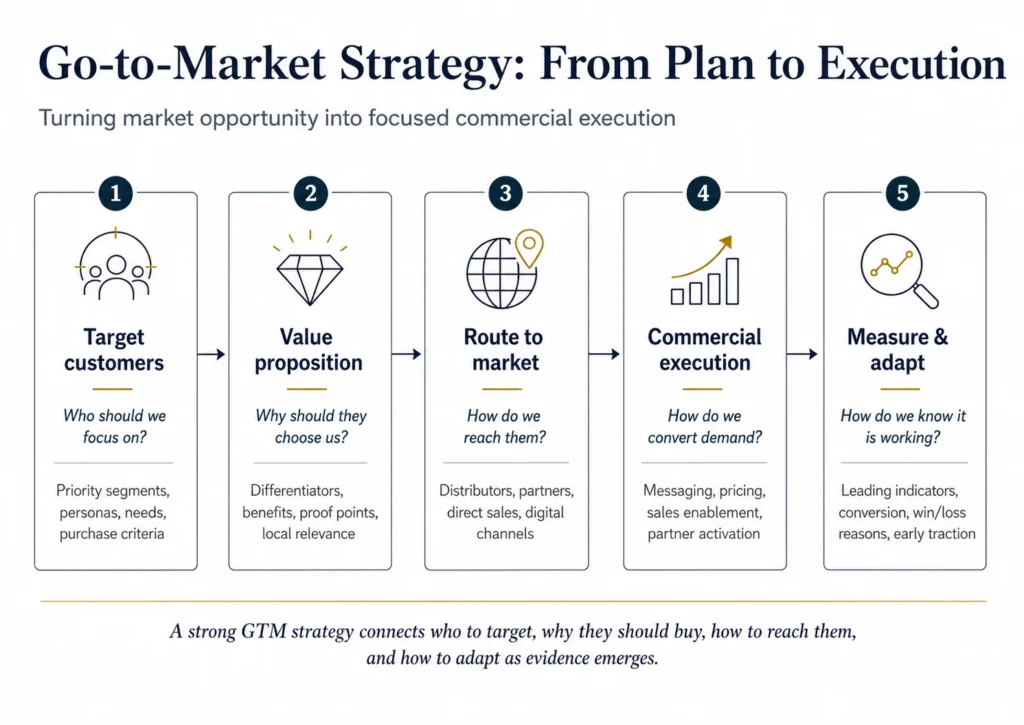
Figure 1. Midas Go-to-Market Strategy Process: A strong GTM strategy connects who to target, why they should buy, how to reach them, and how to adapt as market evidence emerges.

Key Aspects of a Strong Go-To-Market Strategy in Peru:
| Key Component | Description |
|---|---|
| Market Analysis | Comprehensive analysis of industry trends, local demand, and competitive landscape |
| Value Proposition Development | Crafting a compelling message that differentiates your offering for Peruvian customers |
| Sales & Distribution Strategy | Identifying the most effective channels, partners, and market entry tactics |
| Competitive Benchmarking | Assessing key players, pricing strategies, and industry positioning in Peru |
| Marketing & Demand Generation | Developing targeted campaigns that resonate with Peru’s diverse customer segments |
| Go-to-Market Optimization | Enhancing strategies to improve efficiency, market penetration, and revenue growth |
| Product Launch Execution | Ensuring a data-driven approach to introducing new products successfully |
What Makes Go-to-Market Strategy in Peru Different?
Peru requires a GTM strategy that balances market concentration, regional coverage, distributor capability, technical support, and customer education.
| Peru GTM issue | Why it matters | Executive implication |
| Lima vs. regional expansion | Lima may be the starting point, but growth can depend on secondary cities, industrial clusters, mining-related demand, or regional coverage. | GTM strategy should define where to focus first and how to expand without overextending resources. |
| Distributor capability | Partners may vary in coverage, technical knowledge, service, customer relationships, and execution discipline. | The route to market should evaluate partner capability, not only geographic reach. |
| Customer education | Technical or differentiated products may require proof points, service support, and a clear economic rationale. | GTM should equip sales teams and partners with messages that help customers justify adoption. |
| Logistics and service coverage | Delivery times, after-sales service, and support levels can shape customer experience. | GTM should connect commercial ambition with operational feasibility. |
| Competitive positioning | Customers may compare offers based on price, availability, service, technical support, or relationship strength. | The value proposition must clarify where the company can win and where it should not compete. |
From Channel Presence to Channel Performance
In Peru, companies may have market access but still struggle to generate consistent growth. The issue is often not only whether a distributor exists, but whether the route to market can perform.
Midas helps companies assess:
- Which customer segments or regions should be prioritized.
- Whether the current channel provides the required coverage and support.
- Which partners have the right capabilities and incentives.
- What customers need to understand before adopting the offer.
- Which sales messages and proof points can defend value.
- Which metrics should track channel activation and early traction.
This helps leadership teams move from broad market ambition to practical execution.
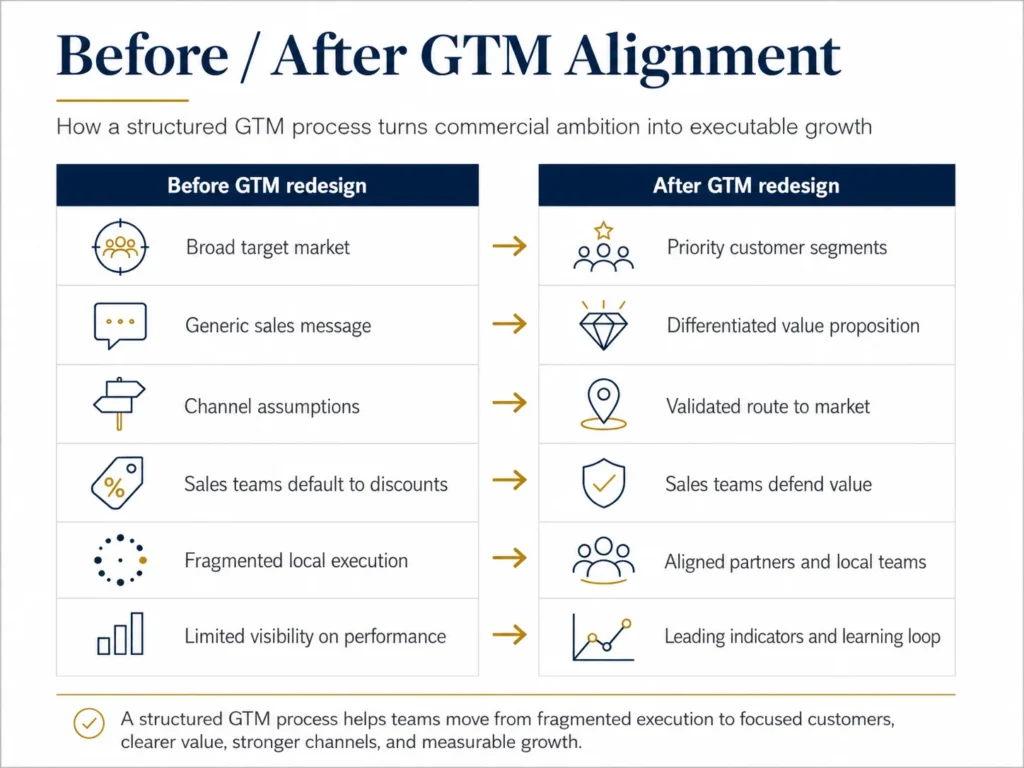
Figure 2. Before and After GTM Alignment: A structured GTM process helps teams move from fragmented execution to focused customers, stronger channels, and measurable growth.
Challenges in Developing a Successful Go-To-Market Strategy in Peru
Peru offers exciting growth opportunities, but expanding or launching in the country comes with its own set of challenges:
- Standing Out in a Competitive Landscape: Peru has strong local and international competition, so having a well-defined value proposition is crucial
- Understanding Regional Market Variability: Consumer behavior and infrastructure vary across regions like Lima, Arequipa, and Trujillo, affecting market strategies
- Selecting the Right Sales and Distribution Channels: Choosing between direct sales, local distributors, or digital channels is essential for long-term success
Want a step-by-step guide on how to build a successful go-to-market strategy?

How Midas Helps You with Go-to-Market Consulting in Peru
At Midas, we provide customized go-to-market consulting services specifically designed for multinational firms operating in Peru. Our expertise includes:
- Local Market Analysis & Customer Insights. Our on-the-ground experts analyze Peru’s economic landscape, purchasing behaviors, and emerging trends to refine your strategy
- Competitive & Industry Benchmarking. We assess market leaders, pricing strategies, and competitive positioning to help you stand out effectively
- Overall Go-to-Market Strategy Development. We identify optimal sales channels, refine pricing structures, and establish key partnerships for maximum market penetration

Ready to refine your go-to-market strategy or optimize a product launch in Peru? Let’s chat and make it happen!
Some of Our Go-to-Market Consulting in Peru Customers:




How We Build the Evidence Base in Peru
Depending on the challenge, our Peru GTM work can include:
- Interviews with executives, local teams, distributors, partners, customers, and market experts.
- Market analysis to assess demand concentration, regional opportunities, customer needs, and adoption barriers.
- Competitor analysis to compare positioning, pricing, channel strategy, service levels, and likely moves.
- Distributor or partner assessment to evaluate coverage, incentives, technical capability, service quality, and execution discipline.
- Customer or channel interviews to validate purchase criteria, objections, switching barriers, and support requirements.
- Executive workshops to align the GTM roadmap, priorities, responsibilities, milestones, and metrics.
This gives leadership teams a practical view of how to convert Peru’s opportunity into measurable commercial traction.
Strengths and Limitations of Our GTM Approach in Peru
A structured GTM process helps companies clarify where to focus, which channels to use, how to differentiate, and how to measure execution.
Its limitation is that a GTM plan must be validated in the market. Distributor performance, customer expectations, service requirements, and competitor behavior can change. The plan should include early indicators and regular review points so leadership can adjust based on evidence.
Case Example, Unlocking Market Potential Through Strategic Distribution
Background and challenges
A multinational coatings company faced difficulties scaling its innovative product in Peru due to limited distribution reach and a lack of technical support infrastructure. Despite strong demand potential, sales remained low. Midas was brought in to develop a strategy that would improve distribution effectiveness and drive adoption


Approach
Midas executed a structured analysis, including:
- Market Research & Benchmarking – Understanding competitive positioning, customer expectations, and distribution gaps
- Stakeholder Interviews – Engaging with distributors and customers to evaluate promotional strategies and adoption challenges
- Strategic Refinements – Enhancing distribution policies, sales engagement tactics, and technical support models
Results
By implementing targeted recommendations, the company achieved:
- Optimized Distributor Incentives – Aligning incentives with distributor needs to drive higher engagement and sales
- Strengthened Technical Support – Establishing joint customer visits with distributors to improve customer confidence and retention
- Refined Market Positioning – Enhancing branding and promotional efforts to increase awareness and demand
With these initiatives, the company significantly expanded its market presence and saw a strong sales increase across Peru

Is Your Peru GTM Strategy Built for Execution?
A growth opportunity in Peru can underperform if customer priorities are unclear, distributors are misaligned, the value proposition is generic, or service requirements are underestimated.
Midas helps executive teams clarify the commercial choices that determine execution.
Let’s talk about your Peru go-to-market strategy.
Frequently Asked Questions About Go-to-Market Consulting in Peru
What does go-to-market consulting in Peru include?
It includes market analysis, customer segmentation, regional prioritization, value proposition design, channel and distributor assessment, competitor analysis, sales execution priorities, and performance metrics.
Why is route-to-market design important in Peru?
Because growth often depends on whether the company can reach the right customers with the right distributor, partner, service model, and commercial message.
When should a company review its GTM strategy in Peru?
When growth is below expectations, distributors are not delivering, customer adoption is slow, expansion beyond Lima is unclear, or competitors are gaining share.
How does Midas adapt GTM strategy to Peru?
We combine local market analysis, customer and channel insight, competitor benchmarking, distributor assessment, and executive alignment to build a practical GTM roadmap.
About the Author:
By Adrian Alvarez, PhD. Adrian Alvarez is Managing Partner at Midas Consulting, a Wharton Alumnus, MBA Professor at Universidad Argentina de la Empresa (UADE), and Competitive Intelligence Fellow. He specializes in competitive strategy, growth strategy, and strategic decision-making under uncertainty across Latin America.
He has developed go-to-market strategies supporting product launches, commercial acceleration, and regional expansion initiatives. Access his published strategic insights.
View professional profile on LinkedIn
External References
This page is informed by Midas Consulting’s project experience and by selected external sources on go-to-market strategy, customer segmentation, and Peruvian market context: