

Why Argentina?
Argentina is undergoing one of the most significant economic and regulatory shifts in Latin America. Under President Javier Milei, the country has moved toward fiscal discipline, deregulation, lower inflation, a more flexible exchange-rate framework, and a more business-friendly investment agenda.
For international companies, this creates a more interesting but still complex entry environment. Argentina combines natural resources, a large and educated population, strong agricultural capacity, world-class energy assets, lithium and mining potential, a sophisticated urban consumer base, and deep B2B capabilities. At the same time, it remains a market where macroeconomic volatility, regulatory changes, tax complexity, foreign exchange management, import procedures, and local execution can determine whether a market entry succeeds or fails.
The opportunity is real, but it should be approached selectively. Argentina is not a market where companies should enter only because reforms are under way. It is a market where companies should ask: which sectors are benefiting from the reform cycle, which customers are ready to buy, what local capabilities are required, which partners can execute, and what risks must be managed before committing resources?
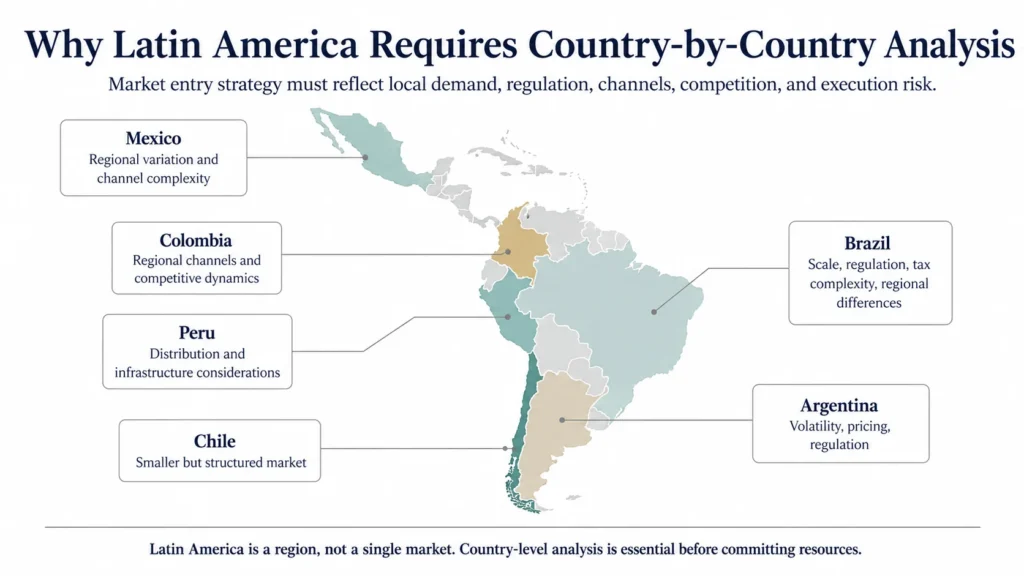
Figure 1. Midas Country-by-Country LatAm Market Entry Analysis: Latin America is a region, not a single market. Market entry decisions should be evaluated country by country, considering local demand, regulation, channels, competition, and execution risk.
What Is Changing in Argentina?
Argentina’s market-entry environment is being reshaped by several trends:
- Macroeconomic stabilization is improving confidence, but volatility remains part of the market. Inflation has slowed significantly from crisis levels, fiscal accounts have improved, and the government has been working to rebuild reserves and reduce distortions. However, inflation, interest rates, real wage recovery, and exchange-rate expectations still need to be monitored closely.
- Foreign exchange and capital flow conditions are becoming more flexible. Measures to ease foreign exchange restrictions and normalize the exchange-rate system have improved the environment for investors, importers, exporters, and companies that need to plan payments, pricing, and profit repatriation. Still, companies should validate current rules before structuring contracts, transfer pricing, dividend flows, or long-term supply arrangements.
- Large-scale investment incentives are becoming more relevant. Argentina’s RIGI regime is designed to attract major investments in sectors such as energy, mining, infrastructure, and other strategic areas. This is particularly important for companies evaluating long-term, capital-intensive opportunities.
- Export-oriented sectors are gaining strategic relevance. Energy, mining, agriculture, and selected industrial and B2B sectors are becoming more central to Argentina’s growth story. Companies that support these value chains may find attractive opportunities even if domestic consumption recovers gradually.
- Domestic demand remains selective. Stabilization does not automatically translate into broad consumer recovery. Companies entering Argentina should distinguish between export-driven opportunities, B2B demand, premium or resilient consumer segments, and categories that remain sensitive to real income and credit conditions.
- Competition is likely to intensify. As Argentina becomes more open, local incumbents, regional players, importers, distributors, and multinational companies may reposition quickly. Market entry decisions should therefore include competitor analysis, channel assessment, pricing strategy, and likely competitor reactions.
Midas Insight | Trade Opening Is Already Reshaping Competitive Strategies
The Midas Import Competition Monitor 2026 tracks 151 business decisions made in response to Argentina’s new import competition environment. We found companies investing to defend local production, reconfiguring their sourcing, regionalizing their portfolios, or reshaping their manufacturing footprint. Forbes Argentina examined the findings of Midas Consulting’s Monitor and the different strategies companies are adopting.

Key Data About Argentina:
| Metric | Data |
|---|---|
| GDP (2025) | $672 Billion |
| GDP growth (2025) | 4.4% |
| Imports (2023) | $113 Billion |
| Exports (2023) | $90 Billion |
| Consumer inflation rate (2025) | 31.5% |
| Unemployment rate (2025) | 7.4% |
| Population (2025) | 48 million |
| Capital | Buenos Aires city |
| Language | Spanish |
Source: Banco Itaú BBA (all data except for import and export figures, which are from the World Bank)
What Are Argentina’s Main Market Entry Challenges?
Despite its renewed potential, Argentina presents unique challenges that businesses must carefully navigate. The main barriers include:
1. Macroeconomic and currency volatility
Argentina is moving toward stabilization, but companies still need to manage inflation, exchange-rate risk, interest rates, pricing frequency, working capital, and payment terms. Market entry plans should include scenarios for currency movements, import costs, local pricing, and customer affordability.
2. Regulatory and tax complexity
The reform agenda is improving the business environment, but Argentina remains a complex regulatory and tax market. Companies need to understand national, provincial, municipal, customs, labor, and sector-specific requirements before entering.
3. Import, payment, and supply-chain execution
Foreign exchange normalization and trade liberalization can create new opportunities, but companies should still validate import procedures, payment timing, inventory strategy, customs processes, and local logistics before committing to a market model.
4. Uneven sector attractiveness
Argentina is not equally attractive across all sectors. Energy, mining, agriculture, infrastructure, selected B2B services, technology, and value-chain support opportunities may be more promising than categories that depend heavily on broad consumer recovery.
5. Partner and distributor selection
Local relationships matter. A strong distributor, channel partner, technical service provider, or local advisor can accelerate entry. A weak partner can create pricing, service, compliance, reputation, or execution problems.
6. Competitive reaction
As Argentina opens, competitors may move quickly. Local incumbents may defend share, distributors may demand exclusivity, customers may compare imported and local offers more aggressively, and multinational competitors may return to categories they had previously deprioritized.
Market Note
Argentina’s regulatory, inflation, currency, and import conditions can change quickly. This page should be read as a strategic overview and should be complemented with updated validation before committing resources, pricing, contracts, partner agreements, or investment decisions.
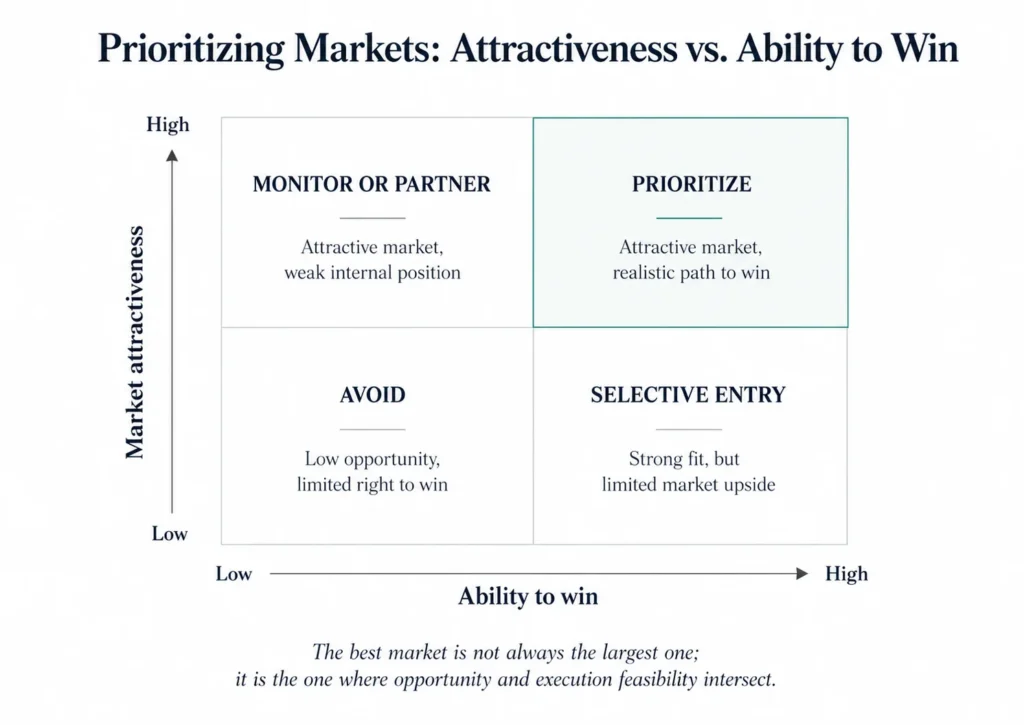
Figure 2. Midas Market Prioritization Matrix: A market should not be prioritized only because it is attractive. It should also offer a realistic path to win.

How Midas Can Help Your Market Entry in Argentina?
At Midas Consulting, we provide businesses with the knowledge and support needed to thrive in Argentina’s evolving market. With boots on the ground, we offer:
- Market entry consulting and competitor benchmarking. Identifying key opportunities, industry trends, and competitive landscapes with insights from our in-country experts
- Distributor search. Connecting businesses with reliable local distributors, partners, suppliers, and stakeholders
- Go-to-market consulting. Tailoring strategies to fit Argentina’s economic climate and consumer preferences, leveraging our deep understanding of local market dynamics
Learn the step-by-step process to develop a clear and actionable market entry strategy

Argentina is at a turning point, and businesses that enter now can capitalize on emerging opportunities. However, success requires local expertise, strategic planning, and adaptability
How This Market Entry Analysis Was Prepared
This page is based on Midas Consulting’s experience supporting market entry, market analysis, distributor search, go-to-market, benchmarking, competitive intelligence, and strategy projects across Latin America.
Our approach typically combines:
- Secondary research from recognized economic, trade, industry, regulatory, and company sources.
- Primary interviews with market participants, including customers, distributors, competitors, experts, associations, regulators, suppliers, or channel partners when relevant.
- Competitive analysis to understand positioning, capabilities, pricing, channels, likely reactions, and barriers to entry.
- Country-by-country interpretation, because Latin America should not be treated as a single homogeneous market.
- Executive decision support, translating findings into practical recommendations on whether to enter, where to focus, which partners to evaluate, what risks to monitor, and how to sequence the market entry plan.
The goal is not to provide generic country information. The goal is to help executive teams make better market entry decisions with stronger evidence, clearer assumptions, and a more realistic view of local execution challenges.
Some of Our Market Entry in Argentina Customers:






Case Example, Breaking Barriers: How an NGO Successfully Entered the Argentine Market
Background and challenges
A non-governmental organization (NGO) aimed to expand its operations into Argentina to better serve vulnerable communities. To ensure a successful market entry, they needed a clear strategy, insights into local needs, and strong partnerships


Approach
To develop an effective market entry strategy, we conducted:
- In-depth Market Research – Identifying market size, unmet needs, and key decision drivers among food product manufacturers
- Stakeholder Interviews – Engaging with government agencies, distributors, industry associations, competitors, and potential partners to gain first-hand insights
- Partner Identification – Assessing and recommending organizations best suited to collaborate with the NGO in fulfilling its mission
Results
With our guidance, the NGO successfully entered the Argentine market. Key outcomes included:
- Prioritized Market Segments – We identified high-impact areas where the NGO could make the most significant difference
- Strategic Partnerships – We recommended potential partners, and the NGO successfully secured a collaboration that allowed them to reach their target communities
- Sustainable Market Entry – With a clear roadmap and local alliances in place, the NGO established a long-term presence in Argentina

About the author
By Adrian Alvarez, PhD. Adrian Alvarez is Managing Partner at Midas Consulting, a Wharton alumnus, MBA professor at Universidad Argentina de la Empresa (UADE), and Competitive Intelligence Fellow.
He specializes in competitive strategy, market entry, go-to-market strategy, distributor search, benchmarking, business wargaming, and strategic decision-making under uncertainty in Latin America. He has led and supervised hundreds of strategy, market entry, market analysis, competitive intelligence, and growth projects across Argentina, Brazil, Chile, Colombia, Mexico, Peru, and other Latin American markets.
His work combines executive-level strategy, primary research, competitive analysis, local market interviews, and practical implementation support. He has published strategic insights and research in the United States, Spain, and Germany, and has trained executives and professionals in competitive intelligence practices and ethics in Latin America.
Making an Impact in Argentina
Expanding into new markets requires more than just ambition. It demands local insights, strategic partnerships, and expert guidance. At Midas Consulting, we help organizations navigate complex landscapes and achieve impactful, sustainable growth.
Looking to expand your operations into Argentina? Let’s connect and discuss how we can support your success