
Go-to-Market Consulting to Grow Your Share and Profits
A promising market, a strong product, or an ambitious sales target does not automatically create growth.
You still need to decide which customers to prioritize, why they should choose you, how you will reach them, which channels and partners can deliver, how your commercial teams should execute, and what you will change when the market responds differently than expected.
Midas Consulting helps you design and implement a go-to-market strategy built around your customers, economics, competitors, channels, and execution capabilities.
With more than 200 go-to-market projects across Latin America and selected international markets, we help leadership teams move from broad growth ambitions to clear commercial choices, stronger organizational alignment, and an actionable implementation roadmap.
200+ go-to-market consulting projects
Across Latin America and selected international markets
25+ years of experience
Supporting leadership teams in complex and fragmented markets
Country-by-country expertise
Argentina, Brazil, Chile, Colombia, Mexico, Peru, and regional Latin America.
From strategy to execution
Customer targeting, value proposition, channels, partners, pricing, sales execution, and measurement

Is Your Go-to-Market Model Helping You Grow, or Holding You Back?
A go-to-market challenge rarely appears as a single problem.
You may initially see weak sales, slow adoption, low distributor engagement, excessive discounting, inconsistent execution, or disappointing market share. But the underlying issue may be customer selection, positioning, channel economics, incentives, commercial capabilities, or a lack of alignment across the organization.
You may need go-to-market consulting when:
- Your growth objectives are clear, but your commercial priorities are not.
- Your teams do not agree on which customers or segments should come first.
- Sales resources are spread too broadly across low-potential opportunities.
- Your value proposition is not clearly understood by customers or sales teams.
- Your salesforce relies too heavily on discounts to win business.
- Your distributors or channel partners are not fully engaged.
- You are unsure whether to sell directly, indirectly, digitally, or through a hybrid model.
- Your route to market has grown historically and no longer reflects your strategy.
- A regional GTM model is producing very different results across countries.
- You are launching a product but do not have an integrated commercial execution plan.
- Your strategy looks strong on paper, but execution is inconsistent.
- You need to anticipate competitor reactions before making a major commercial move.
What Will You Be Able to Decide with Our Go-to-Market Consulting?
At the end of the engagement, your leadership team should be able to answer:
- Which customers and segments should we prioritize?
- Which needs, buying criteria, and barriers matter most?
- Why should those customers choose us rather than an alternative?
- Which route to market can reach them profitably?
- Which distributors, partners, or channels should play a role?
- How should pricing, incentives, messaging, and sales execution reinforce one another?
- What capabilities and organizational changes will execution require?
- Which markets, channels, or customer groups should receive investment first?
- What should we measure during the first commercial cycles?
- How will we adapt when evidence from the market challenges our assumptions?
The goal is to give you a clear, evidence-based plan that your organization can execute.
Go-to-Market Consulting Is the System That Connects Your Strategy with Revenue
A go-to-market strategy is not simply a launch plan, marketing campaign, sales target, or distributor agreement.
It is the integrated set of choices that determines:
- Who you will target
- Which problems you will solve
- Why customers should choose you
- How you will reach and serve them
- Which channels and partners you will use
- How pricing and incentives will support the strategy
- What your commercial teams must do differently
- How you will measure, learn, and adjust
A strong GTM strategy connects customer insight, value proposition, route to market, channel economics, pricing, commercial execution, organizational capabilities, and performance measurement.
When those elements reinforce one another, you create a realistic path to profitable growth.
When they conflict, even a strong product can underperform.
For a deeper explanation, read our executive guide: Go-to-Market Strategy: From Plan to Execution.
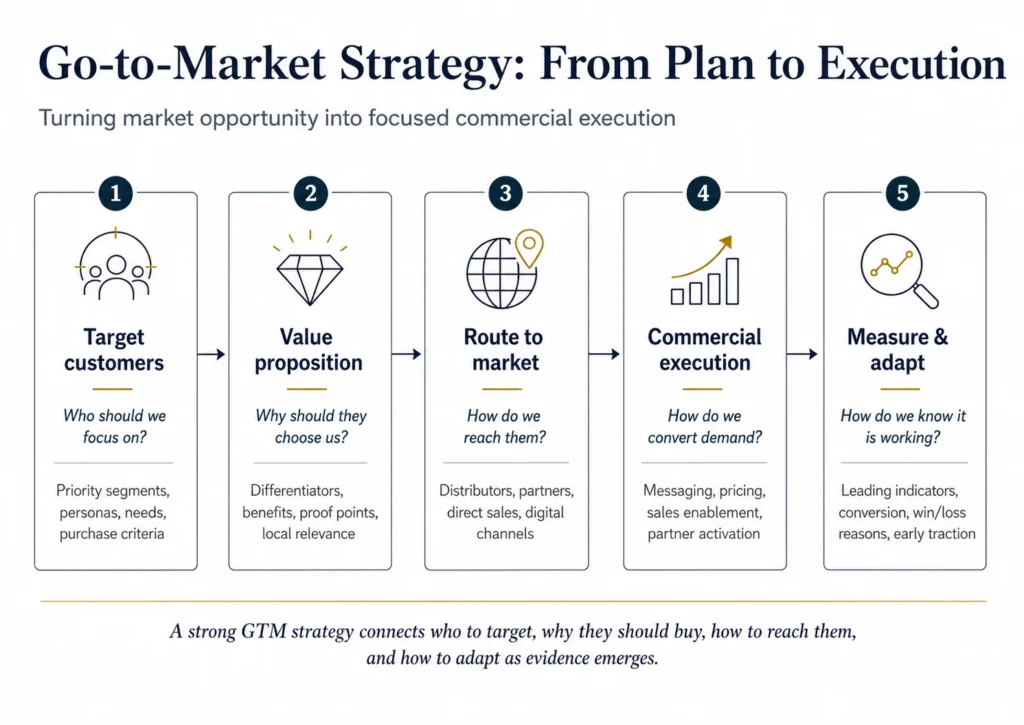
Figure 1. The Midas Go-to-Market System. A strong go-to-market strategy connects who you should target, why customers should choose you, how you will reach them, how your teams will execute, and how you will adapt as evidence emerges.

Where Can Midas Consulting Help You Improve Your Go-to-Market Strategy?
Every GTM project begins with a different business question. We design the scope around the decision you need to make rather than applying a standard template.
Customer Segmentation and Prioritization
Identify which customers, use cases, industries, geographies, or segments offer the strongest combination of need, accessibility, profitability, strategic fit, and readiness to buy.
Value Proposition and Positioning
Clarify why customers should choose your offer, which benefits genuinely influence their decisions, and how your sales and marketing teams should communicate value without defaulting to price.
Route-to-Market and Channel Strategy
Determine whether you should use direct sales, distributors, retailers, agents, integrators, digital channels, partnerships, or a hybrid model.
We assess coverage, capabilities, costs, margins, control, customer access, incentives, and execution risk.
Distributor and Partner Model
Define the role local partners should play, the capabilities they need, how they should be selected, and how incentives, governance, and performance management should work.
Pricing and Commercial Architecture
Align pricing, discount policies, channel margins, commercial conditions, bundles, incentives, and value communication with your strategic objectives.
Sales Model and Commercial Execution
Define account priorities, coverage models, roles, routines, capabilities, sales arguments, enablement needs, governance, and performance metrics.
Product Launch and Market Expansion
Translate a new product, category, geography, or growth ambition into a practical launch and execution roadmap.
Regional GTM Adaptation
Adapt your model country by country when customer expectations, regulation, channels, pricing, competition, or operating capabilities differ across Latin America.
GTM Consulting Diagnostic and Redesign
Assess an existing model when growth has slowed, execution is fragmented, distributors are underperforming, or your organization no longer agrees on priorities.
Competitor Response and Risk Testing
Pressure-test how competitors, customers, distributors, and internal stakeholders may react before implementing a major pricing, channel, product, or positioning change.
A Go-to-Market Consulting Must Align the Entire Commercial System
A GTM strategy can fail even when most individual decisions look reasonable.
The target customer may be attractive, but difficult to reach. The distributor may have coverage, but little motivation. The value proposition may be compelling, but poorly translated into sales arguments. The pricing model may protect margin, but create channel conflict.
That is why we examine the GTM system as a whole.
Depending on your needs, the engagement may cover:
- Market and demand potential
- Customer segments and priority accounts
- Purchase criteria and customer journey
- Decision-makers and influencers
- Value proposition and positioning
- Competitive alternatives
- Product and service adaptation
- Pricing and discount architecture
- Direct and indirect channels
- Distributor economics and incentives
- Sales coverage and account allocation
- Commercial roles and capabilities
- Sales tools and messaging
- Partner governance
- Launch priorities
- KPIs and feedback loops
- Implementation responsibilities and milestones
We do not assume that every component needs to change.
The analysis identifies which parts of your GTM model are already strong, which are misaligned, and which improvements would have the greatest impact.

How Our Go-to-Market Consulting Builds a Strategy You Can Execute
Every engagement is customized, but our GTM projects generally follow five connected stages.
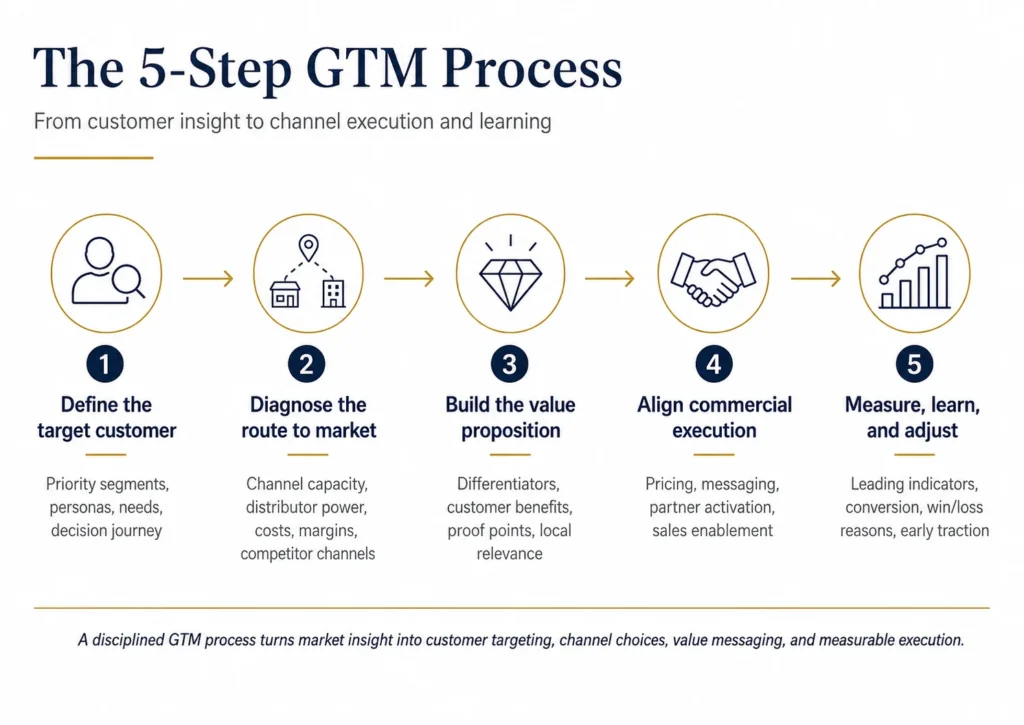
Figure 2. The Midas Five-Step GTM Process. Our process turns market insight into customer priorities, channel choices, differentiated value, aligned commercial execution, and measurable learning.
1. Define the Target Customer and Priority Opportunity
We begin by identifying where your company has the strongest right to win.
This may involve:
- Estimating demand by segment, geography, channel, or use case
- Understanding customer needs and purchase criteria
- Identifying decision-makers, users, approvers, and influencers
- Mapping the customer journey
- Evaluating accessibility, profitability, and strategic fit
- Prioritizing segments and accounts
- Identifying barriers to adoption
This stage prevents your sales and marketing resources from being spread across too many low-potential opportunities.
2. Diagnose the Route to Market
We assess how customers currently buy and which routes can reach them effectively and profitably.
The analysis may include:
- Direct sales
- Distributors
- Retailers
- Agents
- Integrators
- E-commerce
- Marketplaces
- Strategic partners
- Hybrid models
We examine channel coverage, capabilities, incentives, costs, margins, control, service levels, customer access, and potential conflict.
The goal is not to select the channel with the broadest theoretical reach. It is to select the model that can actually execute your strategy.
3. Build a Differentiated Value Proposition
We compare customer needs with your offer, competitor alternatives, and the solutions customers already use.
We then distinguish between:
- Benefits that customers value and competitors cannot easily match
- Basic expectations required to compete
- Advantages that matter only to selected segments
- Features that add complexity but little purchasing influence
The result is a value proposition your commercial teams can explain, support with evidence, and translate into relevant customer conversations.
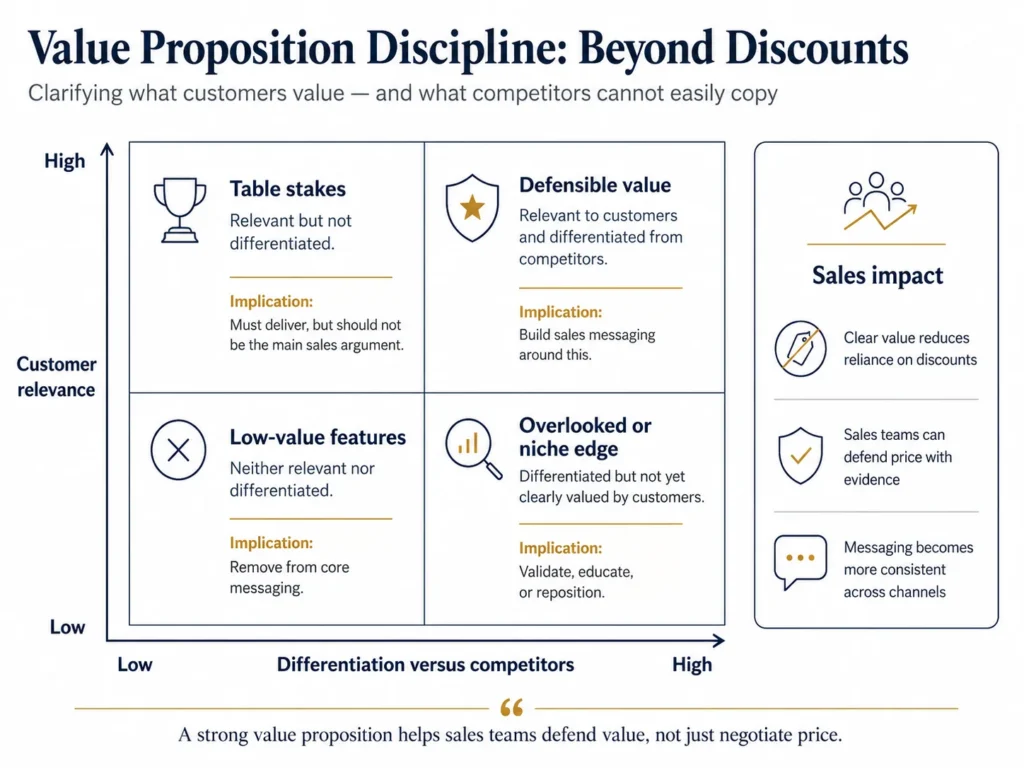
Figure 3. Build a Value Proposition Your Sales Team Can Defend. The strongest elements of your value proposition are both relevant to customers and meaningfully differentiated. Other features may be necessary to compete, valuable only to a niche, or too weak to influence the purchase decision.
4. Align Pricing, Messaging, Partners, and Commercial Execution
A GTM strategy only becomes real when it changes behavior.
We translate the strategic choices into:
- Pricing and discount principles
- Commercial messages
- Sales arguments
- Channel roles
- Partner incentives
- Coverage priorities
- Account ownership
- Sales tools
- Capability requirements
- Governance routines
- Launch actions
We co-create these choices with the people who will execute them so that the strategy fits the reality of your markets and organization.
5. Measure, Learn, and Adjust
GTM execution should not depend only on annual sales results.
We define early indicators that help your leadership team understand whether the strategy is gaining traction.
These may include:
- Qualified opportunities
- Conversion rates
- Distributor activation
- Channel coverage
- Customer objections
- Win-loss reasons
- Discount levels
- Pipeline quality
- Time to first purchase
- Repeat purchase
- Early revenue and margin
- Adoption by segment
Your GTM strategy becomes an ongoing discipline of execution, learning, and adjustment rather than a one-time launch document.
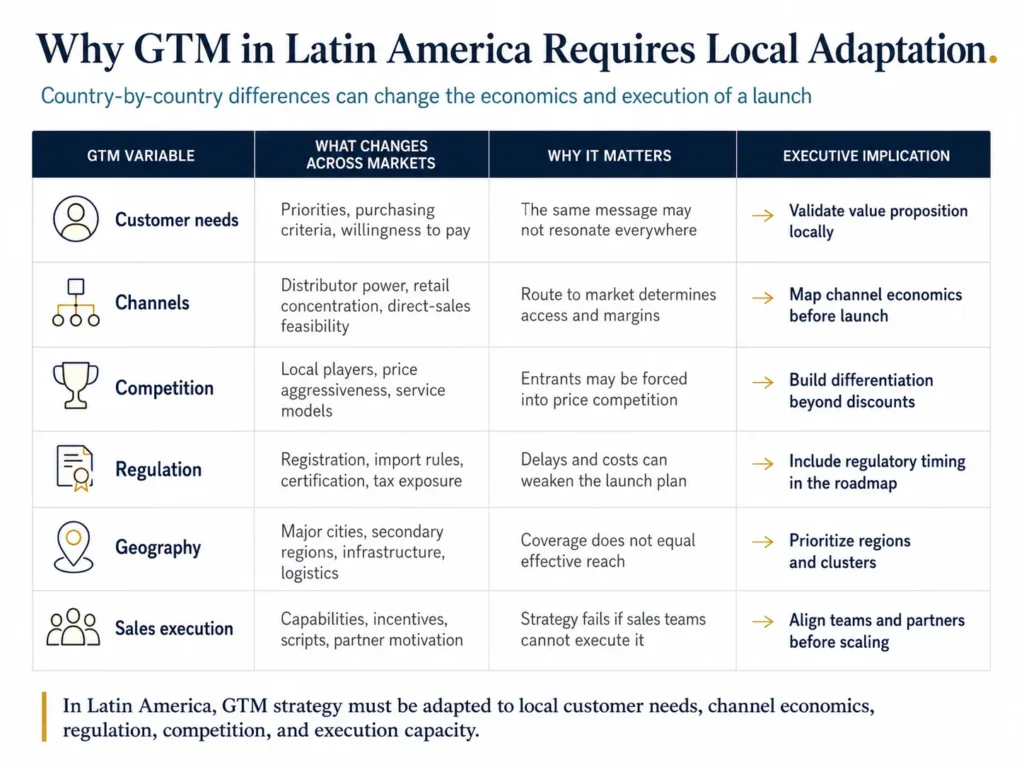
Figure 4. Why Go-to-Market Strategy Must Be Adapted Locally. A regional strategy creates direction, but local execution determines results. Customer needs, channel economics, competitive behavior, regulation, geography, and execution capacity can differ substantially across countries—and sometimes across cities within the same country.
How We Protect the Quality of Your Go-to-Market Decisions with Our Consulting
A GTM strategy is only as strong as the evidence and assumptions behind it.
Multiple Sources of Evidence
Depending on the engagement, we may combine:
- Interviews with customers and former customers
- Distributor and partner interviews
- Executive and sales-team interviews
- Competitor analysis
- Market and channel research
- Win-loss analysis
- Benchmarking
- Regulatory and industry sources
- Commercial and financial data
- Midas’ local and sector experience
We triangulate material findings whenever feasible rather than relying on a single opinion or source.
Clear Treatment of Assumptions
Not every market question has a perfect or auditable answer.
We distinguish between:
- Confirmed facts
- Evidence-supported estimates
- Management assumptions
- Working hypotheses
- Issues that require testing during implementation
This helps your leadership team understand what is known, what is inferred, and where flexibility is required.
Local Validation
Regional strategies can look coherent but fail locally.
We validate important assumptions with local teams, channel participants, customers, and market evidence whenever the scope permits.
Ethical Research
We use lawful and ethical research methods. We comply with SCIP’s ethical code.
We do not request trade secrets, encourage sources to violate contractual obligations, or present uncertain competitive information as confirmed fact.
Confidentiality
Your internal data, growth objectives, channel plans, customer priorities, and strategic alternatives are treated confidentially.
Where appropriate, the engagement can operate under a mutual nondisclosure agreement.
Executive Challenge and Alignment
We discuss emerging conclusions with your leadership team before finalizing the strategy.
This helps identify blind spots, test feasibility, and build alignment around the choices that will shape execution.
What Will You Receive from Our Go-to-Market Consulting?
Your deliverables will depend on the business question and agreed scope, but a typical GTM engagement may include:
- Market and opportunity assessment
- Priority segments and target-customer profiles
- Customer needs and buying-criteria analysis
- Customer-journey and decision-maker mapping
- Competitor and alternative analysis
- Route-to-market assessment
- Channel and distributor economics
- Partner-role and capability requirements
- Differentiated value proposition
- Positioning and commercial messages
- Pricing and discount principles
- Sales coverage and account-prioritization model
- Commercial organization and capability implications
- Launch or growth priorities
- Risks, assumptions, and dependencies
- KPIs and early-warning indicators
- Prioritized initiatives
- Implementation roadmap
- Executive presentation and decision workshop
You will also receive progress discussions and preliminary findings during the engagement.
We prefer to build the strategy with your organization rather than present a finished model that your teams have not helped test.
Trusted for Go-to-Market Consulting by Companies Facing Complex Growth and Commercial Decisions
Midas Consulting has supported multinational and regional companies in go-to-market, route-to-market, value proposition, distribution, commercial strategy, market entry, and related growth challenges.
Our experience includes sectors such as:
The logos below represent organizations Midas has supported in GTM and related strategic engagements.











Why Executives Choose Midas for Go-to-Market Strategy Consulting
We Start with the Decision, Not a Standard Framework
Your company does not need every possible GTM analysis.
We begin by clarifying the decision you need to make, the risk you need to reduce, and the result you need to achieve. We then design the scope around that question.
We Combine Strategy with Market Reality
A GTM strategy must reflect customer behavior, channel power, partner incentives, competitor actions, pricing practices, regulation, and execution capabilities.
We bring those elements together so that the strategy is commercially attractive and operationally realistic.
We Understand Latin America Country by Country
Latin America is not one homogeneous market.
A model that works in Mexico may need significant adaptation in Brazil, Argentina, Chile, Colombia, or Peru. Even within one country, customer behavior and channel structures may vary by region or city.
We help you preserve regional direction while adapting execution to local realities.
We Connect Go-to-Market with Strategic Intelligence
GTM choices are made in a competitive system.
Competitors may change prices, defend channels, increase incentives, imitate your offer, or target the same accounts. Customers and partners may also react differently than expected.
Our strategic-intelligence capabilities help you interpret those reactions and pressure-test the plan before committing resources.
We Work Side by Side with Your Team
Your local and commercial teams hold essential knowledge about customers, channels, execution barriers, and organizational realities.
We involve them throughout the engagement so that the strategy is stronger, the assumptions are challenged, and implementation begins before the final presentation.
We Make Trade-Offs Explicit
A GTM strategy is a set of choices.
We help your leadership team decide:
- Which customers to prioritize, and which not to prioritize
- Which channels to invest in, and where control may be limited
- Which differentiators to emphasize, and which features do not matter
- Which capabilities to build, and which activities to outsource
- Which markets to enter first, and which to delay
- Which assumptions require testing before scaling
We Focus on Implementation
The project does not end with a conceptual model.
We translate strategic choices into initiatives, responsibilities, milestones, KPIs, risks, and a practical execution roadmap.
Go-to-Market Consulting Strategy in Action
Client identities and selected details have been withheld or generalized to protect confidentiality.
Case 1: Moving from Low Market Share to Second Place in Three Years
The situation
A multinational printer-cartridge company faced low market share and growing pressure from counterfeit and refilled products.
Leadership lacked reliable information about the size of the unofficial segment, competitor distribution policies, channel incentives, and the needs of local distributors.
What we did
We combined secondary research with interviews involving distributors, competitors, channel participants, and cartridge refillers.
The work helped the client:
- Understand competitor distribution strategies
- Estimate the role of counterfeit and refilled products
- Identify distributor needs and decision criteria
- Redesign commercial incentives
- Develop actions to reduce the influence of refillers
- Strengthen its route-to-market model
The executive impact of our go-to-market consulting
The company improved its distribution strategy and aligned incentives more closely with distributor needs.
Within three years, it became the second-largest player in the market.
Case 2: Turning an Unclear Offer into a Value-Led Sales Model
The situation
A technology company had a strong offer, but customers did not clearly understand how it differed from competing alternatives.
Sales conversations frequently focused on technical features and price, limiting conversion and putting pressure on margins.
What we did
We worked with the leadership and commercial teams to:
- Identify priority customer needs
- Separate meaningful differentiators from low-impact features
- Clarify the value proposition
- Translate the proposition into commercial messages
- Align sales arguments with customer purchase criteria
- Support adoption by the sales team
The executive impact of our go-to-market consulting
Customers gained a clearer understanding of the company’s differentiators.
According to the client’s CEO, sales doubled after the new value proposition was implemented.
Case 3: Aligning Customer Priorities, Channels, and Business Units
The situation
A multinational company had growth opportunities across several business units, but its commercial teams did not share a consistent view of target customers, channel priorities, or execution responsibilities.
The lack of alignment created duplicated efforts and made implementation difficult.
What we did
We facilitated a collaborative GTM process involving regional and local stakeholders.
The engagement included:
- Customer and segment prioritization
- Route-to-market assessment
- Value-proposition refinement
- Channel-role clarification
- Cross-functional workshops
- Execution priorities and governance
- A shared implementation roadmap
The executive impact of our go-to-market consulting
The client left the project with a clearer and more structured GTM strategy, stronger collaboration across business units, and a shared fact base for implementation.
Case 4: Reducing Discount Dependence Through Stronger Value Communication
The situation
A consumer-goods company found that sales teams frequently relied on discounts because customers did not clearly perceive the value of the offer.
What we did
We connected customer insights, competitive alternatives, value-proposition design, sales messaging, and commercial execution.
The project helped the team identify which benefits mattered most and how to communicate them more consistently.
The executive impact
The commercial team shifted more conversations from price toward value.
According to one salesperson involved in the project, the company began offering substantially fewer discounts.
These summaries are based on Midas Consulting engagements. Client identities and selected contextual details have been withheld or generalized to protect confidentiality. Results reflect client-reported outcomes or management actions associated with the projects and should not be interpreted as guarantees of future performance.
Go-to-Market Consulting Is Stronger When It Is Connected to Strategic Intelligence
Your GTM strategy does not operate in isolation.
Competitors may defend key accounts, change prices, increase distributor incentives, copy your value proposition, launch alternatives, or create channel conflict. Customers may respond differently than interviews suggested. Partners may prioritize another supplier. Regulation or economic conditions may alter channel economics.
That is why GTM decisions often need to connect with market analysis, competitor analysis, benchmarking, win-loss analysis, distributor search, market entry, scenario planning, business wargaming, and strategic execution.
Midas’ Strategic Intelligence Applied hub brings together practical frameworks, applied research, and lessons from complex corporate engagements to help you turn competitive uncertainty into better decisions.
Go-to-Market Consulting Expertise Across Latin America
A regional strategy can create direction, but execution needs to reflect local customer behavior, channel structure, regulation, competition, pricing, and organizational capacity.
Explore our country-specific experience:
- Latin America. Build a regional GTM strategy that creates common direction while recognizing country, city, channel, and customer differences.
- Argentina. Design a GTM strategy that can adapt to volatility, changing customer priorities, pricing pressure, regulation, and channel constraints.
- Brazil. Turn scale into focused execution by adapting your GTM model to regional differences, channel economics, regulation, competition, and partner capabilities.
- Chile. Compete in an open market where customers can compare alternatives and differentiation, channel choices, and execution discipline are essential.
- Colombia. Align customer priorities, distributor engagement, market education, regional execution, and commercial capabilities.
- Mexico. Convert market scale into focused growth by prioritizing regions, customers, channels, and partners while accounting for competition and nearshoring dynamics.
- Peru. Build a GTM model that reflects regional variation, channel realities, customer needs, competitive pressure, and evolving market conditions.
Frequently Asked Questions About Go-to-Market Consulting
What is a go-to-market consulting strategy?
A go-to-market strategy defines how your company will reach the right customers, communicate relevant value, activate the right channels, align commercial execution, and convert market demand into profitable growth.
It connects customer targeting, value proposition, route to market, pricing, partners, sales execution, organizational capabilities, and measurement.
How is go-to-market strategy different from marketing strategy?
Marketing strategy generally focuses on market positioning, brand, demand generation, communication, and customer engagement.
Go-to-market strategy is broader. It also defines target customers, channels, distributors, sales coverage, partner roles, pricing, incentives, commercial capabilities, implementation priorities, and performance measurement.
The two should reinforce one another.
How is go-to-market different from market entry?
Market entry helps you decide whether, where, and how to enter a new market.
Go-to-market strategy defines how you will compete and execute after selecting the opportunity: which customers to target, what value proposition to offer, which channels and partners to use, how to price, and how commercial teams will operate.
In many expansion projects, market entry and GTM are consecutive or overlapping stages.
When does a company need consulting to redesign its GTM strategy?
You may need a redesign when:
- Growth slows
- Customer needs change
- A new product or category is launched
- The current channel model underperforms
- Distributors lose focus
- Sales teams rely excessively on discounts
- A regional model produces inconsistent local results
- Digital channels change customer behavior
- New competitors or substitutes emerge
- Your organization no longer agrees on priorities
Does GTM consulting only apply to product launches?
No. GTM consulting can support:
- New-product launches
- Market expansion
- Entry into a new channel
- Commercial-model redesign
- Distributor optimization
- Customer-segment reprioritization
- Value-proposition improvement
- Salesforce redesign
- Pricing changes
- Turnarounds
- Growth acceleration in an existing market
How do you identify the right target customers with your go-to-market consulting?
We normally evaluate customer groups based on factors such as:
- Need
- Market size
- Accessibility
- Purchase readiness
- Profitability
- Strategic fit
- Competitive intensity
- Cost to serve
- Channel access
- Probability of conversion
The strongest target is not necessarily the largest segment. It is the segment where your company has an attractive and realistic right to win.
How do you determine the right route to market with your go-to-market consulting?
We compare the economics, reach, capabilities, control, risks, and customer experience associated with direct sales, distributors, agents, retailers, integrators, digital channels, partnerships, and hybrid models.
The right choice depends on your customers, offer, economics, capabilities, desired level of control, and local market structure.
Can you help us choose or evaluate distributors?
Yes. When local partners are central to the GTM model, we can define distributor requirements, map candidates, assess capabilities, evaluate strategic fit, support outreach, and help structure the partner model.
This can be integrated into the GTM project or conducted as a separate distributor-search engagement.
Can you improve an existing distributor network with your go-to-market consulting?
Yes. We can evaluate:
- Coverage
- Capabilities
- Strategic fit
- Focus
- Incentives
- Margins
- Service levels
- Account access
- Governance
- Performance management
- Channel conflict
The result may involve strengthening current partners, changing roles, adding new partners, or redesigning the channel model.
How do you build a value proposition with your go-to-market consulting?
We begin with customer needs, buying criteria, pain points, current alternatives, and competitor offers.
We then identify which benefits are genuinely relevant and differentiated, test whether the evidence supports them, and translate the strongest elements into positioning, sales messages, proof points, and commercial tools.
Can you help us reduce excessive discounting?
Yes, although discounting may be a symptom rather than the root problem.
Excessive discounts can result from weak differentiation, unclear value communication, poor sales capabilities, channel pressure, inappropriate pricing architecture, or targeting customers who do not value the offer.
We diagnose the cause before recommending changes.
How do you account for competitor reactions in your go-to-market consulting?
We analyze competitor positioning, likely objectives, capabilities, channel relationships, pricing behavior, and historical responses.
For major commercial changes, we may recommend a business wargame or scenario exercise to pressure-test likely countermoves before implementation.
How do you adapt a regional GTM model to different countries?
We separate the elements that should remain consistent across the region from those that require local adaptation.
Common elements may include strategic priorities, brand positioning, core value proposition, governance, and performance principles.
Local elements may include target segments, channels, pricing, partner roles, messages, service levels, account priorities, and execution routines.
What information will you need from our company for your go-to-market consulting?
Depending on the scope, we may need:
- Growth objectives
- Sales and margin data
- Customer and segment information
- Channel and distributor data
- Pricing and discount information
- Commercial organization details
- Existing research
- Product and service information
- Access to executives, sales teams, and local stakeholders
- Current strategic assumptions
We define the exact request at the start of the engagement and protect the information under appropriate confidentiality arrangements.
What does a GTM consulting project deliver?
A GTM consulting project typically delivers:
- Target-customer priorities
- Customer and market insights
- Route-to-market recommendations
- Channel and partner roles
- Value proposition
- Pricing and commercial implications
- Sales-execution priorities
- Capability requirements
- KPIs
- Risks and assumptions
- An implementation roadmap
The final scope is designed around your business decision.
How long does a GTM consulting project take?
Timing depends on the number of countries, customer segments, channels, products, and research requirements.
A focused diagnostic or value-proposition project may take several weeks. A multi-country GTM redesign involving customer research, channels, pricing, and implementation planning may require several months.
After an initial discussion, we can recommend an appropriate scope, timeline, team, and fee structure.
Can you help us implement the strategy?
Yes. Depending on your needs, implementation support can include:
- Executive alignment workshops
- Sales-team workshops
- Distributor engagement
- Launch planning
- Initiative prioritization
- Governance design
- KPI dashboards
- Capability building
- Progress reviews
- Adaptation after initial market feedback
How will we know whether the strategy is working?
We define leading and lagging indicators before execution.
These may include qualified leads, conversion, distributor activation, channel coverage, pipeline quality, customer objections, win-loss reasons, discounting, time to first purchase, repeat purchase, revenue, margin, and market share.
The right metrics depend on your GTM model and stage of implementation.
Our Go-to-Market Consulting Experience and Evidence Base
Midas Consulting has more than 25 years of experience supporting leadership teams with growth, go-to-market, route-to-market, customer segmentation, value proposition, commercial strategy, distribution, market entry, competitor analysis, and related strategic decisions.
Our work spans multinational and regional companies across Latin America and selected international markets.
Our approach combines practical engagement experience with established GTM principles: identifying the right target customer, defining a relevant value proposition, selecting the appropriate route to market, aligning commercial execution, and adapting based on evidence.
Suggested external references
- Harvard Business School Online: How to Develop a Go-to-Market Strategy for Your Tech Venture
- MIT Sloan Management Review: Closing the Gap Between Strategy and Execution
- Midas Consulting — Go-to-Market Strategy: From Plan to Execution
- Midas Consulting — Strategic Intelligence Applied
External references provide methodological context. Every Midas recommendation is based on the specific objectives, evidence, market conditions, capabilities, and strategic priorities of the client engagement.
What Happens When You Contact Us For Go-to-Market Consulting Project?
1. You Tell Us Where Growth Is Breaking Down
You do not need to arrive with a fully defined project.
Tell us:
- What growth objective you are pursuing
- What is not working as expected
- Which markets, products, customers, or channels are involved
- What your leadership team needs to decide
2. We Help You Frame the Real GTM Question
We determine whether the issue is mainly related to:
- Customer targeting
- Value proposition
- Route to market
- Distributors
- Pricing
- Commercial execution
- Organizational alignment
- Market entry
- Competitor response
- A combination of these factors
3. You Receive a Tailored Proposal
We provide a proposal explaining:
- Objectives
- Scope
- Methodology
- Research approach
- Countries and segments
- Client and Midas responsibilities
- Schedule
- Deliverables
- Team
- Assumptions
- Professional fees
4. We Work with Your Team Throughout the Engagement
We share progress, test emerging insights, involve relevant stakeholders, and refine the strategy as the evidence develops.
5. Your Leadership Team Receives an Executable Roadmap
The final output clarifies:
- Where to focus
- How to win
- Which channels and partners to activate
- What must change internally
- How implementation should be prioritized
- How success will be measured
Your Market Opportunity Is Only Valuable If Your Organization Can Convert It into Growth
You may already have a strong product, an attractive market, capable teams, and ambitious goals.
But if your customer priorities, value proposition, channels, partners, pricing, and execution model do not reinforce one another, that potential will remain difficult to capture.
Tell us what your leadership team is trying to achieve and where execution is getting in the way.
We will help you determine whether your GTM model needs a focused adjustment or a broader redesign—and what evidence you need before committing resources.
Related Services and Executive Resources
- Go-to-Market Strategy Guide. See how customer targeting, value proposition, route to market, commercial execution, and measurement fit together.
- Market Analysis. Understand demand, customer segments, barriers, market structure, and opportunity before committing commercial resources.
- Competitor Analysis. Understand competitor positioning, pricing, channels, capabilities, likely priorities, and potential responses.
- Value Proposition Design. Clarify why your customers should choose you and translate differentiation into stronger commercial messages.
- Distributor Search. Identify and evaluate local partners with the access, capabilities, motivation, and execution discipline your GTM model requires.
- Market Entry. Decide which markets and opportunities to prioritize before defining how you will compete and execute.
- Benchmarking. Compare channel models, commercial practices, sales structures, pricing, service levels, and competitor approaches.
- Win-Loss Analysis. Understand why buyers choose, reject, delay, or replace your offer in real commercial situations.
- Business Wargaming. Pressure-test competitor, customer, distributor, and internal reactions before implementing a major GTM move.
- Strategic Intelligence. Connect GTM decisions with broader market signals, competitor behavior, scenarios, and strategic execution.
About Midas Go-to-Market Consulting
Midas Consulting is a strategy and strategic-intelligence consulting firm with more than 25 years of experience helping leadership teams turn market opportunity into focused decisions and executable growth.
Our go-to-market work covers customer targeting, value proposition, route to market, channels, distributors, pricing, sales execution, organizational alignment, performance measurement, and implementation across Latin America and selected international markets.
Last reviewed: August 2026