
Benchmarking consulting for improving your performance
Your competitors may be operating at a lower cost, moving faster, reaching customers more effectively, or achieving better results with fewer resources. The important question is not simply how you compare. It is why the gap exists, and which parts of it you can realistically close.
Midas Consulting helps you go beyond industry averages and surface-level comparisons. We reconstruct how selected competitors operate, normalize the differences that could distort the analysis, and identify the performance drivers that matter most to your business.
With more than 300 benchmarking projects completed across Latin America and selected global markets, we help leadership teams turn competitive intelligence into practical decisions about costs, pricing, processes, commercial execution, organization, innovation, and resource allocation.
300+ benchmarking consulting projects
Across Latin America and selected global markets
25+ years of experience in benchmarking consulting
Supporting executives in complex and often opaque markets.
Multiple benchmarking applications
Costs, pricing, salesforce, channels, processes, organization, innovation, and operations.
82.2% Net Promoter Score
Based on client feedback collected between 2020 and 2025.
Net Promoter Score based on client feedback collected by Midas Consulting between 2020 and 2025.
Is Benchmarking Consulting the Right Tool for Your Decision?
Benchmarking is most valuable when you are facing a specific performance gap but do not yet understand its cause. You may know what is happening without knowing why it is happening, or what you should change.
You may need strategic benchmarking when:
- A competitor consistently operates at a lower cost, but your team cannot explain the difference.
- Your prices or margins are under pressure and you need to reconstruct competitor economics.
- Another company launches products, serves customers, or makes decisions faster than you do.
- Your salesforce, distribution network, plant, function, or regional structure appears less productive.
- Performance varies significantly across countries, business units, channels, or teams.
- You are considering a major investment and need an external reality check before committing capital.
- Internal debates are driven by assumptions rather than a shared fact base.
- You need to identify best practices without blindly copying another company’s business model.
What You Will Be Able to Decide with Our Benchmarking Consulting
At the end of the engagement, you should be able to answer:
- Where is the real performance gap?
- What structural, strategic, and operational factors explain it?
- Which differences are directly addressable?
- Which gaps would require investment or a change in business model?
- Which competitor practices should you adapt rather than imitate?
- Where can you leapfrog the market instead of merely catching up?
- Which initiatives should receive priority, ownership, and resources?
The objective is not to produce another comparison report. It is to give you a stronger fact base for the decisions your leadership team already needs to make.
Benchmarking Consulting Should Explain the Gap, not Just Measure It
Traditional benchmarking usually tells you that another company is cheaper, faster, leaner, or more productive. Strategic benchmarking explains why.
A competitor’s advantage may come from scale, supplier terms, channel design, plant configuration, technology, labor model, incentives, management routines, make-or-buy decisions, product mix, or simply stronger execution. These explanations lead to very different strategic responses.
That distinction matters because not every gap should be closed. Some differences are structural. Some require investment. Some can be addressed through operational discipline. Others may be central to your differentiation and should remain untouched.
We help you separate those possibilities so you can decide where to:
- Match a competitor when the gap weakens your competitiveness.
- Leapfrog the market when a different model can create greater advantage.
- Remain different when imitation would undermine your positioning or economics.
For a deeper explanation of the methodology, read our executive guide: Benchmarking That Delivers Real Competitive Advantage.
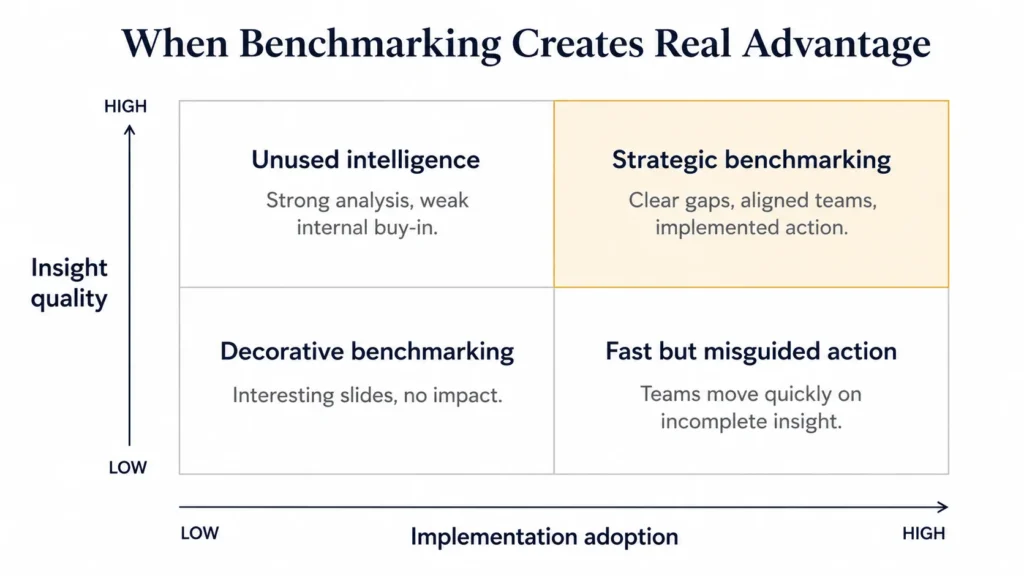
Figure 1. When Benchmarking Creates Real Advantage. Benchmarking creates value when high-quality competitive insight is combined with strong internal understanding and adoption. Reliable analysis without implementation becomes unused intelligence. Fast implementation based on weak analysis can move the company in the wrong direction. Strategic benchmarking combines both.

With these insights, you’ll be equipped to build a strategy that not only levels the playing field but puts you ahead!
What Can You Benchmark?
The right scope depends on the decision you need to make. We design each engagement around your strategic question rather than forcing your company into a standard template.
Competitive Cost and Economic Benchmarking Consulting
Understand why a competitor can price lower, sustain higher margins, win tenders, or operate with a different cost base. We can examine cost drivers such as plant configuration, labor, suppliers, logistics, scale, sourcing, channels, and regional operating choices.
Commercial and Go-to-Market Benchmarking Consulting
Compare sales coverage, account priorities, channel design, distributor models, salesforce productivity, pricing practices, incentives, segmentation, and commercial routines.
Process and Operational Benchmarking Consulting
Identify why another company performs an activity faster, more consistently, or with fewer resources. The analysis can cover workflows, roles, technology, service levels, decision rights, productivity, and performance-management practices.
Organizational Benchmarking Consulting
Evaluate structures, spans of control, role allocation, governance, staffing, incentives, and decision-making models. The objective is not merely to compare headcount but to understand how the organization supports, or constrains, performance.
Innovation and R&D Benchmarking Consulting
Assess how competitors organize innovation, allocate resources, collaborate with external partners, prioritize projects, and connect technical capabilities with commercial results.
Channel and Distributor Benchmarking Consulting
Understand whether competitor advantage comes from stronger partners, broader coverage, better distributor economics, superior account access, or more effective channel management.
Internal and Cross-Market Benchmarking Consulting
Sometimes the strongest practice is already inside your organization. We can compare countries, plants, functions, business units, teams, or channels to identify practices that can be transferred internally.
Not sure which form of benchmarking would best answer your question? We can help you define the scope before you commit to a full engagement.
How We Turn Competitive Data into Decisions
Every project is customized, but our benchmarking engagements generally follow six stages.
1. Define the Strategic Question
We begin with the decision, not the data. Together, we clarify what your leadership team needs to understand and how the findings will be used.
The question may involve pricing, costs, productivity, salesforce design, channel performance, organizational structure, innovation, footprint, resource allocation, or another strategic priority.
2. Build Your Internal Baseline
Before comparing your company with the market, we develop a clear view of your current operating model. Depending on the project, this may include your processes, costs, roles, KPIs, incentives, channel structure, assumptions, and performance differences across units or countries.
This step prevents an external benchmark from being compared against an incomplete or inconsistent internal picture.
3. Select the Right Comparators
The most visible competitor is not always the most useful benchmark. We help you select companies, business units, markets, or operating models that can genuinely inform your decision.
Depending on the objective, the benchmark set may include direct competitors, best-in-class companies, adjacent industries, regional peers, internal units, or organizations with a particularly relevant capability.
4. Reconstruct the External Benchmark
We combine multiple sources to understand how selected organizations actually operate. These may include:
- Executive and expert interviews
- Supplier and channel intelligence
- Industry and regulatory sources
- Company disclosures
- Specialized databases
- Field research
- Customer or distributor perspectives
- Midas’ local and sector experience
We triangulate material findings whenever feasible rather than relying on a single source.
5. Normalize the Comparison
An apparent gap may be caused by scale, product mix, regulation, taxes, labor structure, geography, channel model, asset configuration, outsourcing choices, or other structural differences.
We separate these factors from true performance gaps so you do not act on a misleading comparison.
6. Translate Findings into Action
We convert the analysis into practical choices. Depending on the engagement, this can include:
- Opportunity sizing
- Prioritized improvement initiatives
- Strategic alternatives
- Quick wins and longer-term changes
- Investment implications
- Risks and dependencies
- Owners and next steps
- An implementation roadmap
Your final output should make it easier for your leadership team to decide what to change, what not to change, and where to focus first.
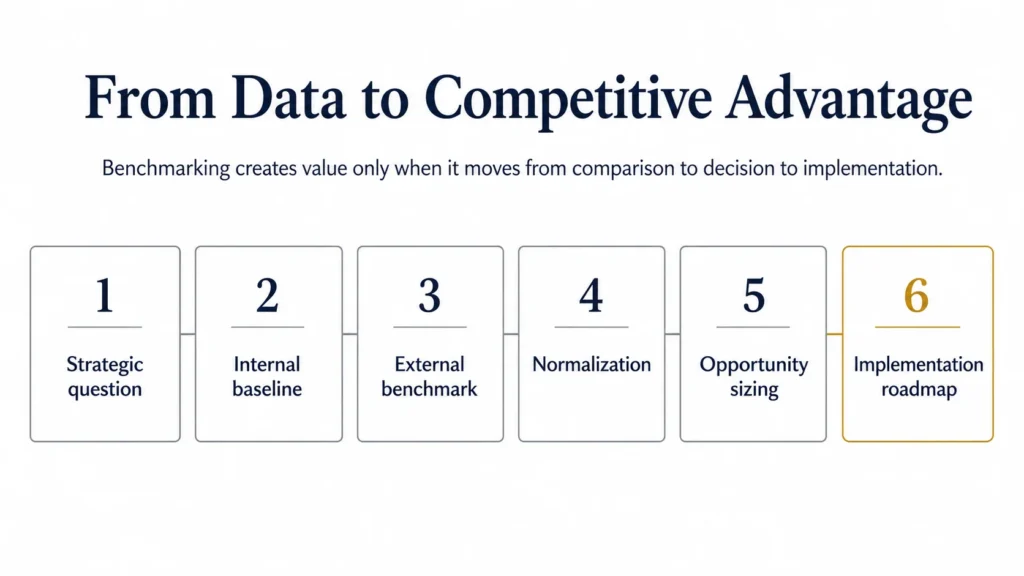
Figure 2: The Midas Benchmarking Advantage Framework. Our process connects the strategic question with the internal baseline, external intelligence, normalized comparison, opportunity sizing, and an actionable implementation roadmap.
How We Protect the Quality and Integrity of the Benchmarking Consulting Analysis
Competitive benchmarking is only useful when the information is credible, comparable, and obtained responsibly.
Triangulation
We seek to validate important findings through more than one source whenever feasible. When a conclusion is based on an estimate, inference, or limited evidence, we identify it as such rather than presenting it as a confirmed fact.
Apples-to-Apples Comparability
We adjust the comparison for material differences in scale, geography, product mix, channel structure, regulation, labor, taxes, business model, and operating configuration.
Clear Treatment of Uncertainty
Competitive intelligence is not the same as audited financial information. We distinguish confirmed data, informed estimates, hypotheses, and areas where evidence remains incomplete.
Ethical Research
We use lawful and ethical research methods and comply with SCIP’s code of ethics. We do not request trade secrets, misrepresent the purpose of interviews in an improper manner, or encourage sources to violate legal or contractual obligations.
Confidentiality
Your information, project objectives, internal data, and strategic priorities are treated as confidential. Where appropriate, the engagement can operate under a mutual nondisclosure agreement.
Executive Validation
We review preliminary findings with your team before finalizing the conclusions. This allows us to challenge assumptions, resolve inconsistencies, and ensure that recommendations reflect your actual operating context.
What Will You Receive in Our Benchmarking Consulting?
Your deliverables will depend on the strategic question, but a typical engagement may include:
- A clearly defined internal performance baseline
- A profile of each benchmarked company or operating model
- Comparative KPIs and performance ranges
- Reconstructed processes, structures, practices, or economics
- An explanation of the drivers behind each material gap
- Normalization of structural and market differences
- Identification of gaps to close, leapfrog, or consciously retain
- Opportunity sizing and potential business impact
- Practical recommendations tailored to your company
- Prioritized initiatives, risks, dependencies, and next steps
- An executive presentation and leadership discussion
- An implementation roadmap, when included in the scope
You will also receive regular progress discussions during the project. We prefer to test emerging findings with your team rather than disappear for several weeks and return with a finished report that no one has helped shape.

Benchmarking Consulting Trusted by Companies Facing Complex Competitive Questions
Our benchmarking experience spans multinational and regional organizations in consumer goods, healthcare, industrial products, food and beverage, packaging, agribusiness, energy, automotive, chemicals, construction, mining, and technology.
We bring deep experience across a broad range of industries, including:
The logos below represent organizations Midas Consulting has supported across benchmarking and related strategic-intelligence engagements.

















Why Executives Choose Midas for Benchmarking Consulting
We Reconstruct Reality Rather Than Depend on Averages
Industry averages can provide context, but they rarely explain why the specific competitor you face is outperforming you. We focus on the companies, operating models, and performance drivers that are relevant to your decision.
We Understand the Complexity of Latin America
A comparison that works in a highly transparent market can become misleading in Latin America. Taxes, labor rules, import exposure, informality, channel margins, union dynamics, regulation, logistics, procurement, and local execution can all change the economics.
We normalize these differences before drawing conclusions.
We Connect Competitive Intelligence with Strategy
Benchmarking is one component of a broader strategic-intelligence capability. We help you interpret competitor behavior, market signals, operating choices, and likely implications for your company.
Explore our Strategic Intelligence Applied: Insights for Executives and Organizations hub to see how benchmarking connects with competitive simulation, market intelligence, strategy, and execution.
We Work Alongside Your Team
We involve your executives and local teams throughout the engagement. Their operating knowledge helps us interpret the evidence correctly, while their participation increases confidence in the findings and supports implementation.
We Make Uncertainty Visible
When evidence is incomplete, we say so. You receive a clear distinction between validated findings, informed estimates, and working hypotheses so you can make decisions with an appropriate understanding of risk.
We Focus on Action
The engagement does not end with a ranking. We help you determine which gaps matter, which levers you can influence, what the potential impact could be, and what your organization should do next.

Benchmarking Consulting in Action
Client identities and selected details are withheld or generalized to protect confidentiality.
Case 1: Understanding a Competitor’s Cost Advantage in Government Tenders
The situation
A multinational healthcare manufacturer was repeatedly being undercut in government tenders. Its leadership team needed to determine whether the competitor’s advantage came from aggressive pricing, lower input costs, plant configuration, supplier relationships, scale, or another operating-model difference.
What we did
We benchmarked relevant competitor operations in Brazil and Paraguay, reconstructed the principal cost drivers, mapped supplier dynamics, and compared the client’s assumptions with the competitor’s likely economics.
We also normalized differences in operating configuration so that the client could distinguish structural advantages from gaps it could realistically address.
The executive impact
The company gained a much clearer view of why the competitor could bid at lower prices and developed a roadmap for closing selected gaps in priority tenders.
The conversation changed from “They are cheaper” to “We understand why they are cheaper and which levers we can act on.”
Case 2: Redesigning Salesforce Incentives Across Four Latin American Markets
The situation
A healthcare company wanted to assess whether its commercial organization was properly aligned with market conditions in Argentina, Brazil, Mexico, and Peru.
The company needed more than a headcount comparison. Its executives wanted to understand differences in roles, incentives, coverage models, account priorities, and field execution.
What we did
We mapped competitor sales structures and compensation models across the four markets. We compared staffing levels, but also examined the strategic logic behind deployment, incentives, responsibilities, and customer coverage.
The executive impact
The client refined its incentive model and created stronger regional alignment around the behaviors it needed from its commercial teams.
The benchmark helped management distinguish between structural market differences and execution issues that could be addressed internally.
Case 3: Optimizing R&D Resources in the Food Industry
The situation
A multinational food company wanted to benchmark a newly established R&D center against a relevant competitor in Brazil.
The real question was not simply whether the company had the right budget or number of employees. Leadership wanted to know whether its structure, capabilities, partnerships, and priorities would support innovation and commercial growth.
What we did
We mapped the competitor’s organizational structure, decision rights, external partnerships, capabilities, innovation priorities, and links between R&D and the commercial organization.
The executive impact
The company identified resource misalignments and redesigned elements of the R&D model to improve efficiency and strategic focus.
The project demonstrated that benchmarking is not only about spending less. It is about allocating resources where they can create the greatest strategic impact.
These summaries are based on actual Midas Consulting engagements. Client names and selected contextual details have been withheld or generalized to protect confidentiality. Outcomes describe management actions and reported project impact; they should not be interpreted as guarantees of future results.
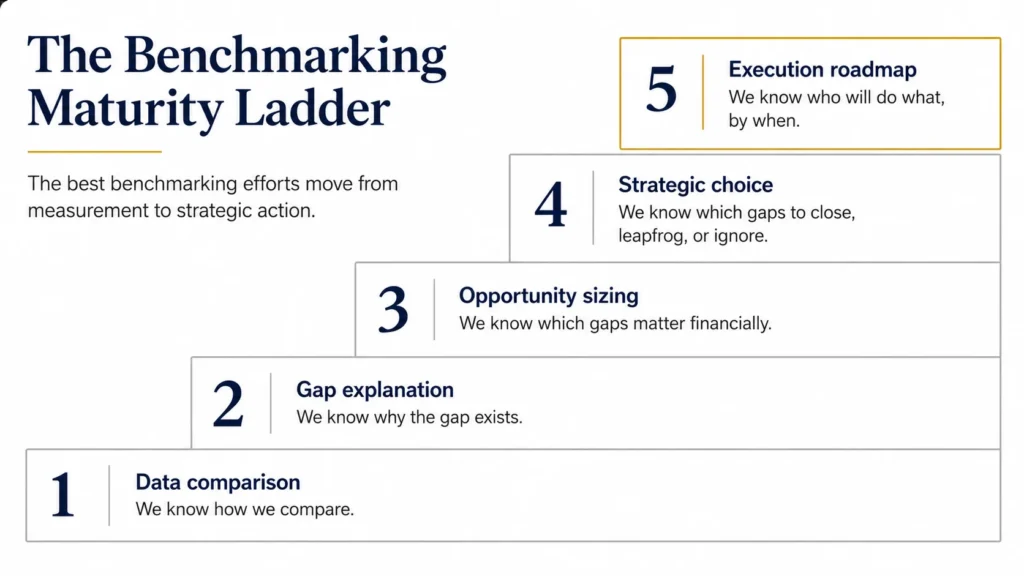
Figure 3. From Comparison to Execution. The value of benchmarking increases as the analysis moves from comparing data to explaining performance gaps, sizing opportunities, making strategic choices, and creating an execution roadmap.
Benchmarking Consulting Is Part of a Broader Strategic Intelligence System
Benchmarking tells you where competitors outperform and why. But the findings often raise additional questions:
- How are competitors likely to react if you change your prices or commercial model?
- Which market signals should your leadership team monitor?
- How could a new regulation, technology, entrant, or channel shift change the benchmark?
- Does the performance gap require operational improvement or a broader strategic change?
- How should your organization prioritize competing initiatives?
These questions connect benchmarking with competitor analysis, scenario planning, business wargaming, market intelligence, strategy, and execution.
Our Strategic Intelligence Applied hub brings together Midas frameworks, applied research, publications, and practical experience to help executives turn competitive uncertainty into better decisions.
Frequently Asked Questions About Benchmarking Consulting
What is strategic benchmarking?
Strategic benchmarking compares your company with selected competitors, peers, internal units, or best-in-class organizations to understand not only where performance differs, but why.
The objective is to identify the practices, economic drivers, organizational choices, capabilities, and operating conditions behind the gap, and determine what your company should do about it.
How is strategic benchmarking different from a traditional benchmark?
A traditional benchmark often compares indicators and produces a ranking. Strategic benchmarking connects those differences with the decision your executives need to make.
It explains why the gap exists, adjusts for structural differences, identifies which gaps are addressable, and translates the findings into strategic choices and implementation priorities.
Which competitors should we benchmark?
The answer depends on your question. Direct competitors may be appropriate when you need to understand pricing, costs, channels, or commercial execution. In other situations, an adjacent industry, a best-in-class company, or one of your own internal business units may offer a more relevant comparison.
We define the benchmark set with you at the beginning of the engagement.
Can you obtain reliable information about privately held competitors?
Private-company benchmarking is more difficult, but it is often feasible to develop a reliable decision-grade picture by combining multiple sources.
These may include interviews, supplier and channel intelligence, regulatory records, company disclosures, specialized databases, field research, expert perspectives, and operating-model reconstruction.
We clearly distinguish validated facts from estimates and hypotheses.
How do you obtain competitive information ethically?
We use lawful and ethical research methods. We do not seek trade secrets, request confidential information that a source is not authorized to disclose, or encourage anyone to breach a legal or contractual obligation.
The objective is to build a robust picture through legitimate research, triangulation, and analysis.
How do you ensure an apples-to-apples comparison?
We normalize material differences such as company scale, geography, product mix, labor model, regulation, taxes, channel structure, outsourcing, asset configuration, and import exposure.
Without this step, an apparent performance gap may be structural rather than operational, and acting on it could lead to the wrong conclusion.
What information will you need from our company?
The requirements depend on the scope, but we usually need access to relevant executives, internal KPIs, process information, organizational data, cost or commercial information, and the assumptions currently guiding management decisions.
We agree on the exact information request during the project-design stage and protect it under appropriate confidentiality arrangements.
What does a benchmarking consulting project deliver?
A strong engagement should provide:
- A reliable internal baseline
- A normalized external comparison
- An explanation of the most important performance gaps
- Identification of structural and addressable differences
- Opportunity sizing where feasible
- Strategic recommendations
- Prioritized initiatives and an implementation roadmap
The specific deliverables are defined around your decision and agreed before the engagement begins.
How long does a benchmarking consulting project take?
Timing depends on the number of markets, companies, processes, and variables included. A focused benchmark may take several weeks, while a multi-country or highly technical engagement can require several months.
After an initial conversation, we can recommend a scope, schedule, project team, and fee structure that fit your decision timetable.
Can you benchmark several Latin American countries?
Yes. Midas Consulting conducts single-country and multi-country benchmarking across Latin America.
Regional comparisons require careful normalization because taxes, regulation, labor models, channels, import costs, operating conditions, and data availability can vary significantly from one country to another.
Will benchmarking consulting tell us exactly what our competitors will do next?
Benchmarking explains current or recent performance drivers. It does not, by itself, guarantee an accurate prediction of future behavior.
When the decision could trigger a significant competitive response, we may recommend complementing the benchmark with competitor analysis, scenario planning, or a business wargame.
How do you prevent our team from simply copying competitors?
We classify findings according to the strategic response they support:
- Gaps you may need to close
- Capabilities you may be able to leapfrog
- Differences you should retain because they protect your positioning
- Practices that work for a competitor but would be inappropriate for your model
The goal is informed adaptation, not imitation.
Can you help us implement the recommendations?
Yes. Depending on your needs, we can facilitate executive workshops, help prioritize initiatives, define owners and milestones, support implementation planning, or connect the findings with a broader strategy, go-to-market, channel, or organizational project.
Our Benchmarking Consulting Evidence Base
Midas Consulting’s approach reflects more than 300 benchmarking engagements conducted across Latin America and selected global markets over more than 25 years.
Our experience includes competitive cost, commercial, salesforce, channel, distributor, process, organizational, innovation, and operational benchmarking across healthcare, industrial products, consumer goods, food and beverage, packaging, agribusiness, energy, chemicals, automotive, technology, and other B2B sectors.
Our methodology also draws on established benchmarking principles, including the distinction between performance benchmarking, which identifies where a gap exists, and practice benchmarking, which helps explain how the gap is created.
References and Further Reading
- What is Benchmarking? | APQC
- What are the Four Types of Benchmarking? | APQC
- Midas Consulting | Benchmarking That Delivers Real Competitive Advantage
- Midas Consulting | Strategic Intelligence Applied: Insights for Executives and Organizations
External references are included to provide methodological context. Midas Consulting’s recommendations are based on the specific circumstances, evidence, and strategic priorities of each client engagement.
What Happens When You Contact Us For a Benchmarking Consulting Project?
1. You Tell Us the Decision You Need to Make
You do not need to arrive with a fully developed scope. Tell us what you are seeing, what your team does not understand, and which decision is at stake.
2. We Help You Frame the Benchmark
We identify the right comparison set, variables, countries, information sources, internal participants, deliverables, and level of precision required.
3. You Receive a Tailored Proposal
We provide a project design explaining the scope, methodology, schedule, team, deliverables, assumptions, and professional fees.
4. We Work with Your Team Throughout the Engagement
You receive progress discussions and preliminary findings so the analysis can be challenged, refined, and connected with your business reality.
5. Your Leadership Team Receives a Decision-Ready Roadmap
The final output explains the gaps, their causes, their potential impact, and the practical actions available to your organization.
You Already Know There Is a Gap. Let’s Find Out What Is Causing It.
You may be seeing lower competitor prices, stronger margins, faster execution, greater productivity, broader channel coverage, or a more effective organization.
The next step is to replace internal assumptions with a clear view of how the advantage is created, and which levers are available to you.
Tell us what your leadership team needs to understand. We will help you determine whether benchmarking is the right tool, how the project should be scoped, and what level of evidence your decision requires.
The Cost of Making Decisions Without a Reliable Benchmark
When leadership teams lack a credible external comparison, they may:
- Set targets based on internal history rather than market potential.
- Invest in closing gaps that are structural or strategically irrelevant.
- Copy a competitor practice without understanding the business model behind it.
- Misdiagnose a performance problem as a people, cost, process, or technology issue.
- Overlook stronger practices already present in another part of the organization.
- Commit resources before understanding the likely business impact.
- Allow internal opinions to substitute for a shared fact base.
A well-designed benchmark does not remove uncertainty. It makes uncertainty more visible, separates evidence from assumption, and improves the quality of the decisions you make.
Related Strategic Services and Executive Resources
Benchmarking often identifies a gap that requires a broader strategic response.
- Benchmarking Executive Guide. Learn how to move from performance comparison to gap explanation, opportunity sizing, strategic choice, and execution.
- Strategic Intelligence. Explore Midas frameworks, applied research, publications, and executive perspectives on competitor behavior, uncertainty, strategy, and execution.
- Strategy Consulting. Use benchmarking findings to make broader decisions about priorities, investment, capabilities, positioning, and resource allocation.
- Go-to-Market Consulting. Address gaps involving segmentation, sales coverage, channels, pricing, value proposition, or commercial execution.
- Distributor Search and Partner Evaluation. Identify stronger local partners when the benchmark shows that channel access or distributor capabilities create competitive advantage.
- Business Wargaming. Pressure-test the likely competitive response before implementing major pricing, channel, market, or strategic moves.
About the Author: Midas Consulting
Midas Consulting is a strategy, benchmarking, and market intelligence consulting firm that helps leadership teams make better decisions in complex and competitive markets. Our approach to benchmarking is based on more than 300 engagements conducted across Latin America and selected global markets over more than 25 years.
Our senior consultants combine experience in competitive intelligence, strategy, market analysis, operations, commercial effectiveness, and executive decision-making. We work directly with leadership teams to understand not only how their performance compares with competitors, but why the gaps exist and which actions can realistically create value.
The insights on this page reflect Midas Consulting’s applied project experience, proprietary methodologies, executive research, and established benchmarking practices. Material findings in our consulting work are triangulated whenever feasible, and we distinguish evidence, estimates, and hypotheses so that executives can make decisions with an appropriate understanding of uncertainty.
Last reviewed: August 2026