

Navigate Chile’s Market with Confidence and Precision Thanks to Our Go-to-Market Consulting in Chile
Chile is often viewed as one of Latin America’s more open and attractive markets. That can create a dangerous assumption: that entry or expansion will be straightforward.
In practice, Chile’s openness can increase competitive intensity. Companies need a GTM strategy that clarifies where to focus, how to differentiate, which channels or partners matter most, and how to execute in a market where customers often compare alternatives carefully.
For C-level executives, the key question is: How do we turn a clear market opportunity into a disciplined commercial model that wins without relying only on price?
At Midas Consulting, we help companies design and refine go-to-market strategies in Chile by aligning customer targeting, value proposition, channel strategy, distributor or partner requirements, competitive positioning, sales execution, and performance metrics.
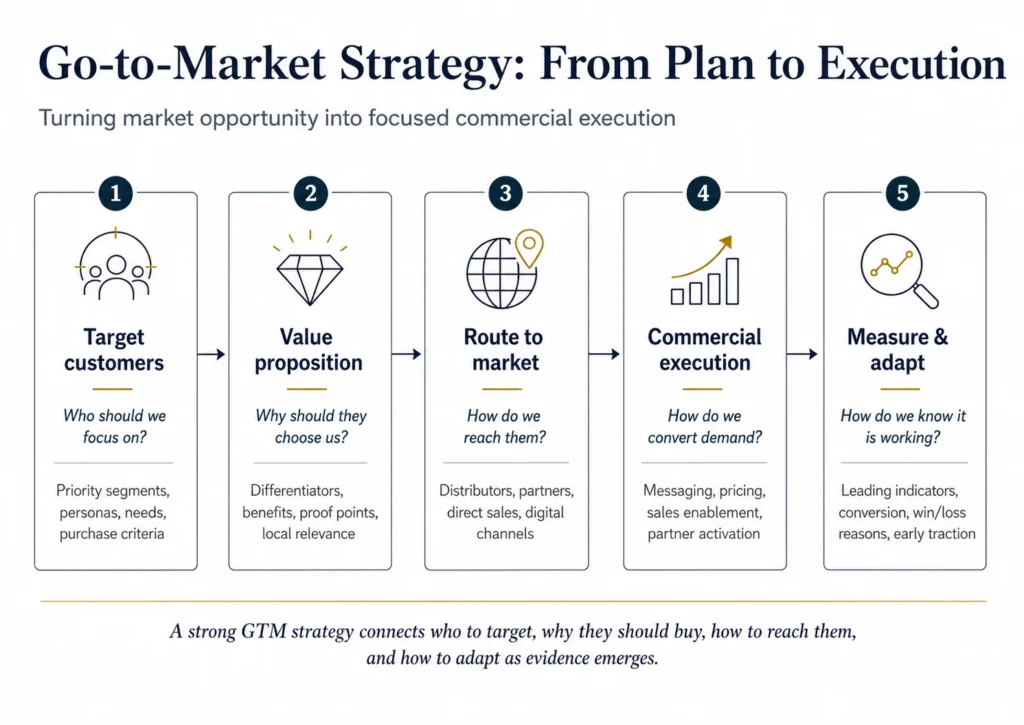
Figure 1. Midas Go-to-Market Strategy Process: A strong GTM strategy connects who to target, why they should buy, how to reach them, and how to adapt as market evidence emerges.

Key Aspects of a Strong Go-To-Market Strategy in Chile:
| Key Component | Description |
|---|---|
| Market Analysis | Comprehensive analysis of industry trends, local demand, and competitive landscape |
| Value Proposition Development | Crafting a compelling message that differentiates your offering for Chilean customers |
| Sales & Distribution Strategy | Identifying the most effective channels, partners, and market entry tactics |
| Competitive Benchmarking | Assessing key players, pricing strategies, and industry positioning in Chile |
| Marketing & Demand Generation | Developing targeted campaigns that resonate with Chile’s diverse customer segments |
| Go-to-Market Optimization | Enhancing strategies to improve efficiency, market penetration, and revenue growth |
| Product Launch Execution | Ensuring a data-driven approach to introducing new products successfully |
What Makes Go-to-Market Strategy in Chile Different?
Chile can be attractive, but it requires precision. Strong competitors, concentrated channels, demanding customers, and geographic coverage challenges can make execution harder than expected.
| Chile GTM issue | Why it matters | Executive implication |
| Open and competitive market | Customers often have access to multiple alternatives and clear benchmarks. | Differentiation, service model, and execution discipline matter as much as the initial offer. |
| Channel concentration | In some sectors, a limited number of key accounts, retailers, distributors, or partners can shape market access. | GTM strategy should map who controls access and how value is captured across the channel. |
| Geography and coverage | Chile’s long geography can affect logistics, service levels, and national coverage economics. | Companies need to define where direct coverage is justified and where partners are needed. |
| Value-based selling | Generic claims can quickly become price-based selling. | Sales teams need clear messages linked to customer priorities and competitive alternatives. |
| Execution consistency | A narrow but competitive market can expose misalignment quickly. | Pricing, messaging, channel incentives, and sales routines must be aligned before scaling. |
Where GTM Strategy Creates Value in Chile
In Chile, GTM strategy creates value by helping leadership teams make sharper choices:
- Which customer segments or accounts should receive priority.
- Which channels or partners provide the best access and service model.
- Which value proposition is strong enough to avoid competing only on price.
- Which competitors or alternatives shape customer expectations.
- Which execution metrics should be monitored after launch or expansion.
This is especially important when the company already has a strong product, but commercial results depend on positioning, channel performance, service model, and sales execution.
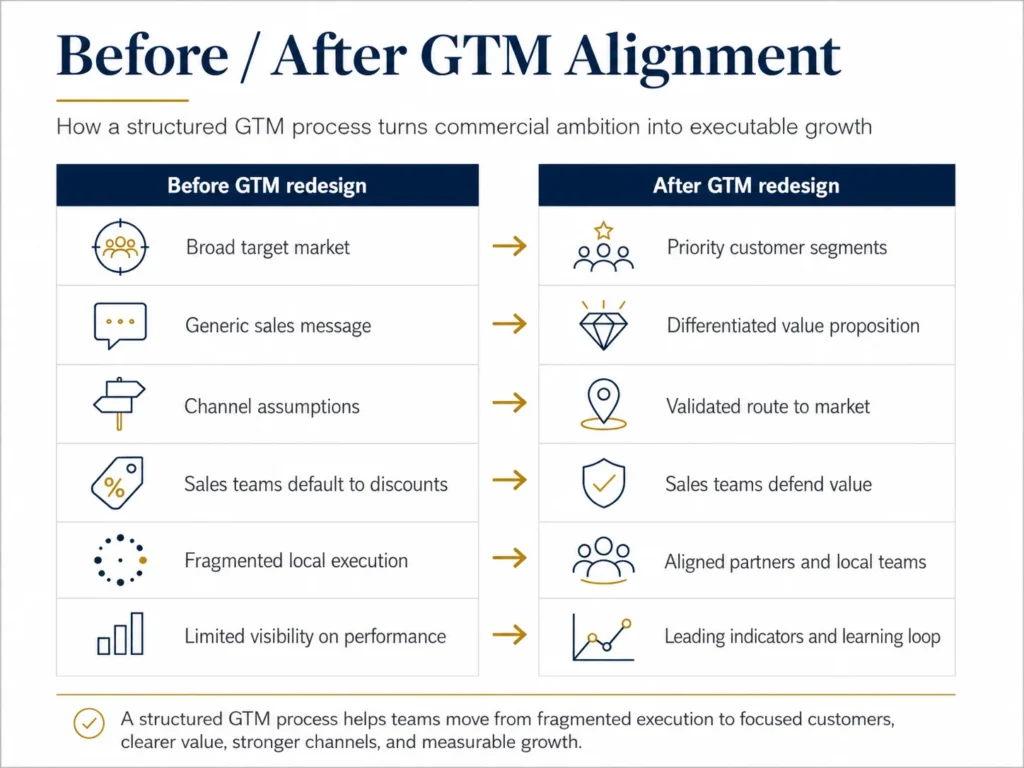
Figure 2. Before and After GTM Alignment: A structured process helps teams move from broad intent to focused customers, stronger channels, and measurable growth.
Challenges in Developing a Successful Go-To-Market Strategy in Chile
Chile presents unique opportunities but also distinct challenges. Companies expanding or launching in the country often encounter:
- Managing Logistics & Distribution. Chile’s geography, with its long and narrow shape, presents challenges for distribution and operational efficiency
- Navigating a Highly Competitive Market. Chile’s open economy attracts both local and international players, making differentiation essential
- Understanding Regional Consumer Behavior. Despite a relatively small population, Chile has distinct economic zones that impact purchasing behavior
Learn how to align channels, customers, and value propositions in our guide to go-to-market strategy in Latin America.

How Midas Helps You with Go-to-Market Consulting in Chile
At Midas, we provide customized go-to-market consulting services specifically designed for multinational firms operating in Chile. Our expertise includes:
- Local Market Analysis & Customer Insights. Our experts analyze Chile’s economic landscape, purchasing behaviors, and industry shifts to refine your strategy
- Competitive & Industry Benchmarking. We assess market leaders, pricing strategies, and competitive positioning to help you gain a strategic advantage
- Overall Go-to-Market Strategy Development. We identify optimal sales channels, and establish key partnerships to maximize market penetration

Looking to refine your go-to-market strategy or optimize a product launch in Chile?
Some of Our Go-to-Market Consulting in Chile Customers:






How We Build the Evidence Base in Chile
Depending on the project, our Chile GTM work can combine:
- Interviews with leadership, local teams, distributors, retailers, key accounts, customers, or market experts.
- Market analysis to understand demand, regional differences, purchase criteria, and channel structure.
- Competitor analysis to compare positioning, pricing, coverage, service levels, and likely responses.
- Channel assessment to evaluate distributor or partner capabilities, incentives, economics, and service performance.
- Executive workshops to align priorities, messages, channel choices, owners, and implementation milestones.
This allows leadership teams to move from assumptions to a GTM roadmap grounded in Chile’s actual market conditions.
Strengths and Limitations of Our GTM Approach in Chile
A structured GTM process helps companies clarify focus, strengthen differentiation, align channel execution, and avoid spreading resources too thin.
Its limitation is that even a strong GTM plan needs market validation and follow-through. Channel behavior, customer expectations, competitor moves, and service requirements should be monitored after launch. The plan should evolve as evidence emerges.
Case Example, Securing Market Leadership in Chile’s Laser Cartridge Industry
Background and challenges
A global laser cartridge manufacturer sought to expand its footprint in Chile but faced two key obstacles: limited market share and growing competition from counterfeit and refill products. The lack of data on the size and impact of counterfeits made it difficult to develop an effective strategy. Additionally, understanding competitor distribution tactics and incentives was essential to gaining a competitive edge


Approach
We conducted extensive secondary research and carried out in-depth interviews with industry insiders, including distributors, competitors, and re-fillers. This approach helped us uncover critical insights into the market’s distribution dynamics and provided a clear understanding of how counterfeit products affected sales
Results
Armed with our more strategic distribution model and customized incentives for distributors, the company was able to significantly reduce the impact of counterfeit products. In just three years, it had risen to become the second-largest player in the Chilean market

Is Your Chile GTM Strategy Specific Enough to Win?
In Chile, a good product is rarely enough. The strategy needs to clarify priority customers, channel access, competitive differentiation, service expectations, and execution metrics.
Midas helps executive teams transform those questions into practical GTM decisions.
Let’s talk about your Chile go-to-market challenge.
Frequently Asked Questions About Go-to-Market Consulting in Chile
What does go-to-market consulting in Chile include?
It includes customer targeting, market analysis, value proposition design, channel and partner assessment, competitor benchmarking, sales execution priorities, and performance metrics.
Why is GTM strategy important in Chile?
Because Chile’s openness and competitive intensity can make differentiation, channel execution, and service model critical to profitable growth.
When should a company review its GTM strategy in Chile?
When sales are not meeting expectations, channel partners are not delivering, competitors are gaining share, customers do not perceive the differentiation, or expansion requires clearer priorities.
How does Midas adapt GTM strategy to Chile?
We combine market insight, customer or channel input, competitor analysis, and executive alignment to build a GTM roadmap that reflects local market realities.
About the Author:
By Adrian Alvarez, PhD. Adrian Alvarez is Managing Partner at Midas Consulting, a Wharton Alumnus, MBA Professor at Universidad Argentina de la Empresa (UADE), and Competitive Intelligence Fellow. He specializes in competitive strategy, growth strategy, and strategic decision-making under uncertainty across Latin America.
He has developed go-to-market strategies supporting product launches, commercial acceleration, and regional expansion initiatives. Access his published strategic insights.
View professional profile on LinkedIn
External References
This page is informed by Midas Consulting’s project experience and by selected external sources on go-to-market strategy, customer segmentation, and Chilean market context: