Chemical Industry Consulting for Stronger Growth, Margins, and Market Position
In the chemical industry, volume does not always create value.
Your sales may grow while margins decline because feedstock costs rise, customers reformulate, distributors demand more support, imports change the price benchmark, or a competitor introduces a technically acceptable substitute.
A product that appears differentiated in the laboratory may become difficult to defend once purchasing, production, technical, and financial teams evaluate its full economics.
Midas Consulting helps chemical companies understand these dynamics and turn them into clearer strategic decisions.
For more than 25 years, we have supported companies across industrial chemicals, specialty chemicals, polymers, resins, additives, coatings, adhesives, construction chemicals, water treatment, agrochemicals, consumer applications, and related markets.
We can help you answer questions such as:
- Which markets, applications, and customer segments offer the strongest value potential?
- Where is your product genuinely differentiated—and where is it becoming commoditized?
- How much value does your solution create in your customer’s process or finished product?
- Which technical requirements, qualification processes, and switching barriers shape adoption?
- How should you adapt your portfolio, pricing, channel structure, or technical-service model?
- Which distributors can develop demand rather than simply move volume?
- How do your competitors achieve lower costs, stronger margins, or faster growth?
- Which products should you grow, defend, reposition, reformulate, partner, or exit?
- How could regulation, sustainability requirements, feedstock changes, or substitution reshape demand?
- Should you expand through organic investment, local production, licensing, a joint venture, or an acquisition?
- How will competitors and customers respond to your next strategic move?
You receive more than a market assessment.
You receive a clearer view of where value is created, what could weaken it, and how your company can build a more defensible position.
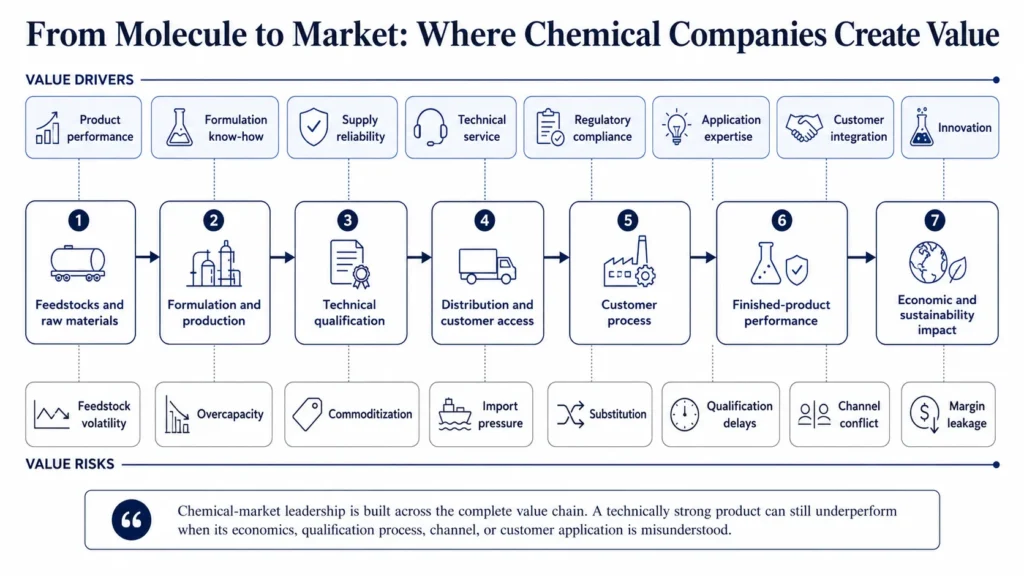
Figure 1. Chemical-market leadership is built across the complete value chain. A technically strong product can still underperform when its economics, qualification process, channel, or customer application is misunderstood.
Your Product Is Only One Part of the Customer’s Decision
Chemical companies frequently describe their offer through technical specifications:
- Purity
- Viscosity
- Molecular weight
- Concentration
- Density
- Particle size
- Drying time
- Adhesion
- Resistance
- Stability
- Compatibility
- Regulatory classification
Those specifications matter.
However, customers rarely evaluate them in isolation.
Your product may influence:
- Production speed
- Energy consumption
- Scrap and rework
- Equipment cleaning
- Worker safety
- Finished-product durability
- Appearance
- Yield
- Storage life
- Warranty claims
- Regulatory compliance
- Carbon footprint
- Total formulation cost
- Customer complaints
- Brand performance
A higher-priced chemical can be economically attractive when it improves yield, reduces downtime, lowers dosage, simplifies production, or enables a more valuable finished product.
A lower-priced product can become expensive when it creates inconsistency, higher application costs, quality problems, or operational risk.
We help you understand the complete value equation—not only the price per kilogram, liter, or ton.
The Relevant Price Is Not Always the Invoice Price
Your customer may pay more for your product and still reduce total cost.
Alternatively, your product may appear inexpensive but create hidden costs through higher dosage, waste, downtime, technical support, inventory, or quality variability.
A strong chemical value proposition connects product performance with measurable operational and commercial outcomes.
Define the Market Through the Application
Broad labels such as “specialty chemicals,” “industrial chemicals,” or “polymers” rarely provide a sufficiently precise view of the opportunity.
The same molecule or formulation may compete differently according to:
- Industry
- Application
- Production process
- Substrate
- Customer size
- Required performance
- Regulatory environment
- Technical standard
- Dosage
- Climate
- Equipment
- Finished-product positioning
- Price segment
- Channel
- Geography
A resin used in automotive parts may face different competitors, qualification requirements, price sensitivity, and substitution risks from the same resin used in packaging or construction.
An additive may create significant value for one customer but provide little benefit to another because their equipment, process, raw materials, or quality requirements differ.
We therefore begin by defining the market through the application.
We seek to understand:
- What function does the chemical perform?
- Which applications require that function?
- Which industries and customer segments use it?
- What performance level is necessary?
- What alternatives can provide the same function?
- How much product is used per unit of customer output?
- Which technical or regulatory standards apply?
- Who specifies, tests, approves, purchases, and uses it?
- How long does qualification take?
- What would cause the customer to change suppliers?
- How much of the theoretical market is commercially accessible?
This produces a more realistic opportunity assessment than applying a broad industry growth rate to your expected sales.
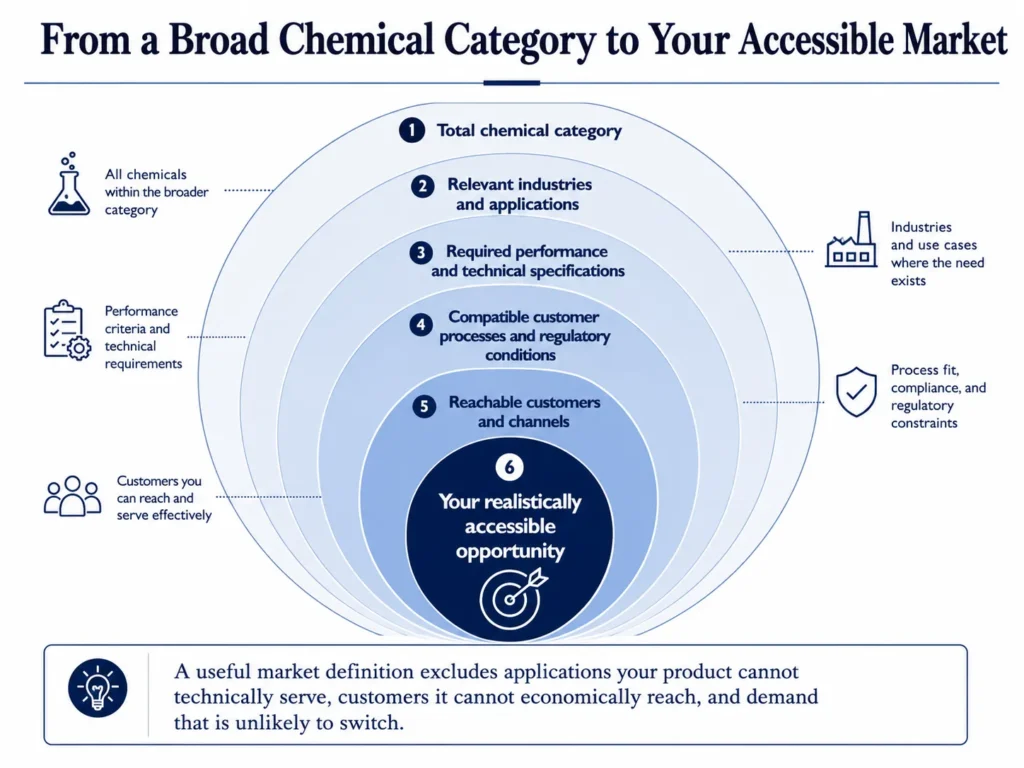
Figure 2. A useful market definition excludes applications your product cannot technically serve, customers it cannot economically reach, and demand that is unlikely to switch.
The Chemical Value Equation
Chemical purchasing decisions are rarely based on one variable.
Different participants may evaluate the same product through different lenses.
Research and development may ask:
- Does it meet the formulation target?
- Is it compatible with other ingredients?
- Does it enable a new performance level?
- Can it simplify the formulation?
- Does it support future innovation?
Production may ask:
- Is it consistent?
- Will it run reliably on our equipment?
- Does it affect cycle times?
- Will it increase cleaning or maintenance?
- Can the supplier guarantee continuity?
Quality may ask:
- Does it remain within specification?
- Can variability affect the finished product?
- Is traceability sufficient?
- How are nonconformities managed?
Procurement may ask:
- What is the price?
- Can we negotiate alternatives?
- How exposed is the supplier?
- Can we dual-source it?
- What payment and delivery conditions are available?
Regulatory, safety, or sustainability teams may ask:
- Is the product approved?
- What documentation is required?
- Does it create handling or disposal risks?
- Does it support our environmental commitments?
- Could future regulation restrict it?
Senior management may ask:
- Does this improve margin?
- Does it protect production?
- Does it support differentiation?
- Does it reduce strategic risk?
- Does it strengthen our customer proposition?
A chemical strategy must address this complete decision unit.
Winning the technical evaluation without supporting procurement economics may delay adoption. Winning on price without reassuring production or quality may produce a trial but not sustained demand.
We map the relevant stakeholders, their decision criteria, and the evidence required to move from interest to approval and repeat purchase.
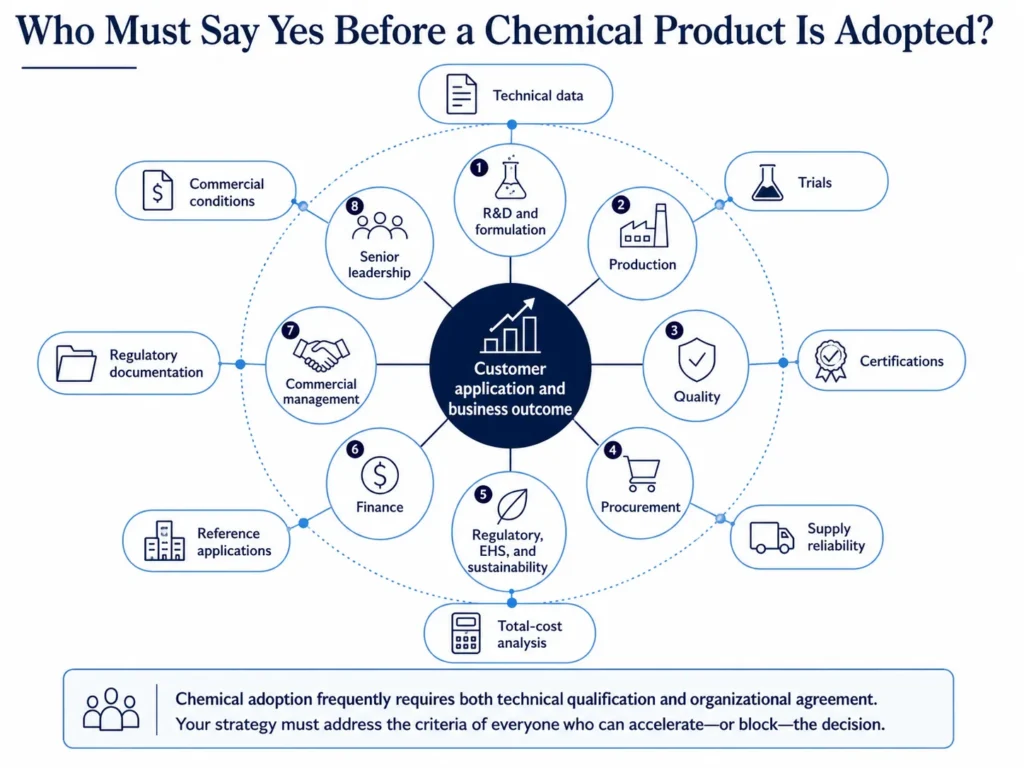
Figure 3. Chemical adoption frequently requires both technical qualification and organizational agreement. Your strategy must address the criteria of everyone who can accelerate—or block—the decision.
Decisions We Help Chemical Companies Make
Which markets and applications should you prioritize?
We compare opportunities using factors such as:
- Current demand
- Expected market development
- Customer concentration
- Application growth
- Product fit
- Technical differentiation
- Qualification requirements
- Substitution risk
- Price and margin potential
- Competitive intensity
- Feedstock exposure
- Supply requirements
- Regulation
- Sustainability pressure
- Channel access
- Required investment
- Ability to win
The objective is not to identify the largest market.
It is to identify where your company can create and retain attractive value.
Which segments deserve different strategies?
Chemical-market segmentation may reflect more than customer size or industry.
Relevant differences can include:
- Application
- Required performance
- Technical sophistication
- Production technology
- Regulatory exposure
- Current formulation
- Willingness to test
- Importance of supply continuity
- Price sensitivity
- Switching cost
- Service requirements
- Sustainability priorities
- Innovation orientation
Two customers buying similar volumes may require very different propositions.
One may value formulation support and performance. Another may prioritize price, payment conditions, and immediate availability. Treating both identically can weaken margins without improving conversion.
How should you position your offer?
We help you determine:
- Which customer problem is commercially relevant
- What your product does better
- Whether customers recognize that difference
- Which evidence makes the claim credible
- How the benefit affects customer economics
- What competitors can claim in response
- Which applications support premium pricing
- Where the product may need adaptation
- Which claims are technically or legally supportable
A strong value proposition should connect:
Chemical property → Application performance → Operational effect → Financial or strategic benefit
For example:
Higher thermal stability
→ Fewer failures during processing
→ Less scrap and downtime
→ Lower total production cost
Or:
Improved adhesion at lower dosage
→ Better final-product performance with less material
→ Reduced formulation cost
→ Stronger customer margin
How should you protect or improve margins?
Margin pressure may originate in several parts of the system:
- Feedstock inflation
- Currency changes
- Lower-cost imports
- Distributor discounts
- Customer concentration
- Product proliferation
- Low plant utilization
- Small production runs
- High service costs
- Freight
- Packaging
- Payment conditions
- Overcustomization
- Price inconsistency
- Unprofitable accounts
- Insufficient differentiation
We help you distinguish structural cost disadvantages from commercial leakage and strategic choices.
The response may involve:
- Pricing architecture
- Product rationalization
- Customer segmentation
- Service differentiation
- Sourcing changes
- Local production
- Distributor redesign
- Minimum order policies
- Contract terms
- Value communication
- Reformulation
- Account prioritization
- Exit from unattractive business
How should you respond to substitution?
Chemical products rarely compete only against chemically similar products.
They may compete against:
- Alternative molecules
- Different formulations
- New materials
- Mechanical solutions
- Process changes
- Lower dosage
- Recycled inputs
- Bio-based alternatives
- Customer backward integration
- Elimination of the application requirement
We examine substitution through the function the customer needs—not merely through the product category you sell.
This helps reveal threats and opportunities that conventional competitor lists may miss.
Understand the Economics Behind Chemical Demand
A market estimate should explain how demand is generated.
Depending on the category, we may model demand through variables such as:
- Customer production volume
- Chemical consumption per unit of output
- Dosage
- Yield
- Application penetration
- Technology mix
- Plant utilization
- Scrap rates
- Replacement or maintenance frequency
- Import and export flows
- Local production
- Inventory changes
- Formulation changes
An application-based model might use:
Customer output × chemical dosage × application penetration = theoretical demand
We then adjust for:
- Actual operating rates
- Product losses
- Recycled material
- Alternative technologies
- Informal production
- Customer self-production
- Import availability
- Qualification barriers
- Economic accessibility
- Likely supplier share
This creates a demand estimate that can be discussed, tested, and updated.
When data is incomplete, we provide ranges and identify the assumptions that have the greatest effect on the result.
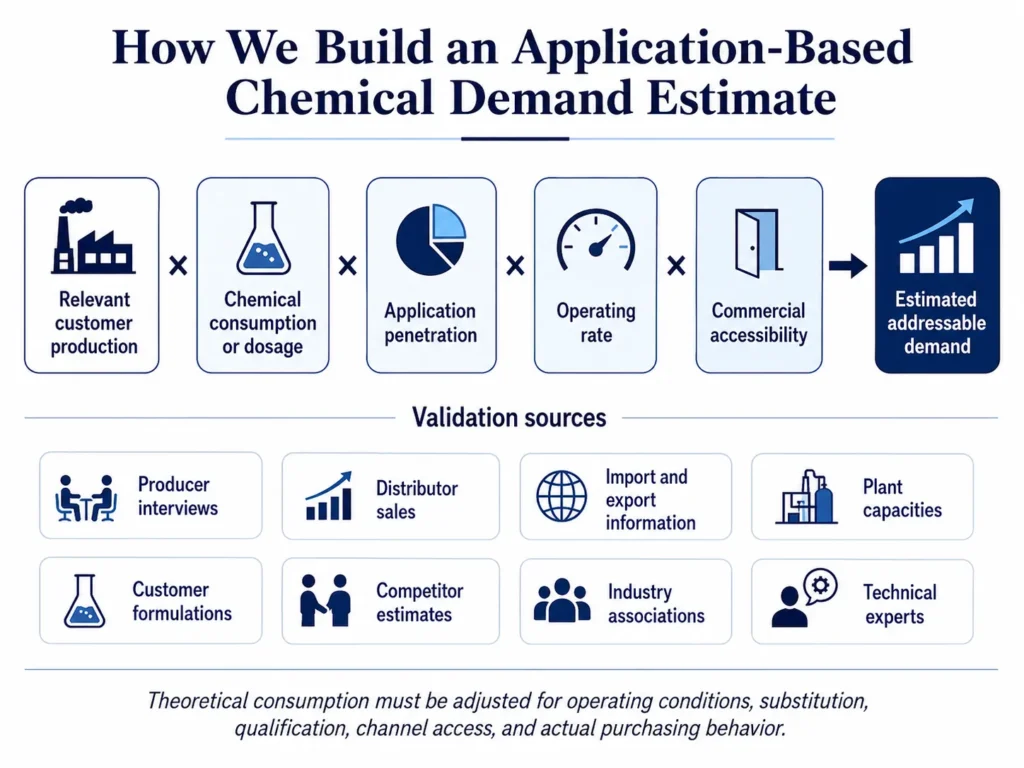
Figure 4. Theoretical consumption must be adjusted for operating conditions, substitution, qualification, channel access, and actual purchasing behavior.
Competitive Intelligence Beyond Published Capacity
Chemical competitors may appear similar when compared through public information.
Two companies may report comparable capacity, product ranges, and geographic coverage while having very different economics.
Their performance may depend on:
- Feedstock integration
- Energy contracts
- Plant age and configuration
- Capacity utilization
- Batch size
- Product mix
- Sourcing
- Labor model
- Yield
- Waste
- Maintenance
- Packaging
- Logistics
- Local tax treatment
- Distributor margins
- Technical-service intensity
- Customer mix
- Contract structure
- By-product economics
Published capacity does not reveal effective production.
A plant may have significant nameplate capacity but face bottlenecks, low utilization, limited product flexibility, maintenance constraints, or weak access to feedstocks.
Similarly, a competitor’s lower price may not indicate a lower manufacturing cost. It may reflect a strategic account, surplus inventory, cross-subsidization, a temporary import position, or an attempt to establish market share.
We reconstruct the economic and strategic drivers behind competitor behavior so your team can respond appropriately.
Benchmarking Consulting for the Chemical Industry. Costs, Operations, and Commercial Models
Benchmarking should do more than tell you that a competitor is cheaper, faster, or more profitable.
It should explain why.
For chemical companies, the analysis may cover:
Cost and plant economics
- Feedstock sources and terms
- Energy
- Plant configuration
- Scale
- Capacity utilization
- Yield
- Waste and reprocessing
- Labor
- Maintenance
- Packaging
- Logistics
- Environmental costs
- Make-or-buy choices
- Product complexity
- Campaign and batch sizes
Commercial practices
- Segment priorities
- Account coverage
- Technical-sales roles
- Pricing authority
- Discounts and rebates
- Contract terms
- Distributor economics
- Customer service
- Cross-selling
- Innovation selling
- Key-account management
Innovation and application development
- R&D structure
- Application laboratories
- Customer collaboration
- Stage-gate processes
- Resource allocation
- Product-development speed
- Portfolio governance
- External partnerships
- Technical-service integration
Organization
- Regional and country roles
- Business-unit structure
- Decision rights
- Sales and technical headcount
- Shared services
- Incentives
- Governance
- Performance management
We normalize differences before drawing conclusions.
A local producer, regional importer, integrated multinational, and specialty-formulation company may have fundamentally different models. Direct comparison without adjustment can produce the wrong recommendation.
The objective is not to copy another company.
It is to identify:
- Gaps you should close
- Capabilities you could leapfrog
- Differences you should preserve
- Practices that would not fit your strategy
- Investments that could improve competitiveness
- Structural disadvantages that require a different business model
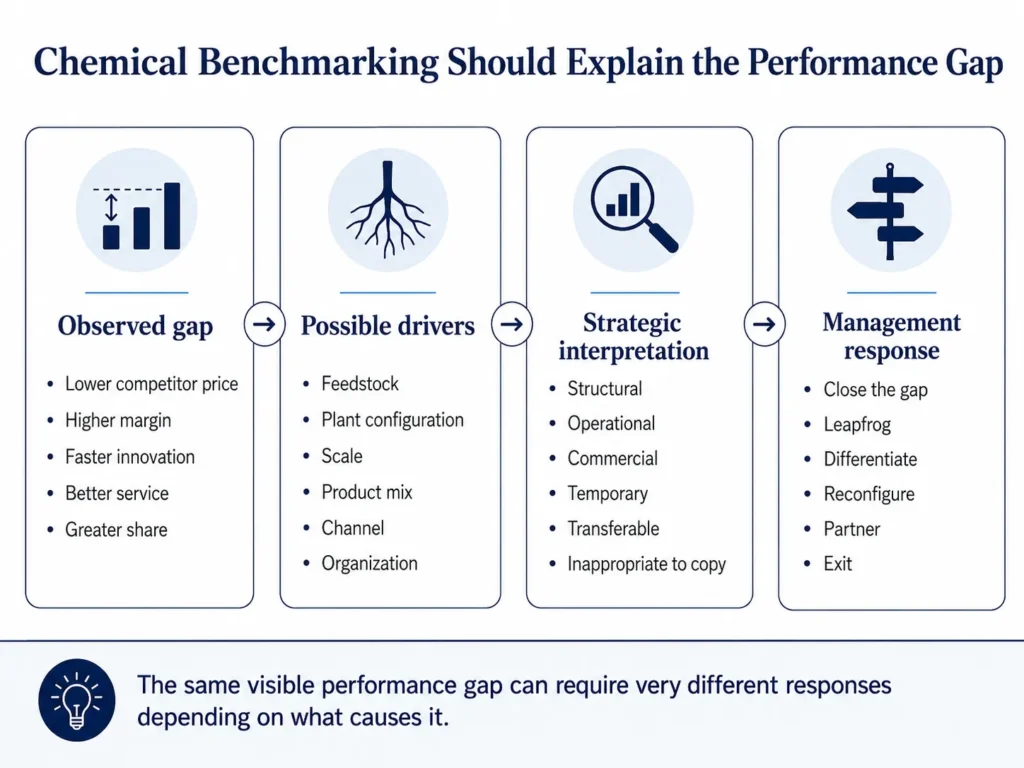
Figure 5. The same visible performance gap can require very different responses depending on what causes it.
Market Entry Consulting in the Chemical Industry Requires More Than Finding Demand
An attractive demand estimate does not automatically make a market accessible.
Chemical-market entry may require:
- Product registration
- Local representation
- Safety and environmental documentation
- Import permits
- Labeling
- Storage conditions
- Hazardous-goods logistics
- Local testing
- Customer qualification
- Technical support
- Working capital
- Inventory
- Credit
- Waste handling
- Emergency response
- Product stewardship
- Local-language documentation
- Country-specific packaging
Customer adoption can also take longer than expected.
A technically interested customer may require laboratory tests, industrial trials, quality approval, production validation, legal review, supplier registration, and contract negotiation before purchasing at scale.
We help your team evaluate the complete path from market potential to recurring revenue.
This may include:
- Country and application prioritization
- Regulatory and qualification requirements
- Competitor and substitute analysis
- Customer validation
- Channel structure
- Entry-mode comparison
- Product and service adaptation
- Pricing and margin model
- Investment requirements
- Risk assessment
- Phased implementation
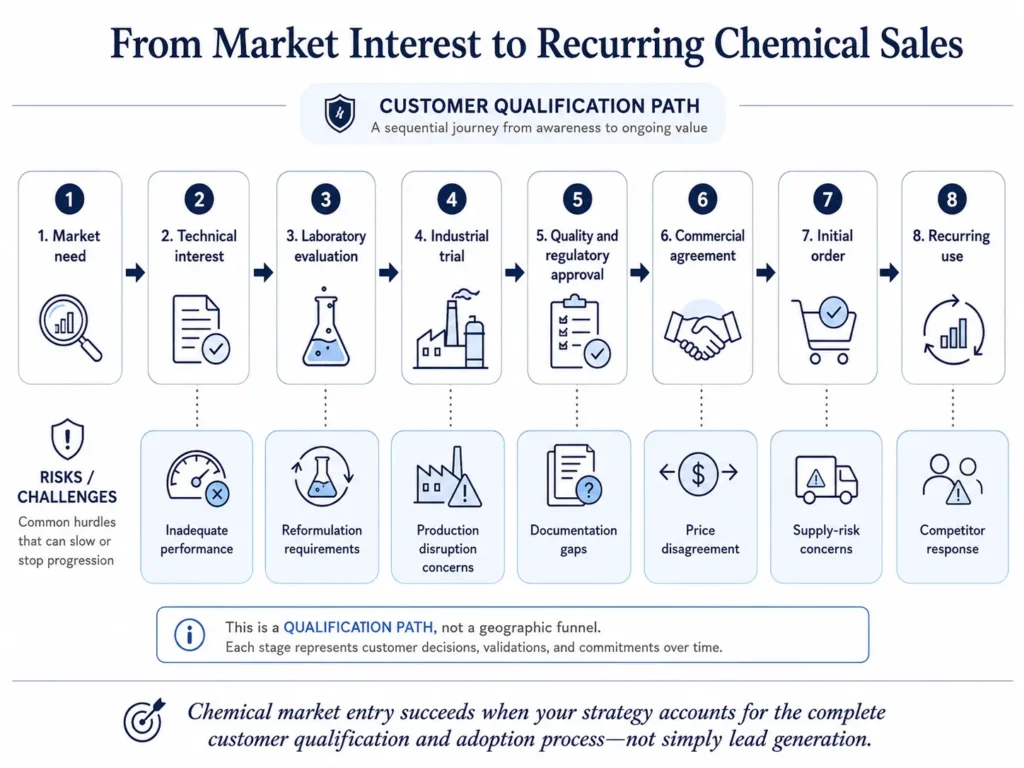
Figure 6. Chemical market entry succeeds when your strategy accounts for the complete customer qualification and adoption process—not simply lead generation.
Go-to-Market Strategy Consulting for the Chemical Industry
A chemical go-to-market strategy must connect technical value with commercial execution.
It may require decisions about:
- Priority industries
- Applications
- Customer segments
- Direct and indirect accounts
- Key-account coverage
- Distributor territories
- Product assortment
- Local inventory
- Technical-service resources
- Sampling and trials
- Pricing
- Payment conditions
- Distributor margins
- Lead generation
- Application development
- Sales-force capabilities
- Customer qualification
- Performance indicators
For technically complex products, the sales process may not be controlled by one commercial contact.
Your organization may need coordinated interaction among:
- Sales
- Technical service
- Application development
- R&D
- Regulatory
- Supply chain
- Customer service
- Finance
- Senior management
We help define how those roles should work together.
The resulting roadmap may include:
- Priority applications and accounts
- Customer decision map
- Value proposition
- Technical evidence requirements
- Qualification plan
- Channel model
- Pricing architecture
- Technical-support model
- Sales and marketing activities
- Ownership
- Milestones
- Conversion indicators
- Governance
Distributor Search Consulting for the Chemical Industry
A chemical distributor is more than a logistics intermediary.
The right partner may provide:
- Customer relationships
- Local inventory
- Credit
- Regulatory support
- Technical selling
- Sampling
- Application knowledge
- Market feedback
- Smaller-volume fulfillment
- Geographic coverage
- Collections
- Warehousing
- Product stewardship
However, a distributor with a large portfolio may allocate limited attention to your products.
Its salespeople may prioritize easier-to-sell lines, established principals, products with better incentives, or categories that require less technical support.
We evaluate prospective distributors through criteria such as:
Market access
- Relevant industries and applications
- Priority customer relationships
- Geographic coverage
- Access to technical decision-makers
- Key-account penetration
Technical capability
- Product knowledge
- Application expertise
- Laboratory or testing support
- Qualified salespeople
- Regulatory documentation
- Product stewardship
Operational capability
- Warehousing
- Hazardous-material handling
- Inventory
- Delivery
- Packaging
- Credit
- Collections
- Reporting
Strategic fit
- Portfolio compatibility
- Conflicts
- Management attention
- Investment willingness
- Growth ambition
- Cultural alignment
- Long-term commitment
Our distributor-search work can include:
- Ideal-partner profile
- Market mapping
- Candidate screening
- Capability validation
- Initial approach
- Interest assessment
- Shortlist
- Comparative evaluation
- Negotiation preparation
- Governance and KPIs
A successful search identifies a partner capable of creating demand and supporting the product—not merely importing it.
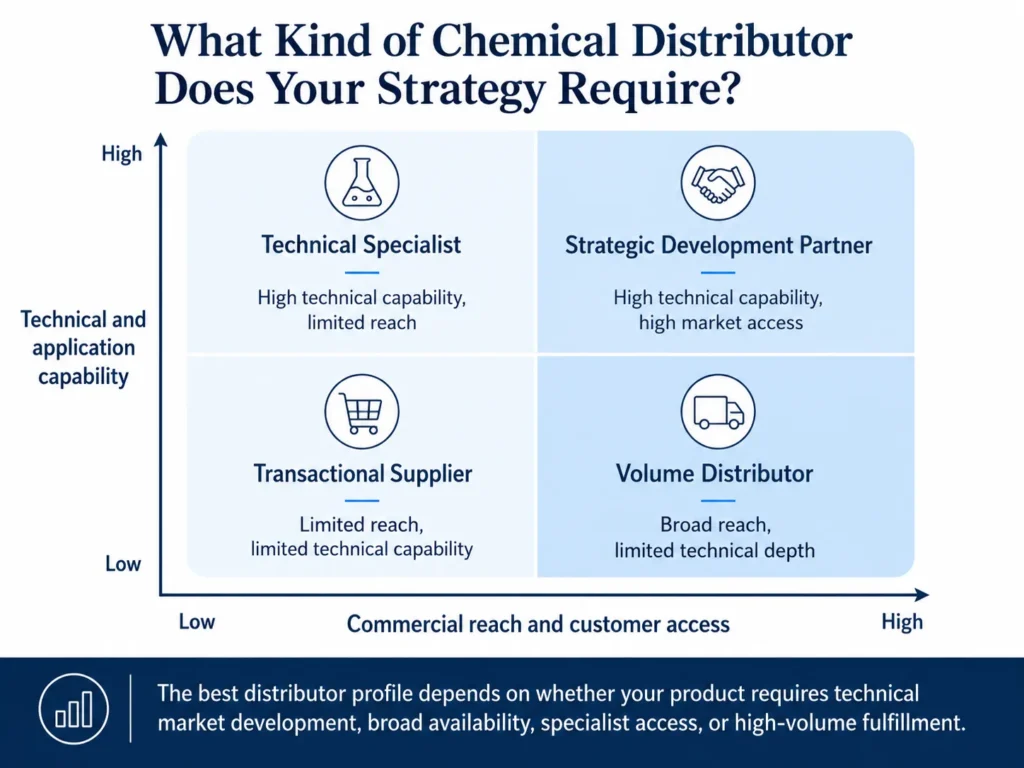
Figure 7. The best distributor profile depends on whether your product requires technical market development, broad availability, specialist access, or high-volume fulfillment.
Managing a Chemical Portfolio Across Its Life Cycle
Chemical portfolios often become more complex over time.
New formulations are added. Customer-specific grades remain active. Regional variations accumulate. Legacy products continue because individual accounts depend on them. Commercial teams resist discontinuation. Plant campaigns become less efficient.
The result may include:
- Too many SKUs
- Small production runs
- High inventory
- Slow-moving products
- Complex quality requirements
- Frequent changeovers
- Duplicated formulations
- Inconsistent positioning
- Sales-force confusion
- Low-margin customization
- Resources spread across too many opportunities
We help you evaluate products and applications according to:
- Revenue
- Margin
- Growth
- Strategic importance
- Customer dependency
- Differentiation
- Technical advantage
- Competitive intensity
- Production complexity
- Working capital
- Future regulatory exposure
- Substitution risk
- Cross-selling potential
- Innovation role
The objective is not automatically to eliminate smaller products.
Some products may protect important customer relationships, enable broader solutions, utilize specific plant assets, or create an entry point for more attractive business.
The analysis helps determine which products should be:
- Accelerated
- Defended
- Repositioned
- Reformulated
- Bundled
- Migrated
- Partnered
- Harvested
- Discontinued
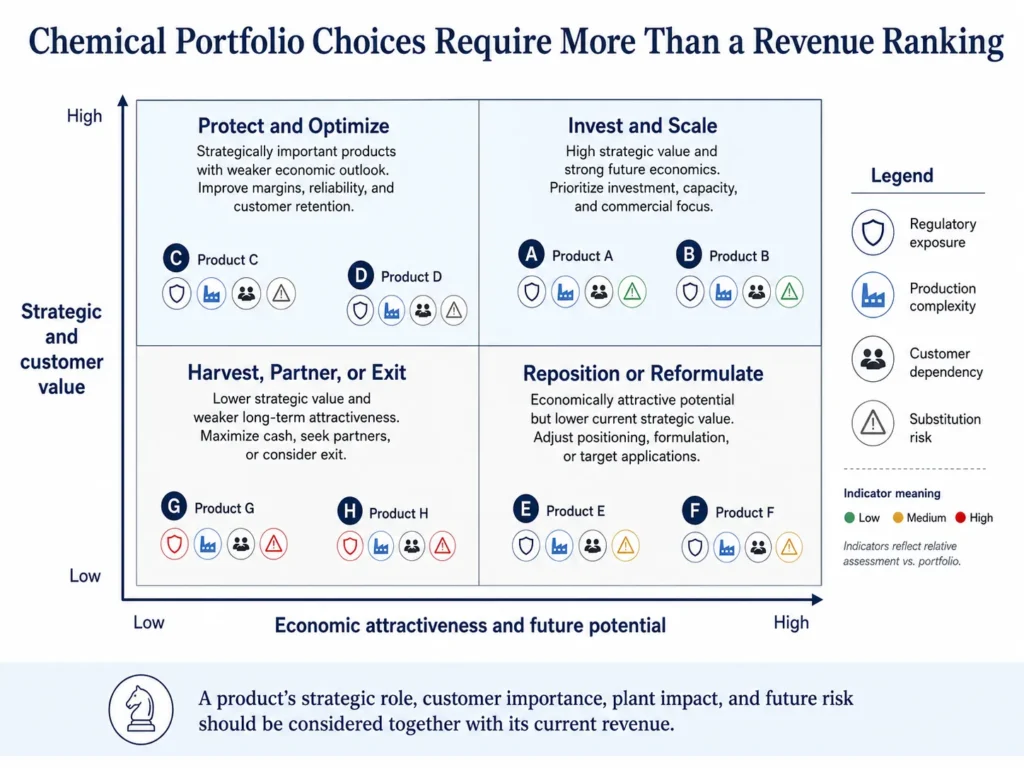
Figure 8. A product’s strategic role, customer importance, plant impact, and future risk should be considered together with its current revenue.
Preparing for Sustainability and Regulatory Change
Sustainability is not one trend with one commercial consequence.
For chemical companies, it may influence:
- Raw-material selection
- Energy use
- Emissions
- Water consumption
- Waste
- Packaging
- Transportation
- Product toxicity
- Worker exposure
- Recycling
- Biodegradability
- Renewable content
- Customer reporting
- Extended producer responsibility
- End-of-life recovery
Different customers may interpret sustainability differently.
One may prioritize carbon reduction. Another may focus on worker safety, recycled content, water use, regulatory compliance, or the durability of the final product.
A sustainable alternative may still face adoption barriers if it:
- Costs substantially more
- Requires reformulation
- Performs differently
- Has uncertain supply
- Requires new equipment
- Lacks regulatory approval
- Creates a quality risk
- Is difficult to scale
We help you distinguish among:
- Compliance requirements. Changes your company must address to continue operating or selling.
- Customer requirements. Capabilities or documentation increasingly required to maintain accounts.
- Sources of differentiation. Benefits customers may value and reward.
- Emerging threats. Alternatives or regulations that could weaken your existing portfolio.
- Strategic options. Investments or partnerships that preserve future flexibility.
This prevents sustainability from becoming a disconnected list of initiatives.
It becomes part of your market, innovation, portfolio, and investment strategy.
Scenario Planning Consulting for a Chemical Industry Exposed to Multiple Uncertainties
Chemical strategies often depend on assumptions that can change simultaneously.
Examples include:
- Feedstock availability
- Oil and gas prices
- Energy costs
- Exchange rates
- Freight
- Trade barriers
- Local industrial policy
- Customer production
- Regulation
- Sustainability requirements
- New capacity
- Industry consolidation
- Technology
- Substitution
- Geopolitical disruption
A single forecast may not adequately represent those interactions.
Scenario planning helps your team examine several plausible operating environments and determine how your strategy would perform in each.
An illustrative scenario exercise could use:
- Critical uncertainty 1: Regional production economics (Favorable ↔ Unfavorable)
- Critical uncertainty 2: Speed of substitution and sustainability-driven change (Gradual ↔ Rapid)
This could produce four scenarios:
- Regional Manufacturing Advantage. Competitive local economics and gradual substitution support investment, capacity utilization, and regional supply.
- Green Industrial Acceleration. Competitive production combines with rapid material change, rewarding companies that can scale differentiated and lower-impact solutions.
- Import-Driven Competition. Weak local economics and gradual substitution intensify pressure from imported conventional products.
- Portfolio Disruption. Unfavorable regional economics combine with rapid substitution, placing both the current cost structure and product portfolio under pressure.
For each scenario, we identify:
- Market implications
- Vulnerable products
- Attractive applications
- Capacity consequences
- Customer behavior
- Competitor moves
- Strategic options
- No-regret actions
- Early-warning indicators
- Decision triggers
- Management responses
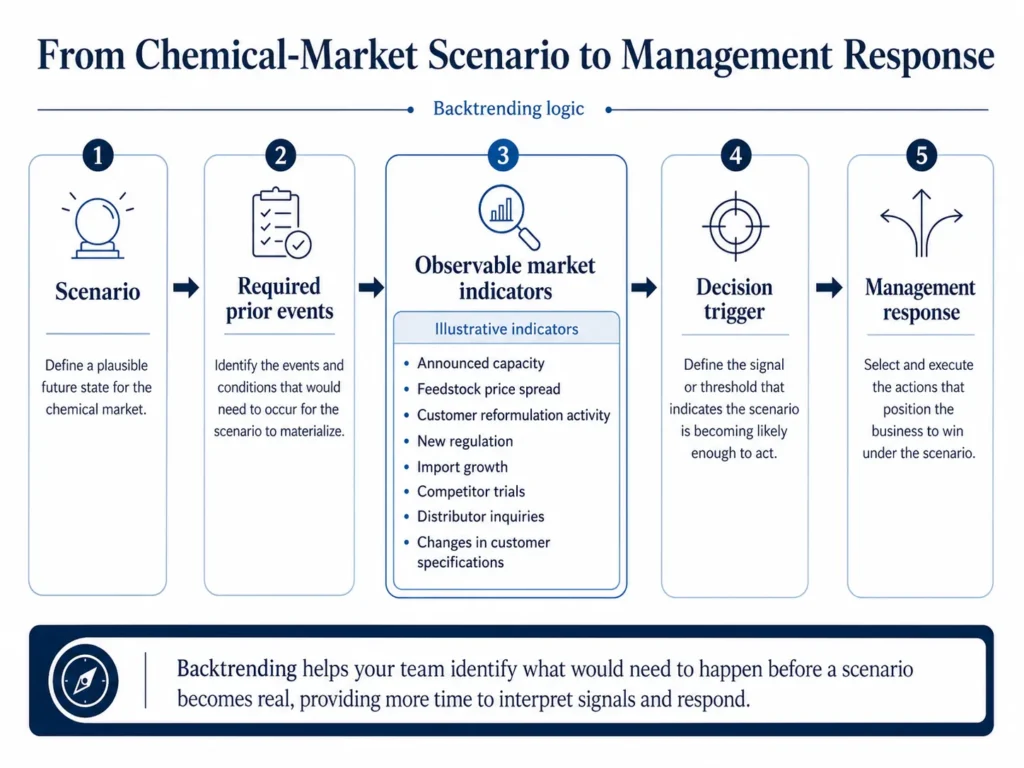
Figure 9. Backtrending helps your team identify what would need to happen before a scenario becomes real, providing more time to interpret signals and respond.
Business Wargames Consulting for Chemical Industry Decisions
Chemical-market actions do not occur in isolation.
A new plant, formulation, price, distributor, or sustainability claim may trigger responses from:
- Global competitors
- Regional producers
- Low-cost importers
- Distributors
- Strategic customers
- Alternative-material suppliers
- Regulators
- Industry associations
A competitor may respond by:
- Reducing prices
- Locking in customer contracts
- Increasing distributor incentives
- Accelerating qualification
- Expanding capacity
- Bundling products
- Questioning your technical claims
- Introducing a substitute
- Changing payment conditions
- Acquiring a local participant
A business wargame allows your team to test those reactions before making an irreversible commitment.
The exercise helps reveal:
- Unsupported assumptions
- Likely countermoves
- Customer and distributor reactions
- Potential price escalation
- Weaknesses in your value proposition
- Second-round consequences
- Defensive actions
- Alternative moves
- Early-warning signals
Wargaming can be particularly valuable before:
- Building or expanding a plant
- Launching an important product
- Entering a new application
- Changing prices
- Replacing a distributor
- Making an acquisition
- Responding to substitution
- Repositioning a major portfolio
M&A, Licensing, and Partnerships Consulting in the Chemical Industry
Organic growth may not provide the required speed, technology, production footprint, or customer access.
Acquisitions and partnerships can offer:
- Local manufacturing
- Product registrations
- Formulations
- Intellectual property
- Application expertise
- Distribution
- Customer relationships
- Technical teams
- Feedstock access
- Specialized capacity
- Environmental permits
- Faster market entry
They can also conceal material risks:
- Environmental liabilities
- Product-stewardship exposure
- Underinvestment
- Obsolete facilities
- Customer concentration
- Dependence on key personnel
- Unprofitable custom products
- Undocumented know-how
- Feedstock disadvantages
- Working-capital requirements
- Regulatory deficiencies
- Weak process safety
- Difficult plant integration
We help chemical companies with:
- Acquisition strategy
- Target-profile definition
- Target identification
- Competitive intelligence
- Market and customer validation
- Commercial due diligence
- Strategic-fit assessment
- Capacity and portfolio analysis
- Partner and license screening
- Owner-interest assessment
- Approach strategy
- Negotiation preparation
- Post-deal growth priorities
Specialized legal, financial, tax, environmental, process-safety, and technical due diligence should be performed by appropriately qualified professionals.
Our role is to strengthen the strategic and commercial understanding of the opportunity.
Case Example: Building the Value Proposition Behind a Major Investment in Brazil
The investment decision
A multinational chemical company was preparing to invest several hundred million dollars in a new production facility in Brazil.
The business planned to introduce two innovative resin products across selected industries.
The technical promise was attractive, but management needed to determine whether the proposed products and value proposition would create sufficient customer preference to support the investment.
The central questions included:
- Which industries and applications offered the strongest opportunity?
- Which product attributes influenced customer decisions?
- How did those priorities vary by segment?
- What unmet needs could support differentiation?
- How did competitors perform against those needs?
- How could inter-material substitution affect demand?
- Which sales channels and commercial conditions would customers prefer?
The research
Midas conducted in-depth interviews with distributors and end customers across three priority industries.
The research examined:
- Customer applications
- Technical decision criteria
- Relative importance of product attributes
- Customer pain points
- Unmet needs
- Current alternatives
- Competitor strengths and weaknesses
- Channel preferences
- Pricing behavior
- Switching barriers
- Material-substitution trends
Rather than asking whether customers liked the products, we sought to understand how the proposed resins would affect their processes, finished products, risks, and economics.
The analysis
We compared the required value proposition across industries and customer segments.
This revealed that the same generic message would not be equally persuasive everywhere.
Different segments prioritized different combinations of:
- Product performance
- Processing characteristics
- Consistency
- Service
- Supply
- Price
- Technical support
- Finished-product differentiation
We also identified where the proposed products required adaptation to better address unmet customer needs.
The strategic response
The company used the findings to:
- Prioritize the most relevant product features for each industry
- Refine the value proposition
- Adapt selected product characteristics
- Improve differentiation against competing materials
- Align the commercial strategy with customer decision criteria
- Strengthen the market logic supporting the investment
The outcome
The project gave management a clearer basis for translating a large manufacturing investment into an application-specific market strategy.
Important context: The company’s identity and commercially sensitive details are withheld. Outcomes reflect the specific circumstances of this engagement and should not be interpreted as a guarantee of equivalent results in another project.
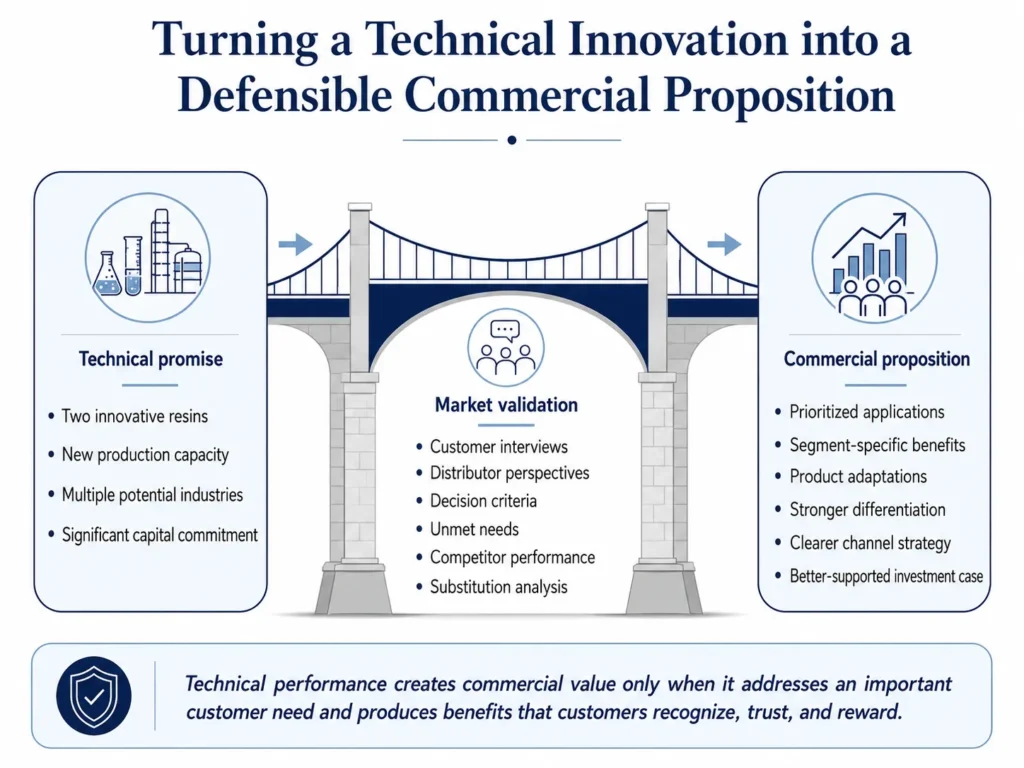
Figure 10. Technical performance creates commercial value only when it addresses an important customer need and produces benefits that customers recognize, trust, and reward.
How We Build Reliable Chemical-Market Intelligence
Chemical markets can be difficult to research.
Public data may aggregate products with different applications, grades, prices, or performance characteristics. Trade classifications may combine products that do not compete. Production capacity may not reflect utilization. Customer formulations are often confidential. Actual transaction prices can vary by volume, contract, geography, delivery, credit, and technical support.
We may combine:
- Production and capacity information
- Import and export data
- Customer production estimates
- Product and formulation analysis
- Regulatory information
- Company disclosures
- Distributor interviews
- Customer interviews
- Former industry executives
- Technical experts
- Suppliers
- Equipment providers
- Industry associations
- Pricing research
- Plant and market visits
- Midas’s accumulated project experience
We triangulate material findings whenever feasible.
We clearly distinguish among:
- Verified facts
- Supported estimates
- Market perceptions
- Analytical inferences
- Management assumptions
- Unresolved questions
When exact information is unavailable, we explain the methodology, assumptions, and range rather than presenting false precision.
Reliable Intelligence, Gathered Responsibly
We use lawful and ethical research methods.
We do not request trade secrets, encourage sources to violate legal or contractual obligations, or present uncertain information as confirmed fact.
Your objectives, internal data, and strategic priorities are treated as confidential. Where appropriate, we can work under a mutual nondisclosure agreement.
From Technical Complexity to a Decision-Ready Strategy through Chemical Industry Consulting
Our chemical-industry projects are designed around the decision—not around a fixed sequence of consulting activities.
Depending on your needs, the work may include five interconnected workstreams.
1. Decode the value chain
We identify how products, information, influence, costs, and margins move from raw materials through production, distribution, customer application, and the finished product.
2. Quantify the opportunity
We estimate demand through applications, customer production, dosage, adoption, substitution, qualification, and accessibility.
3. Understand the value equation
We determine what customers need, how stakeholders make decisions, what alternatives compete, and which benefits support differentiation.
4. Test the strategic choices
We compare segments, channels, prices, portfolios, investments, partners, scenarios, and competitor reactions.
5. Mobilize execution
We translate the recommendation into priorities, initiatives, owners, milestones, indicators, and decision triggers.
Your deliverables may include:
- Market and application model
- Value-chain map
- Customer segmentation
- Decision-unit analysis
- Competitor profiles
- Substitute-material analysis
- Pricing and margin assessment
- Cost benchmark
- Distributor long list and shortlist
- Partner assessments
- Value proposition
- Go-to-market strategy
- Portfolio recommendations
- Scenario framework
- Business-wargame conclusions
- Acquisition target profiles
- Implementation roadmap
- Executive workshop
- Supporting database and evidence files
The objective is not to leave your team with more information.
It is to help you make and implement a stronger decision.
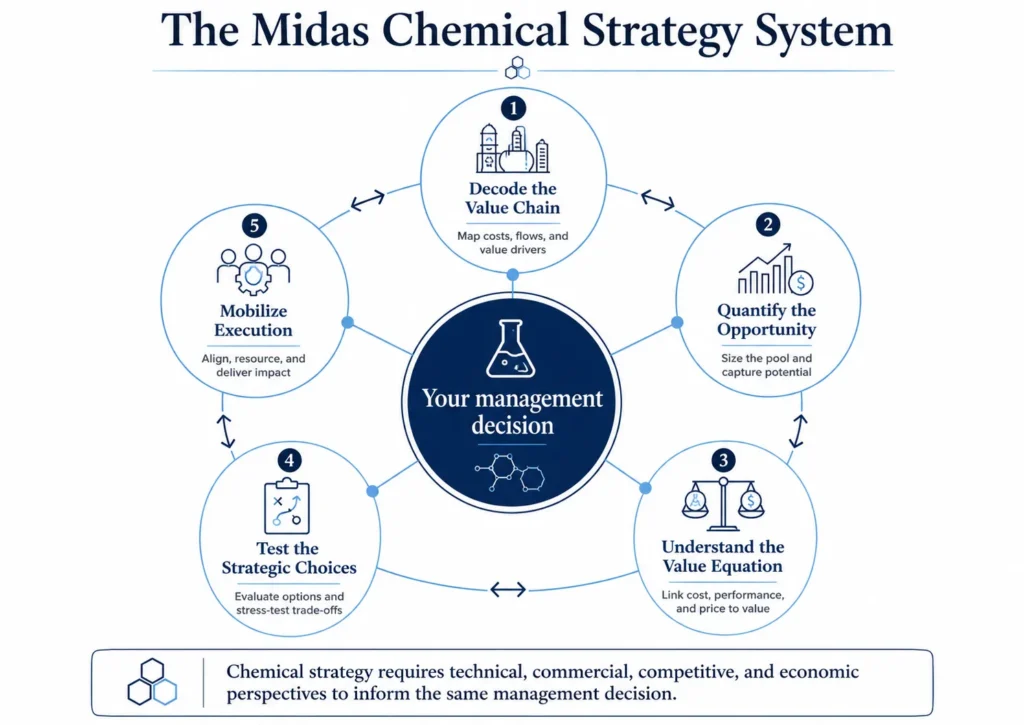
Figure 11. Chemical strategy requires technical, commercial, competitive, and economic perspectives to inform the same management decision.
Executive Workshop Consulting for Chemical Industry Decisions
Chemical strategies often require alignment across teams that use different language and success criteria.
Participants may include:
- Business leadership
- Commercial
- Marketing
- R&D
- Application development
- Production
- Supply chain
- Procurement
- Finance
- Regulatory
- Quality
- EHS
- Sustainability
A commercial team may see an attractive market while operations sees an inefficient product mix. R&D may see technical differentiation while customers see insufficient economic value. Procurement may focus on feedstocks while business leadership focuses on market growth.
We design and facilitate executive workshops that help your team:
- Build a shared fact base
- Make assumptions explicit
- Compare alternatives
- Understand trade-offs
- Resolve conflicting priorities
- Select strategic actions
- Assign ownership
- Define indicators
- Establish implementation governance
The workshop is built around your decision and supported by relevant market and competitive evidence.
It is not a generic brainstorming exercise.
Why Chemical Industry Companies Work with Midas Consulting
More than 25 years of experience
We have supported companies in complex B2B and industrial markets since 2000.
Our experience includes hundreds of projects involving chemical companies, related industrial sectors, channels, customers, competitors, growth strategies, and investment decisions.
An application-level perspective
We do not treat chemicals as homogeneous commodities.
We examine how products perform within customer applications, how they affect customer economics, and what must happen before adoption.
Deep Latin American experience
We work across Latin America, Spain, Portugal, and selected international markets.
We understand how local production, imports, regulation, taxation, logistics, inflation, currency, customer concentration, and channel structures affect chemical-market economics.
Senior involvement
Senior professionals remain involved throughout the engagement—from defining the strategic question to interpreting research and discussing recommendations with management.
Primary market intelligence
Where public information is insufficient, we develop evidence through interviews, field research, expert perspectives, customer validation, distributor intelligence, and cross-source triangulation.
Technical and commercial integration
We connect product characteristics with customer needs, application performance, value creation, market access, pricing, and strategic execution.
Collaboration with your team
Your technical and commercial knowledge is essential.
We work alongside your executives and specialists to interpret evidence correctly, challenge assumptions, and build ownership of the recommendation.
Transparency about uncertainty
We make evidence limitations, estimates, assumptions, and risks visible.
You receive the strongest conclusion supported by the available information—not artificial certainty.
Client feedback
Midas Consulting’s Net Promoter Score was 82.2% based on client feedback collected between 2020 and 2025.
Selected Chemical Industry Consulting Experience
We have supported chemical and related industrial companies across different products, applications, countries, and strategic decisions. Each logo represents a separate client relationship; project scope, timing, and services differed.

What Chemical Industry Clients Say About Working with Midas
“Midas delivered practical, high-impact ideas that helped us expand market share in a competitive environment.”
Marketing Manager
Chemical Company
Client identity withheld due to confidentiality
“Midas was highly effective, giving us the insights and tools we needed to co-create a robust strategy for complex markets.”
Chief Financial Officer
Chemical Company
Client identity withheld due to confidentiality
“Midas helped us reassess priorities and focus our efforts where they truly mattered. The process was eye-opening and impactful.”
Global Market Segment Leader
Chemical Company
Client identity withheld due to confidentiality
“Midas combined deep market experience with thorough analysis, collaborating seamlessly across our teams to deliver actionable results.”
Global Product Manager
Chemical Company
Client identity withheld due to confidentiality
Strategic Intelligence for Chemical-Market Leadership
Chemical companies operate in markets where important information is frequently fragmented, technical, confidential, or difficult to compare.
Leadership teams must connect:
- Feedstock economics
- Customer applications
- Competitor capabilities
- Regulation
- Substitution
- Channel behavior
- Capacity
- Technology
- Sustainability
- Strategic intent
Market data can describe current conditions.
Strategic intelligence helps your team interpret what those conditions mean, identify how they may change, and determine which management action is justified.
Midas Consulting’s applied strategic intelligence work connects:
- Market intelligence
- Competitive intelligence
- Benchmarking
- Scenario planning
- Business wargaming
- Early-warning systems
- Strategic decision-making
- Market entry
- Growth strategy
- M&A intelligence
Selected External Resources
Our recommendations are based primarily on client-specific research, Midas Consulting’s project experience, local market intelligence, and the strategic requirements of each engagement.
We also consult relevant institutional and technical sources when they improve the regulatory, economic, environmental, trade, safety, or industry context.
Potential resources include:
- United Nations Industrial Development Organization
- Organisation for Economic Co-operation and Development — Chemical Safety and Biosafety
- United Nations Environment Programme — Chemicals and Pollution Action
- United Nations Economic Commission for Latin America and the Caribbean
- International Council of Chemical Associations
- American Chemistry Council
- European Chemicals Agency
These sources provide methodological, technical, regulatory, or industry context. They do not replace application-specific research into customers, competitors, distributors, pricing, plant economics, or commercial behavior.
Frequently Asked Questions
What types of chemical industry companies does Midas Consulting support?
We work with companies across industrial chemicals, specialty chemicals, polymers, resins, additives, coatings, adhesives, construction chemicals, water treatment, agrochemicals, consumer applications, and related industrial products.
The methodology is adapted to the product, application, geography, customer, channel, and strategic decision.
Can you estimate the size of a market with your chemical industry consulting?
Yes, when sufficient evidence is available.
Depending on the category, we may combine:
- Customer production
- Chemical dosage
- Application penetration
- Plant utilization
- Imports and exports
- Local production
- Customer interviews
- Distributor sales
- Competitor estimates
- Pricing
- Substitution
- Qualification rates
We explain the assumptions and usually provide ranges when the available information does not support a single precise figure.
How do you handle products that serve several applications?
We normally assess the opportunity at the application and customer-segment level.
The same product may create different value, face different competitors, require different qualifications, and support different prices depending on where and how it is used.
This allows your team to prioritize the applications where the product has the strongest fit and value potential.
Can you help us develop a stronger value proposition with your chemical industry consulting?
Yes. We identify relevant customer needs, technical and economic decision criteria, competitor performance, switching barriers, and the evidence required to support differentiation.
The final value proposition connects product characteristics with application performance, customer operations, and financial or strategic benefits.
Can you interview technical decision-makers?
Yes. Depending on the project, we may interview:
- R&D leaders
- Formulators
- Production managers
- Quality professionals
- Procurement
- Regulatory specialists
- Distributors
- Application engineers
- Plant managers
- Former industry executives
- Technical experts
Access depends on the topic, market, timing, and willingness of qualified participants.
Can you benchmark competitor production costs with your chemical industry consulting?
We can reconstruct and compare relevant cost drivers when sufficient evidence is available.
The analysis may include feedstocks, energy, capacity, utilization, plant configuration, yield, labor, maintenance, packaging, logistics, product mix, sourcing, and channel economics.
Because competitors’ exact costs are normally confidential, many conclusions are estimates or ranges developed through triangulation. We clearly explain the methodology and level of confidence.
Can you benchmark chemical prices and commercial conditions?
Yes, subject to market accessibility.
Chemical prices may vary according to specification, volume, contract, customer, geography, delivery terms, payment conditions, packaging, technical support, and feedstock adjustment mechanisms.
We define comparable products and normalize relevant differences before drawing conclusions.
Some projects are necessarily conducted on a best-efforts basis because companies and customers may not disclose confidential commercial information.
Can you help us identify material-substitution threats?
Yes. We evaluate alternatives through the function they perform in the customer application.
This may include other chemicals, formulations, materials, production technologies, mechanical alternatives, recycled products, bio-based solutions, or process changes that eliminate the need for the product.
Can you help us find chemical distributors with your chemical industry consulting?
Yes. We can define the ideal partner profile, map candidates, assess technical and commercial capabilities, validate interest, support initial contact, compare alternatives, and prepare your team for negotiations.
We consider application knowledge, regulatory and logistics capabilities, portfolio conflicts, customer access, economics, and strategic commitment.
Can you evaluate our existing distributor network?
Yes. We can assess:
- Customer and application coverage
- Technical-sales capabilities
- Product attention
- Inventory
- Geographic reach
- Pricing discipline
- Reporting
- Regulatory support
- Working capital
- Management commitment
- Portfolio conflicts
- Strategic alignment
The recommendation may involve improving the current network, changing responsibilities, adding partners, renegotiating conditions, or replacing selected distributors.
Can you help us decide whether to produce locally or import with your chemical industry consulting?
Yes. We can compare alternatives according to:
- Market demand
- Freight
- Duties
- Taxes
- Lead times
- Inventory
- Feedstocks
- Energy
- Scale
- Plant utilization
- Product flexibility
- Regulation
- Customer preferences
- Supply resilience
- Required investment
- Strategic control
Specialized engineering, environmental, legal, and financial studies may also be required before making a final investment decision.
Do you provide regulatory or environmental advice?
We analyze the strategic and commercial implications of regulation, environmental requirements, product stewardship, and market-access conditions.
We do not replace licensed legal, environmental, process-safety, toxicology, engineering, or regulatory specialists.
Where formal professional conclusions are required, they should be reviewed by appropriately qualified experts in each jurisdiction.
Can you support an acquisition with your chemical industry consulting?
Yes. We can help define the acquisition strategy, identify potential targets, profile competitors, assess strategic fit, validate the market, conduct commercial due diligence, evaluate customer and product exposure, and support negotiation preparation.
Financial, legal, tax, environmental, technical, and process-safety due diligence should be conducted by qualified specialists.
Can you help us evaluate sustainability-related opportunities?
Yes. We can assess customer needs, willingness to adopt, regulatory drivers, competing technologies, performance requirements, economics, substitution, and market maturity.
We help distinguish mandatory compliance, customer requirements, genuine differentiation opportunities, and longer-term options.
How long does a chemical industry consulting project take?
Timing depends on the number of countries, applications, products, competitors, interviews, and strategic questions included.
A focused market assessment or distributor review may require several weeks. A multicountry strategy, detailed benchmarking program, acquisition search, or integrated market-entry engagement may require several months.
The proposal defines the phases, methodology, milestones, deliverables, and expected timing.
What information will you need from our company?
Useful inputs may include:
- Product portfolio
- Technical specifications
- Target applications
- Current customers
- Sales and margins
- Prices
- Production footprint
- Capacity
- Raw-material exposure
- Distributor information
- Customer research
- Competitor hypotheses
- Regulatory status
- Previous studies
- Strategic priorities
- Decision timetable
We begin with the available information and identify the gaps that materially affect your decision.
How do you protect confidential information?
We treat client information as confidential and can work under a nondisclosure agreement.
Access is limited to relevant project participants. Public case examples, client identities, product details, and testimonials may be anonymized when disclosure has not been authorized.
Do you guarantee specific commercial results from your chemical industry consulting?
No responsible chemical industry consulting firm should guarantee a particular level of sales, margin, market share, investment return, or transaction success.
Results depend on factors such as product performance, feedstock economics, customer adoption, pricing, execution, distributor commitment, regulation, competitor actions, investment, supply reliability, and economic conditions.
Our role is to improve the evidence, strategic choices, preparation, and implementation behind your decision.
The Cost of Making Chemical-Market Decisions with an Incomplete Fact Base
The consequences may include:
- Overestimating accessible demand
- Building capacity for an unattractive application
- Misreading customer value
- Underpricing a differentiated product
- Investing in features customers do not reward
- Selecting a distributor without sufficient technical capability
- Continuing unprofitable customization
- Missing a substitution threat
- Responding incorrectly to a competitor’s low price
- Carrying excessive portfolio complexity
- Entering before regulatory or qualification requirements are understood
- Acquiring a business with hidden commercial weaknesses
- Protecting current volume while margins deteriorate
Better intelligence cannot remove uncertainty.
It can help your team identify which assumptions matter, which risks are acceptable, and which strategic action deserves your resources.
Let’s Clarify Your Next Chemical-Market Decision
You may be evaluating a new plant, market, product, application, distributor, acquisition, reformulation, or competitive response.
We begin with the decision, not with a predetermined chemical industry consulting package.
Tell us what is at stake
Share the choice your company is considering, what your team already knows, and where uncertainty remains.
Define the evidence
Together, we determine which customer, competitor, application, cost, channel, regulatory, and market questions must be answered.
Compare the strategic options
We make the relevant assumptions visible, evaluate alternatives, and identify the strongest path supported by the evidence.
Prepare your team to act
You receive clear priorities, recommendations, risks, responsibilities, milestones, indicators, and decision triggers.
About Midas Chemical Industry Consulting
Midas Consulting is a strategy and market intelligence consulting firm that helps companies grow, compete, enter markets, select partners, evaluate investments, and make stronger decisions across Latin America and selected international markets.
For more than 25 years, we have supported companies through market entry, go-to-market strategy, distributor search, benchmarking, strategy consulting, scenario planning, business wargaming, and M&A-related decisions.
Our work combines local market research, competitive intelligence, executive experience, and collaborative strategy development.